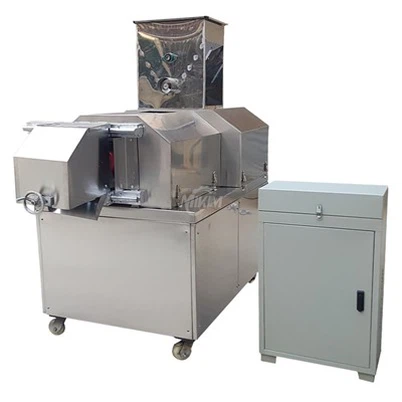
Customized Catfish and Carp Fish Feed Extruding Line Design Guide
Leave a message
What a Customized Catfish and Carp Feed Extruding Line Does
A customized catfish and carp fish feed extruding line is a complete processing system that turns raw feed ingredients into high-quality floating and sinking pellets. It is engineered around capacity, pellet quality and water stability, and it uses extrusion technology to achieve nutrient retention and improved digestibility. Capacity, pellet size and plant layout can all be customized, which is why the line is normally specified around a target species and a daily output figure rather than bought as a fixed package.
Because catfish and carp are produced at very different scales, the same platform is offered from small farm units up to commercial plants, and the extruder, dryer, coater and packer are sized together so that no single stage becomes a bottleneck.
Raw Materials for Balanced Aquatic Feed
The line is designed to process a variety of raw materials so that the finished feed has balanced nutrition and performs well in water. Three groups of ingredients are typical.
| Ingredient group | Examples | Function |
|---|---|---|
| Base meals and flours | Corn flour, wheat flour, soybean meal, rice bran, rapeseed meal, fish meal, bone meal, meat powder | Proteins, carbohydrates and fats for healthy growth |
| Functional additives | Wheat bran, yeast powder, amino acids, vitamins, minerals | Digestibility, immunity and overall fish health |
| Oils | Fish oil, soybean oil | Energy level and pellet quality |
Grinding fineness matters as much as the formula. A finer, more uniform grind gives better gelatinization in the extruder and produces pellets that hold together in water, while a coarse grind shortens water stability and raises fines at the cooler.
The Seven Stages of the Production Line
The extruder is the heart of the line because it determines output, pellet size and feed quality, but every other stage contributes to the final result.
| Stage | Equipment and function |
|---|---|
| 1. Batching | Fully automatic computer-controlled batching reduces labour and improves precision |
| 2. Crushing | Hammer mill and ultrafine grinder achieve the exact particle size needed for digestibility |
| 3. Mixing | Ensures uniform distribution of nutrients and additives |
| 4. Extrusion | Twin-screw extruder cooks and compresses the mash into uniform pellets |
| 5. Drying | Mesh belt circulation dryer lowers moisture to prevent deterioration |
| 6. Coating | Keeps floating pellets on the surface for more than 12 hours |
| 7. Cooling, screening, packaging | Only quality pellets enter the package; storage and transport are simplified |
Floating and Sinking Feed Applications
The line produces both floating and sinking pellets so that farmers can match the feed to the feeding behaviour of the species.
Floating feed suits tilapia, trout, salmon, catfish, carp, ornamental fish and juvenile fish, because surface feeding can be monitored easily and waste is reduced.
Sinking feed suits shrimp, eels, tortoises, bottom-feeding fish and other species that prefer to feed at lower water levels.
Pellet shape and size can be customized for each application by changing the die and the cutter setting.
Flotation is created in the extruder rather than added afterwards: the sudden pressure release when the hot dough leaves the die expands the pellet, and the coating stage then seals it so that the pellet keeps its buoyancy and its oil content.
What to Consider in a Customized Line
Start with the target species and the type of feed it needs, because this determines whether floating, sinking or both pellet types are required and therefore the die configuration and the coating stage. Confirm the daily output target and select batching, drying and packaging capacities so that no stage becomes a bottleneck. Check raw material availability and quality, since the nutritional balance of the finished feed depends on consistent ingredients and on a grind that the extruder can handle.
Finally, verify the space and power requirements of the full line before installation, including the vertical height needed for the dryer and the area reserved for raw material storage. A line planned around these four points normally reaches its design output within a short commissioning period.
FAQ
Q: Can one line make both floating and sinking feed?
Yes. Buoyancy is controlled by the extrusion parameters and the die, so the same platform can produce floating pellets for surface feeders and sinking pellets for shrimp, eels and bottom feeders by changing the recipe and the operating settings.
Q: What pellet size range is available?
Dies and cutter settings define the size. The range normally used for aquatic feed runs from fine crumbles for fry up to pellets of several millimetres for adult catfish and carp, and sizes are customized to the species.
Q: Why is the coating stage important for floating feed?
Coating seals the expanded pellet and adds oil or other surface nutrients, which keeps the pellet floating on the surface for more than 12 hours and reduces leaching of water-soluble nutrients.
Q: How fine should the raw material be ground?
For aquatic feed a fine, uniform grind is preferred because it improves gelatinization and water stability. Very coarse particles produce weak pellets and increase fines, so the grinder and screen are selected together with the extruder.
Q: What decides the capacity of the whole line?
The extruder sets the pace, but the dryer, coater and packer must be sized to match it. If any downstream stage is undersized it becomes the limiting factor and the extruder cannot run at its rated output.
Q: Can the line use locally available ingredients?
Yes. The formula is built around the meals, flours and oils that are available locally, and the batching system is then programmed with those proportions. Consistency of the incoming ingredients remains the main factor in keeping pellet quality stable.