


In What Ways Does the Production Environment Influence dog food production machines?
Leave a message
content
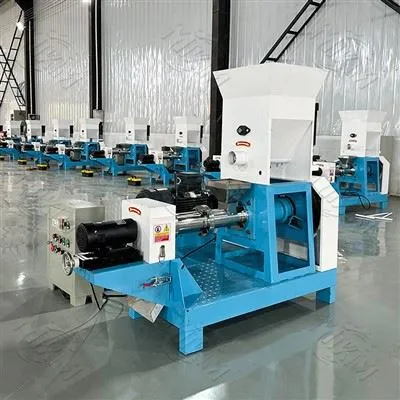
The direct hazards of uneven ground. Uneven ground causes dog food processing machines to be installed at an angle, leading to multiple problems: First, increased equipment vibration. Vibrations during extrusion cannot be evenly distributed, concentrating on one side of the components, causing misalignment between the screw and the extrusion chamber, accelerating wear on both, and uneven stress on the drive belt, making it prone to aging and breakage. Second, unstable feeding and discharging. The tilted equipment causes raw materials to "bridge" and clog in the feed hopper, and the particle trajectory deviates during discharge, affecting subsequent cutting and collection, and reducing particle length uniformity. Third, hydraulic system malfunctions (for extruders with hydraulic devices). The tilted state leads to uneven hydraulic oil levels, insufficient oil suction from the hydraulic pump, and pressure fluctuations, affecting die opening and closing and equipment braking. For example, a farm installed a single-screw extruder on an uneven ground with a tilt angle of 3°. The machine vibrated violently during operation, and after one month, the drive belt broke, the screw and extrusion chamber showed significant wear, and the produced particle length error reached ±1mm, far exceeding the standard ±0.5mm.
The cumulative effect of surrounding vibration sources. If small dog food manufacturing equipment is surrounded by strong vibration sources such as large crushers, air compressors, and water pumps, the vibrations from these devices will be superimposed on the extruder's own vibrations, resulting in a multiplied vibration intensity. Firstly, core components may loosen; screw fixing bolts and die head fastening nuts are prone to loosening, leading to fluctuations in extrusion pressure, unstable extrusion effects, and in severe cases, material leakage. Secondly, monitoring instruments may malfunction; pressure and temperature sensors may experience data drift under strong vibration, failing to accurately reflect the equipment's operating status, leading to operator misjudgments and incorrect parameter adjustments. Thirdly, the equipment foundation may be damaged; prolonged strong vibration can cause cracks in the extruder's installation foundation (concrete base), further exacerbating equipment vibration and creating a vicious cycle. For example, a feed mill installed a twin-screw extruder adjacent to a large crusher. The vibration generated by the crusher caused fluctuations in the extruder's pressure sensor data of ±0.8 MPa. After the operator mistakenly adjusted the screw speed, the produced pellets contained a large amount of over-expanded fragments, resulting in a waste rate of 15%.
Installation foundation optimization and vibration isolation measures are necessary. To address ground and vibration issues, a two-pronged approach is needed: first, optimize the installation foundation by pouring a dedicated concrete base according to the small cat food making machine model, ensuring the base's flatness error is within ±2mm/m, and pre-embed anchor bolts to firmly secure the equipment to the base, preventing displacement during operation; second, install vibration isolation devices by installing rubber damping pads or spring dampers between the equipment and the base to absorb the equipment's own vibration and reduce its transmission to surrounding areas; third, rationally plan the equipment layout, maintaining a distance of at least 5 meters between the extruder and strong vibration sources such as crushers and air compressors. If space is limited, vibration damping walls can be installed between them; fourth, regularly check and tighten the bolts. Before daily production, check the fixing bolts of components such as the screw, die head, and motor, tightening any loose bolts promptly. Check the equipment's level weekly, adjusting any deviations as needed. For example, a large feed mill poured a special concrete base for the twin-screw extruder, installed spring vibration dampers, and isolated it from the crusher by 6 meters. The vibration amplitude of the equipment during operation was reduced from 0.5mm to 0.1mm, the extrusion pressure fluctuation was controlled within ±0.2MPa, and the stability of the pellet quality was greatly improved.
Related equipment



about Us
MIKIM's fish feed pellet production lines and supporting machinery offer excellent value for money. Not only are they affordable, eliminating middlemen markups and allowing small and medium-sized enterprises (SMEs) and fish farmers to purchase complete sets of equipment at reasonable costs, but they also boast exceptional efficiency. The fully automated process, from raw material crushing and precise ingredient mixing to extrusion pelleting and maturation, is completed in one continuous flow. This results in high starch gelatinization rates and uniform pellet formation, significantly improving production efficiency and feed quality, truly achieving "low cost, high output." Choosing a MIKIM fish feed pellet production line means enjoying comprehensive pre-sales and after-sales service, including 24-hour online customer support, a one-year warranty on the entire machine, professional on-site installation, commissioning, and maintenance, and a stable supply of spare parts. Customers can buy with confidence and use with peace of mind, with both excellent value and service quality!!!
Customer visit

Certificate of Honor

FAQ
1. What is the price of the homemade dog food pellet machine?
The price ranges from approximately $1,500-$55,000
2. Do you provide maintenance services for your customers?
Yes, we offer comprehensive after-sales maintenance services to our customers.
If you would like to learn more about MIKIM machinery, please contact us. We offer one-stop service and welcome your inquiries!!!


