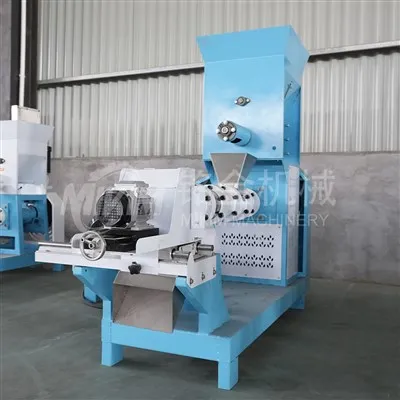
Fish, Shrimp and Dry Pet Food Production Line: Floating and Sinking Pellets
Leave a message
What the Feed Line Can Produce
An aquatic feed production line built around an extruder can produce both floating and sinking pellets for fish, shrimp, crabs and other aquatic animals. Different species need different feed types, and animals of different ages need different pellet sizes, so one line that covers both floating and sinking feed gives a producer far more commercial flexibility than a single-purpose machine.
The same equipment can also run dry pet food, such as dog food, cat food and bird feed. For a feed business that wants to spread risk across several markets, that dual use is one of the most valuable features of the design.
Floating versus Sinking Pellet Technology
| Item | Floating pellet | Sinking pellet |
|---|---|---|
| Bulk density | Low, the pellet stays at the surface | High, the pellet drops to the bottom |
| Extrusion condition | Higher expansion at the die | Restricted expansion, denser melt |
| Water stability | Good, with a suitable binder | High, favoured for bottom feeders |
| Typical species | Tilapia, carp, catfish, ornamental fish | Shrimp, crab, eel, some marine species |
| Feeding behaviour | Easier to observe intake and leftovers | Suits animals that feed on the bottom |
Switching between the two product types is a matter of formula, moisture at the die and die open area, which is why a single extrusion line can serve both markets.
Production Flow of a Compact and an Automated Line
Small output lines follow a compact flow:
Mixer, screw conveyor, extruder, air conveyor
Dryer, hoister, flavour drum with oil sprayer
Optional cooling and packing machines
Higher output lines add automation to the same principle:
Powdered materials pass through a vertical blender and a bucket elevator
Storage hopper, double shaft steam conditioner, twin-screw extruder
Vibrating sieve, cooling conveyor, air conveyor, steam dryer
Hoister, flavour drum, cooling machine and a second vibrating sieve
Storage and packing
Both layouts keep the same core sequence: mix, extrude, dry, flavour, cool and pack. The difference lies in throughput, in the amount of steam conditioning and in how much of the transfer work is automated.
Model Specifications
The table below lists seven common line configurations so that buyers can compare output, installed power and floor space before choosing a layout.
| Model | Output (kg/h) | Installed power (kW) | Dimension L*W*H (m) |
|---|---|---|---|
| 65 | 150 | 80 | 17*1.5*2.2 |
| 70 | 250 | 105 | 20*1.5*2.2 |
| 85 | 500 | 185 | 30*2.0*2.6 |
| 90 | 800-1200 | 110 | 45*2.2*3.0 |
| 95 | 2000-3000 | 135 | 50*2.5*3.2 |
| 120 | 3000-5000 | 350 | 60*2.5*3.5 |
| 140 | 5000-8000 | 415 | 78*3.0*3.8 |
Output depends on the formula, the pellet size and the set moisture, so the values should be read as working ranges for layout planning rather than guaranteed figures for every recipe.
Key Advantages and Pellet Die Options
Wide use for floating feed pellets across many aquatic species.
Straightforward operation and reliable running performance, supported by an ergonomic layout.
High efficiency with low power consumption per tonne of feed.
Screw sleeves built with an embedded alloy steel strip structure for a long service life.
Interchangeable moulds for different pellet diameters and shapes.
Dies available from 1 mm to 12 mm, covering fry, growout and broodstock feed sizes.
Because the die set is the cheapest way to change the product, most producers order a starter set of dies together with the line and add sizes as their market expands.
Frequently Asked Questions
Q: Can one machine really make both floating and sinking pellets?
Yes. Floating and sinking behaviour is controlled by the formula, the moisture at the die and the die open area rather than by two separate machines, so the same extruder can run both products.
Q: Which pellet sizes can the line produce?
With dies from 1 mm to 12 mm the line covers fry feed at the small end and broodstock feed at the large end, and intermediate sizes suit growout stages.
Q: How is the correct line capacity chosen?
Start from the daily feed requirement of the farm or the sales forecast of the feed mill, add a margin for seasonal peaks, and then compare the output column of the specification table.
Q: What is steam conditioning for?
Conditioning pre-heats and moistens the mash before extrusion, which stabilises starch gelatinisation, reduces wear on the screw and die, and improves pellet water stability.
Q: Does the line need a separate dryer?
Yes. Extruded pellets leave the die with high moisture, and a multi-pass dryer brings them to a safe storage level while setting hardness and water stability.
Q: How long does commissioning take?
Mechanical installation of a compact line is usually measured in days, while recipe tuning, die selection and operator training continue for a longer period until the target pellet quality is repeatable.