Sinking and Floating Fish Feed Pellet Extruder Line: Process, Parameters and Pellet Control
Leave a message
Overview of the Sinking and Floating Fish Feed Extruder Line
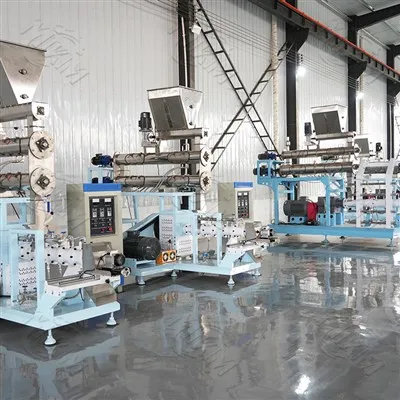
A sinking and floating fish feed pellet extruder line is a continuous, food grade processing system that turns ground grain, fish meal and oil into shaped aquatic feed. The same extruder barrel can deliver floating, slow sinking or fast sinking pellets by changing the formula, the screw configuration and the die, so one line serves surface feeding fish, mid water species and bottom feeders. Common capacities are 2-3 t/h and 4-6 t/h, and the line runs automatically with low electricity and labour consumption.
Process Flow from Raw Material to Packed Pellet
The machines are arranged in a fixed order so that material moves through the plant without manual handling:
Hammer grinder - reduces corn, wheat and other grains to a fine, uniform meal.
Double shaft blender - mixes meal, fish meal, bone powder and animal oil into a homogeneous mash.
Extruder system - cooks, shears and expands the mash under controlled temperature and pressure.
Drying system - lowers pellet moisture to a level that keeps the product stable in storage.
Counter flow cooler - returns hot pellets to ambient temperature with counter current air.
Roller coating machine - applies a protective surface layer to the pellet.
Grease adding machine - doses oil or fat evenly across the pellet surface.
Packaging system - weighs and bags the finished feed.
Technical Parameters
| Item | Specification |
|---|---|
| Capacity | 2-3 t/h and 4-6 t/h |
| Installed power | about 320 kW |
| Voltage | 380 V / 50 Hz, or matched to the local supply |
| Line dimensions | about 50 m x 4 m x 5 m |
| Material of construction | stainless steel contact parts |
| Extruder screws | alloy steel with building block structure |
| Operation | fully automatic, continuous, high speed |
| Pellet size | 1-14 mm floating, slow sinking and sinking feed |
Design Details That Protect Pellet Quality
Several construction choices decide how stable the line remains over years of production. The gearbox runs on high grade bearings selected for roughly ten years of service, and the control cabinet uses internationally rated electrical components so that spare parts stay easy to source. A cooking time of about three minutes inside the extruder barrel gives the starch enough residence time to gelatinise fully, which is what holds a floating pellet together in water. Screws and barrel are treated by a deep nitriding process, raising surface hardness and extending the life of the wear parts. Cutting uses a straight cutting method that produces a clean, smooth pellet face with little dust.
Raw Materials and Finished Feed Range
The line accepts wheat flour, corn flour, fish meal, bone powder and animal oil, with the exact blend set by the target species and the pellet type required. By changing the formula and the die, the same equipment delivers 1-14 mm pellets in three density classes: floating feed for surface feeders, slow sinking feed for mid water fish, and sinking feed for bottom feeders and shrimp. Buyers normally fix the pellet size range first and then match the die set and the drying curve to it, because water stability is decided mainly by the extrusion settings rather than by the die alone.
Frequently Asked Questions
Q: What decides whether a pellet floats or sinks?
Expansion at the die. More expansion traps air inside the pellet and lowers its density so it floats, while less expansion produces a denser, sinking pellet.
Q: Can one line produce both floating and sinking feed?
Yes. Floating, slow sinking and sinking feed can all be made on the same extruder by adjusting the formula, the screw configuration and the die.
Q: What capacity should a buyer choose?
Select from the 2-3 t/h or 4-6 t/h ranges according to daily demand, and allow headroom for future growth rather than running the line at its limit.
Q: Why is the installed power about 320 kW?
The figure covers the grinder, blender, extruder, dryer, cooler, coating units and packing system working together as one continuous line.
Q: How long does the mash stay in the extruder barrel?
Around three minutes of cooking time, which is enough for full starch gelatinisation before the dough reaches the die.
Q: Which parts wear fastest and how is wear reduced?
The screw and barrel wear fastest; both are deep nitrided to raise surface hardness, and the building block screw structure allows individual elements to be replaced.