Automatic Fish and Pet Feed Extruder Production Lines Explained
Leave a message
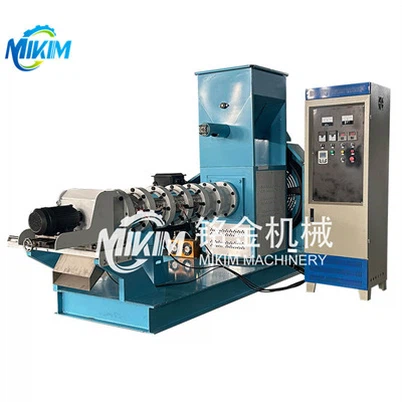
An automatic feed extruder production line turns raw meal powder into ready to sell floating or sinking pellets for fish, shrimp, crab, birds and pets. The twin screw extruder is the key machine in the system: inside the screw barrel the mixed powder is kneaded, compressed and heated, and the combined heat and shear transform the starch so that the material becomes a cooked, plastic dough. When that dough is pushed out through the die it meets the open air, cools and expands, giving a light and porous pellet that floats on the water surface. The same extruder can also produce sinking feed by changing the die and the screw configuration, so one line can serve both feeding methods.
How the Extruder Cooks and Shapes the Pellet
Expansion explains why floating pellets form. As the cooked dough leaves the die, the sudden drop in pressure and temperature makes the moisture inside flash into steam, and the pellet swells to a larger size than the original dough strand. Puffed pellets are light and porous enough to stay on the water surface for a long time, which lets farmers watch feeding activity and reduces feed loss to the pond bottom. Inside the screw, material temperature rises above 100 C, which gelatinises the starch and improves digestibility for fish. For sinking feed, the recipe, the die geometry and the screw configuration are adjusted so the pellets stay dense and heavy instead of expanding. Sinking pellets are used mainly for bottom feeding species and for shrimp, where the feed must reach the pond floor quickly.
Typical Production Line Configuration
A complete floating feed line usually follows the same equipment sequence, and each stage is matched in capacity so the line runs without a bottleneck:
Mixer to blend the formula and equalise particle size.
Screw conveyor to move the blended powder into the extruder.
Twin screw extruder to cook, expand and shape the pellets.
Hoister or air conveyor to transfer the hot, soft pellets without crushing them.
Multi layer drying oven to remove surface and internal moisture.
Single drum flavour line to apply oil, fat or additives.
Cooling machine to stabilise pellet temperature and moisture.
Packing machine, usually offered as the final optional stage.
The drying oven is sized by the number of layers and the total drying length, and both must match the throughput of the extruder. Undersized drying is the most common cause of soft, mould prone pellets and a line that cannot reach its rated output.
Model, Output and Power Parameters
Production lines are normally identified by the model of the twin screw extruder. Larger models give higher output and need more installed power and floor space. The table below lists the common configurations.
| Extruder model | Output | Installed power | Dimension L x W x H |
|---|---|---|---|
| Model 65 | 150 kg/h | 80 kW | 17 x 1.5 x 2.2 m |
| Model 70 | 250 kg/h | 100 kW | 20 x 1.5 x 2.2 m |
| Model 85 | 500 kg/h | 150 kW | 30 x 1.5 x 2.6 m |
| Model 90 | 1000 kg/h | 180 kW | 40 x 2 x 3.5 m |
| Model 95 | 1500 kg/h | 200 kW | 45 x 2 x 3.5 m |
| Model 120 | 3000 kg/h | 245 kW | 60 x 3 x 3.5 m |
| Model 140 | 5000 kg/h | 290 kW | 78 x 3.8 x 3.5 m |
Two practical notes apply to this table. First, the output figures are rated for a floating aquafeed recipe with a typical moisture and fat content; a sinking feed recipe and a high fat pet food recipe will both shift the number. Second, installed power includes the barrel heaters, the cutter and the auxiliary drives, so the actual running load is normally lower than the figure shown.
Hygiene, Traceability and Compliance
Modern dog and pet food production lines favour closed loop processing, in which raw materials and semi finished products move through sealed pipelines, conveyors and containers from ingredient mixing to finished packaging. This design keeps the food away from outside air, dust, microorganisms and human hands, and greatly reduces the risk of cross contamination. Closed equipment in the extrusion and drying stages also keeps airborne bacteria and foreign particles out of the product, which matters when a line has to meet strict food safety rules such as Regulation (EC) No 178/2002 in the European Union.
Many lines are also linked to a manufacturing execution system that records batch numbers, supplier information, inspection reports, real time processing parameters such as temperature, pressure and residence time, and finished product test results including moisture, nutrient levels and microbial counts. If a quality issue appears, this traceability lets the manufacturer identify the affected raw material batches and their distribution channels quickly instead of recalling an entire production period.
Frequently Asked Questions
Q: What decides whether the pellet floats or sinks?
Density. A high expansion recipe with a suitable die produces a light, porous pellet that floats; a denser recipe with a different screw configuration and die produces a pellet that sinks.
Q: Can one line produce feed for fish, shrimp, birds and pets?
Yes. The extruder, dryer, coater and cooler stay the same, while the formula, the die and the cutter setting are changed for each animal and each pellet size.
Q: Why does the drying stage have to match the extruder output?
Because the oven must remove the moisture the extruder adds. If the dryer is too small, pellets leave warm and wet, which causes mould, poor water stability and lost production.
Q: How is cross contamination prevented between batches of different formula?
Closed loop conveying and sealed equipment limit exposure to air and dust, and the extruder, die, cutter and conveying sections are cleaned between formulas that must not be mixed.
Q: What production data should a traceable line record?
Batch and supplier identification, processing parameters such as temperature, pressure and time, and finished product tests for moisture, nutrients and microbial counts.
Q: How do I choose between the models in the table?
Start from the required output per shift, then allow extra capacity for start up loss and future formula changes. Never size the dryer below the extruder rating.