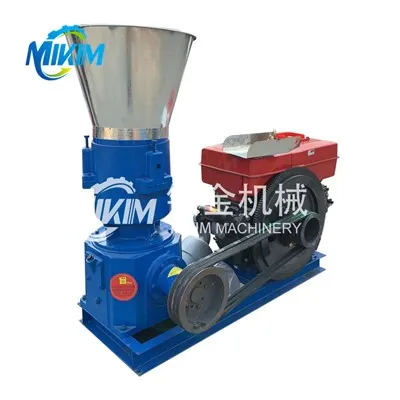
What are the effects of key extruder parameters on the quality and yield of fish feed pellets?
Leave a message
Many feed mills' extruders, which are supposed to produce 10 tons, actually only produce 8 tons, and they often produce "substandard feed"-either the pellets are not expanded enough (sinking feed becomes semi-floating feed), or they are over-expanded (floating feed is too brittle). The problem isn't with the machines themselves, but with the core parameters like temperature, pressure, and speed not being properly adjusted. It's like cooking without controlling the heat; even the best ingredients won't make a good dish.
Effect of extrusion temperature
Floating fish feed (e.g., grass carp, koi carp feed): High temperature promotes extrusion, 120-140℃ is optimal.
Impact on quality: The extruder barrel has three temperature control sections (preheating at 90-100℃ in the first section, gelatinization at 120-140℃ in the middle section, and extrusion at 130-140℃ in the last section). High temperature allows for full gelatinization of starch, generating a large amount of gas, reducing particle density to 0.8-0.9 g/cm³ (less than water), allowing for stable floating for 2-4 hours. If the temperature is below 110℃, the starch gelatinization rate is below 70%, and the particles will sink, becoming "unqualified floating feed."
Impact on output: Once the temperature reaches the target, the raw material has good flowability, and the extruder speed can be stabilized at 400-450 rpm, allowing a 10-ton-per-day production line to operate at full capacity. If the temperature fluctuates wildly (more than ±10℃), frequent shutdowns for temperature adjustment are necessary, resulting in a daily output reduction of 1-1.5 tons.
Sinking fish feed (e.g., crucian carp, bass feed): Low temperature prevents puffing; 60-80℃ is optimal.
Impact on quality: The barrel temperature is controlled at 60-80℃ (only softening the raw material, not gelatinizing and producing gas), maintaining a particle density of 1.1-1.2 g/cm³ (greater than water). It sinks within 10 seconds and has a water resistance of 1.5 hours. If the temperature exceeds 90℃, the raw material slightly puffs, and 30% of the particles float on the surface, becoming "semi-sinking, semi-floating feed."
Impact on output: At low temperatures, the raw material is less likely to stick to the machine, allowing the extruder to run continuously for 8-10 hours. The frequency of blockages decreases from twice a day to 0.5 times, increasing production capacity by 10%.
Effect of extrusion pressure
Floating material: Pressure 3-5 MPa, balancing expansion and compaction.
Pressure too low (below 2 MPa): Raw material over-expands, internal air bubbles become too large, causing the material to disintegrate upon soaking (water resistance decreases from 2 hours to 1 hour); Pressure too high (above 6 MPa): Air bubbles are crushed, particle density increases, and the material cannot float.
Control method: Stabilize the pressure at 3-5 MPa by adjusting the die orifice diameter (4-6 mm die for floating material) and screw speed. Monitor in real time with a pressure gauge; adjust if fluctuations exceed ±0.5 MPa.
Sinking materials: Pressure 8-12MPa, compaction to prevent gas generation.
Pressure too low (below 7MPa): Residual air inside the raw material, particles will float on the surface.
Pressure too high (above 13MPa): Mold wears out quickly (originally usable for 3 months, now needs to be replaced every month), increasing costs.
Control methods: Replace with thick-walled molds (25-30mm thick molds for sinking materials), reduce the screw-barrel clearance, and stabilize the pressure at 8-12MPa.


about Us
MIKIM boasts extensive experience in poultry feed pellet production lines, significantly reducing the incidence of poultry diseases. Its equipment is not only widely used across various industries domestically but also exported to Southeast Asia, Europe, Africa, and South America, earning a high reputation internationally. This global presence not only demonstrates the adaptability and competitiveness of its products, but also demonstrates the company's experience in adapting to diverse market standards and logistics conditions, enabling it to provide a stable supply chain for its overseas customers. Whether serving large domestic farms or cross-border feed companies, MIKIM can leverage its global service network to ensure a consistent, high-quality experience.
For more information on process flow design, equipment layout, factory construction plans, individual equipment pricing, or turnkey project proposals, please feel free to contact us!!!
FAQ
1. What is the price of the floating fish meal extruder line?
The price ranges from approximately $12,000-$51,000
2. Do you provide maintenance services for your customers?
Yes, we offer comprehensive after-sales maintenance services to our customers.