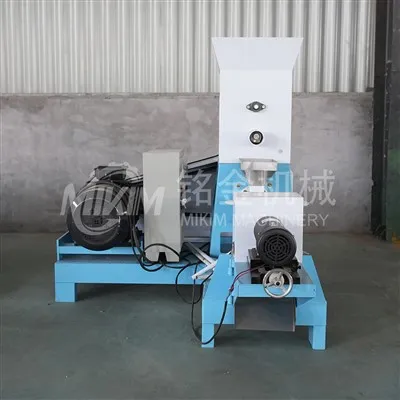
What are the possible reasons for a sudden drop in pellet production in a small electric fish feed extruder?
Leave a message
Cause of the fault
- Feeding system issues: The feeding motor power is reduced, with the speed dropping from 1450 r/min to below 1200 r/min; the gap between the feeding screw and the barrel increases, reducing the efficiency of pushing raw materials; the material level switch at the bottom of the hopper is malfunctioning, falsely reporting a "full" signal, causing the feeding motor to slow down.
- Extrusion system issues in the floating fish food extruder machine: The die orifice is blocked by coke, reducing the number of effective discharge orifices; the extruder spindle speed decreases, resulting in insufficient power; the inner wall of the barrel is severely worn, with the clearance between the screw and the die exceeding 1 mm, increasing material backflow and reducing the effective extrusion volume.
- Raw material issues: The raw material is not finely ground, with particle diameters exceeding 1 mm, making it difficult to soften in the barrel and increasing extrusion resistance; after mixing, the raw material stratifies, with heavier materials sinking and lighter materials floating, preventing even feeding into the barrel.
- Extruder pellet mill parameter issues: The barrel temperature is too low, the raw material has poor flowability, the residence time in the machine is prolonged, and the extrusion volume per unit time is reduced; the speed ratio between the feeding motor and the extrusion motor is out of balance, and the feeding speed and the extrusion speed are mismatched.
Solutions
1. Feeding System Optimization: Use a tachometer to check the feed motor speed. If it is lower than the standard value, replace it with a new motor of the same power or repair the motor. Measure the gap between the feed screw and the barrel; if it exceeds 0.8mm, replace the screw. Check the material level switch; if the motor does not speed up when manually blocked, replace the material level switch and recalibrate it.
2. Animal Food Extruder System Cleaning and Repair: Remove the die head, clean any blocked channels with a steel needle, and sand the surface of the die head to ensure all channels are clear. Use a tachometer to check the spindle speed; if it is lower than the standard value, check the wear of the reducer gears and replace them if necessary. Measure the wear on the inner wall of the barrel; if it exceeds 1mm, replace the barrel.
3. Raw Material Optimization: Re-grind the raw materials to at least 80 mesh to ensure uniform particle size. Adjust the mixing time of the mixer from 3 minutes to 5 minutes. Add 0.1% vegetable oil during mixing as an anti-caking agent to prevent stratification.
4. Pet feed extruder parameter adjustment: Increase the barrel temperature by 5-10℃ to enhance raw material flowability; reset the speed ratio between the feed and extrusion motors, adjusting according to the principle of "feed slightly greater than extrusion" to ensure a small amount of raw material is always stored in the machine to avoid idling.
5. Production test: After each adjustment, conduct a 10-minute production test and record the hourly output until it returns to over 95% of the standard output. If it still does not meet the standard, check the equipment's sealing performance to prevent raw material leakage.


about Us
Customer visit

Certificate of Honor

FAQ
1. What is the price of the dry type fish food extruder?
The price ranges from approximately $4,500-$35,000
2. Do you provide maintenance services for your customers?
Yes, we offer comprehensive after-sales maintenance services to our customers.