


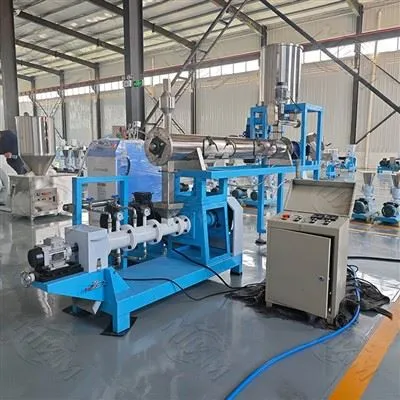
What is the source of the unusually harsh noise from the fish food pellet extruder?
Leave a message
Cause of the fault
- Bearing Wear: Insufficient lubrication or aging of the main shaft bearing and feed motor bearing causes a "rustling" sound due to friction between the balls and inner/outer rings; broken bearing balls or damaged cages produce a "clunking" impact sound.
- Gear Problems: Worn gears in the reducer, with pitted or broken teeth, produce a "humming" resonance sound during meshing; excessive or insufficient gear clearance leads to poor meshing and noise.
- Coupling Failure: Loose bolts on the coupling between the main shaft and reducer cause eccentricity during operation, producing a "clicking" sound; aged or damaged rubber pads on the coupling fail to buffer vibration, exacerbating noise.
- Other Causes: Loose connection between the barrel and die head causes collisions during operation; a bent feed screw rubs against the inner wall of the barrel; loose anchor bolts cause machine vibration and noise.
Solutions
1. Noise Localization: Use a stethoscope (or a long screwdriver pressed against the ear) to touch the spindle bearing housing, reducer, coupling, etc., to determine the source of noise. Noise from bearing wear is concentrated in the bearing housing, noise from gear problems comes from the reducer, and noise from coupling failure is most noticeable at the connection point.
2. Bearing Repair: If the bearing is low on lubrication, remove the bearing cover, clean out the old grease, add lithium-based grease to 2/3 of the bearing space, and retighten the bearing cover. If the bearing balls are broken or the cage is damaged, replace it with a new bearing of the same model. During installation, ensure that the bearing fits tightly with the spindle, with a clearance not exceeding 0.05mm.
3. Gear Inspection: Open the reducer housing cover and inspect the gear wear. Minor wear can be repaired by grinding; severe wear requires replacement of the gears. Adjust the gear clearance to 0.1-0.2mm, add industrial gear oil to the middle position on the oil level gauge, and ensure good lubrication.
4. Coupling Adjustment: Tighten the coupling fixing bolts, replace aged rubber gaskets, and ensure the coupling is concentric with the main shaft and reducer output shaft, with radial runout not exceeding 0.1mm. If the coupling is deformed, replace it directly with a new one.
5. Other Parts of the Fish Food Mill Machine: Retighten the connecting bolts between the barrel and the die head, and add sealing gaskets to the contact surfaces to reduce collisions; correct any bent feed screws, replacing them if the bend exceeds 0.5mm; tighten the equipment's foundation bolts, and install vibration damping pads under the base to reduce vibration transmission.
6. Noise Test: After the floating food making machine is repaired, run it idle for 10 minutes and measure the noise level with a noise meter (normally it should be below 75 decibels); then run it under load for 30 minutes to ensure the noise level stabilizes within the normal range without any abnormal noise.


about Us
Customer visit

Certificate of Honor

FAQ
1. What is the price of the automatic fish food making machine?
The price ranges from approximately $4,500-$35,000
2. Do you provide maintenance services for your customers?
Yes, we offer comprehensive after-sales maintenance services to our customers.


