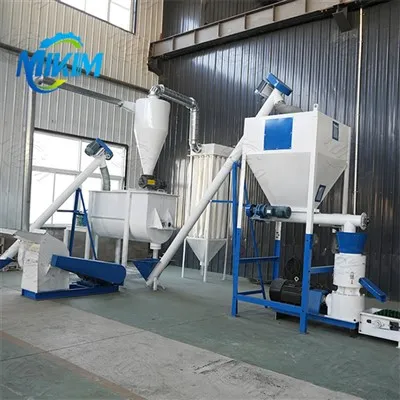
What aspects should be considered when installing a floating fish feed extruder machine?
Leave a message
The first step is no-load commissioning of the fish feed pellet making machine. The core of no-load commissioning is checking the stability and coordination of the equipment's operation. The production line must be started without any raw materials. First, start the cooling and dust removal systems to ensure normal operation. Then, start the motor and slowly increase the screw speed to 50% of the rated speed (usually 150-200 rpm) via the control cabinet. Run for 30 minutes, observing the operating status of the main unit, motor, and reducer. There should be no abnormal noises or vibrations (vibration amplitude ≤1mm), and the bearing temperature should not exceed 70℃. Simultaneously test the coordination of the various supporting equipment. The feeder, conditioner, and cooler must start and stop synchronously with the extruder without any delay. If excessive vibration occurs, the levelness and fixation of core components must be rechecked. If abnormal noises occur, check whether the bearing lubrication is sufficient or whether any parts are stuck.
The second step is load commissioning of the fish food making machine. Load commissioning needs to be carried out in stages, gradually increasing the capacity to the rated value. The first stage is low-load commissioning (20% of rated capacity). Raw materials are added to the hopper, the production line is started, and parameters such as feeding speed, screw speed, and barrel temperature are adjusted. The temperature of each section of the barrel needs to be controlled in a gradient (feeding section 60-70℃, extrusion section 110-120℃, forming section 90-100℃). Observe the forming of the extruded pellets; the pellets should be compact, uniform, without loose material or burrs, and have a water resistance of ≥20 minutes. The second stage is medium-load commissioning (50% of rated capacity), running for 1 hour. The focus is on checking the equipment's capacity stability and energy consumption, recording the power consumption per unit output to ensure it meets the equipment manual requirements. The third stage is full-load commissioning (100% of rated capacity), running continuously for 4 hours. All equipment indicators are comprehensively monitored, including pellet quality, equipment vibration, bearing temperature, and electrical parameters, ensuring they are all within acceptable ranges.
The third step is the overall acceptance of the fish feed pellet making machine. Acceptance testing requires comparing the equipment manual and installation contract, with a focus on checking the following indicators: equipment installation accuracy (center deviation of core components ≤0.1mm, levelness ≤0.2mm/m), production capacity (reaching over 95% of rated capacity), product quality (granule formation rate ≥95%, starch gelatinization rate ≥85%), and safety performance (grounding resistance ≤4Ω, no leakage). Simultaneously, check the equipment's sealing performance, ensuring no raw material or steam leakage at any joints. After acceptance, compile and archive installation and commissioning records, equipment manuals, certificates of conformity, and other relevant documents. If any problems are found, communicate with the installation team for rectification until all indicators meet the standards. Finally, organize training for operators to familiarize them with equipment operating procedures and daily maintenance points, ensuring safe and efficient operation after the equipment is officially put into production.
Related equipment
about Us
MIKIM's fish feed pellet production lines and supporting machinery offer excellent value for money. Not only are they affordable, eliminating middlemen markups and allowing small and medium-sized enterprises (SMEs) and fish farmers to purchase complete sets of equipment at reasonable costs, but they also boast exceptional efficiency. The fully automated process, from raw material crushing and precise ingredient mixing to extrusion pelleting and maturation, is completed in one continuous flow. This results in high starch gelatinization rates and uniform pellet formation, significantly improving production efficiency and feed quality, truly achieving "low cost, high output." Choosing a MIKIM fish feed pellet production line means enjoying comprehensive pre-sales and after-sales service, including 24-hour online customer support, a one-year warranty on the entire machine, professional on-site installation, commissioning, and maintenance, and a stable supply of spare parts. Customers can buy with confidence and use with peace of mind, with both excellent value and service quality!
Customer visit

Certificate of Honor

FAQ
1. What is the price of the fish feed pellet extruder?
The price ranges from approximately $3,500-$55,000
2. Do you provide maintenance services for your customers?
Yes, we offer comprehensive after-sales maintenance services to our customers.
If you would like to learn more about MIKIM machinery, please contact us. We offer one-stop service and welcome your inquiries!!!