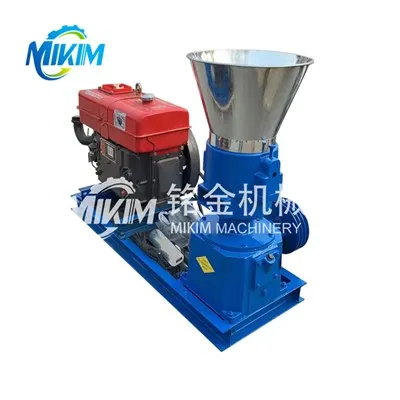
Dog Food Pellet Machine Motors: Power and Types Guide
Leave a message
Why the Motor Rating Must Match the Extruder
The motor is the component of a dog food pellet making machine that drives the screw, and its power rating directly determines how much material the machine can process. An undersized motor stalls under load; an oversized motor wastes energy and adds cost. Matching motor power to extruder capacity is therefore the first step in selecting any machine.
Motor selection is usually considered along three dimensions: power, control method, and protection level.
Motor Power Ranges for Different Capacities
| Motor power | Typical extruder capacity | Typical applications |
|---|---|---|
| About 1.5-5 kW | 50-100 kg per hour | Small factories, laboratories, and workshops with small batches |
| About 5-15 kW | 100-500 kg per hour | Medium production, the most widely used range |
| About 15-37 kW | Above 500 kg per hour | Large-scale dog food plants, continuous high-load operation |
Small motors start quickly and are simple to operate, which suits small-batch production. Medium motors commonly use frequency conversion, adapt to different formulas, and offer moderate energy consumption. Large motors use high-voltage frequency conversion, carry high loads for long periods, and include overheat and overload protection.
Control Method and Protection Level
Asynchronous motors are the traditional choice. Their speed is essentially fixed, typically around 1480 rpm, and a speed reducer is used for adjustment. They have a simple structure, low price, and easy maintenance, which suits fixed formulas and stable production. Their limitation is inflexible speed control when formulas change frequently.
Variable frequency motors are the modern mainstream. A frequency converter adjusts the speed steplessly, for example in the 300-450 rpm range, matching different machine models and formulas. They provide stable power output, lower energy consumption, and precise speed adjustment in response to raw material moisture and recipe differences, and they include overload and overheat protection.
The IP rating describes how well the motor resists dust and water. An IP54 motor is dust-protected and splash-proof, which suits typical dry dog food workshops with low dust levels. An IP65 motor prevents dust ingress completely and withstands water jets, which suits humid and dusty environments or high-moisture raw materials. An IP67 motor is dust-tight and resistant to temporary immersion, which suits outdoor or extreme humidity conditions, although its range of application is narrower.
Choosing a motor with too low an IP rating in a dusty or humid environment risks dust accumulation and moisture damage; choosing a much higher rating than needed adds cost without benefit.
How to Select the Right Motor
Start from the required output: determine the extruder capacity, then select the power range that covers it with margin. Next, decide whether formula flexibility matters; if the line will run multiple recipes, a variable frequency motor is worth the extra cost. Finally, assess the environment: match the IP rating to actual dust and humidity levels, and confirm the power supply voltage matches the motor specification.
Common Misconceptions
One misconception is that a bigger motor always means more production. Throughput is limited by the screw, die, and conditioning, so a motor larger than the process needs only increases energy cost. Another is that variable frequency motors are always more efficient; they save energy mainly when speed varies, and at constant full load the difference is smaller. Finally, some buyers ignore IP ratings, but a motor failure caused by dust or moisture is expensive and entirely avoidable with the correct rating.
FAQ
What motor power does a small dog food extruder need?
A motor of about 1.5-5 kW typically suits extruders with a capacity of 50-100 kg per hour, which is common for small workshops and laboratories.
What is the difference between asynchronous and variable frequency motors?
An asynchronous motor runs at a nearly fixed speed, typically around 1480 rpm, while a variable frequency motor adjusts speed steplessly through a converter, for example from 300-450 rpm, for better formula flexibility.
What do IP54, IP65, and IP67 mean?
They are protection ratings: IP54 is dust-protected and splash-proof, IP65 is dust-tight and jet-proof, and IP67 is dust-tight and resistant to temporary immersion.
Which motor is the mainstream choice in the industry?
Variable frequency motors are currently the mainstream because they combine flexible speed adjustment with stable output and overload protection.
Does a larger motor consume more energy?
Yes, at the same load a larger motor generally consumes more energy, which is why the motor should be matched to the actual capacity rather than oversized.
Why does a wet or high-moisture process need a higher IP rating?
Moisture and dust can enter the motor and cause burnout; a higher IP rating such as IP65 or IP67 prevents this in humid and dusty environments.