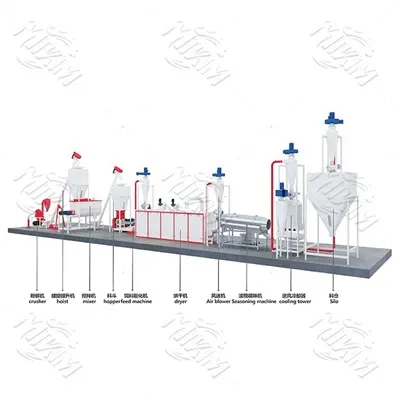
Feed Pellet Line Output Unstable: A Three-Step Correction Plan
Leave a message
Why Output on a Feed Pellet Line Fluctuates
Feed pellet production lines rarely lose tonnage in a single dramatic event. Output drifts during a shift because the operating status of the equipment, the nature of the raw material and the habits of the operator all change at the same time. Unstable tonnage makes planning unreliable, wastes energy per tonne and produces pellets whose hardness and durability vary from hour to hour. The goal is therefore not simply to push the line harder, but to identify which of the three factors is drifting and to correct it in small, measurable steps.
Step 1: Commission the Line for the Current Formula
Commission the equipment whenever the formula changes, because settings that give stable output for one recipe may be wrong for the next. Moisture content, grinding fineness, fat inclusion and the required conditioning time all shift when the raw material mix changes, and each of them changes the load on the pellet mill die.
Build a commissioning checklist that covers the feeder, conditioner, pellet mill and cooler, and record the values that give stable output for every formula. Typical items include feeder speed, steam pressure and conditioning temperature, die and roller clearance, and cooler bed depth. A fully automated line handles batching and keeps operation continuous, but the automation still needs correct set points to deliver a stable tonnage. Verify each formula by running it for a fixed period and comparing measured tonnage with the target, adjusting one parameter at a time before recording the final settings.
Step 2: Standardize Operator Work
Operator experience directly affects output stability, and the variation between people is often larger than the variation in the equipment. Two operators running the same formula on different shifts can produce different tonnage simply because they start the line in a different order or respond to a small alarm in a different way.
Strengthen training until everyone runs the line the same way: the same start-up sequence, the same adjustment procedure and the same response to each alarm. Training should cover how to read the control interface, how to move parameters in small increments instead of large jumps, and when to stop the line rather than force it through a disturbance. Keep the procedure at the control desk and confirm through the shift log that it was followed. Standardized operation removes the random variation that comes from improvised settings.
Step 3: Monitor Production Data in Real Time
Establish a monitoring routine that displays tonnage as it is produced and flags a deviation as soon as it begins. When output drops or surges, compare the current parameters with the recorded values for the same formula and then work upstream, because the cause is often in the feeder, the conditioner or the raw material rather than in the pellet mill itself.
Log the actual tonnage at fixed intervals during the shift.
Record conditioner temperature, moisture and die motor load alongside tonnage.
Compare each reading with the reference values stored for that formula.
Note every adjustment, when it was made and by whom.
Review the log before the shift ends, while the events are still fresh.
Real-time monitoring turns a problem discovered hours later into one corrected within minutes, which prevents a short disturbance from becoming a full shift of off-specification pellets. On large automated lines rated at 15-20 t/h for commercial plants producing chicken, sheep, cattle or shrimp feed, the same principle applies: stable output depends on correct settings, skilled operation and continuous monitoring rather than on machine capacity alone.
Building a Stable Shift Routine
Stability comes from combining the three measures into one daily routine. Begin each shift by confirming that the parameters match the recorded values for the formula being run. Watch the tonnage reading during the first hour and compare it with the target; if it drifts, adjust in small steps and write down what was changed. At the end of the shift, record the actual tonnage, any disturbance and the settings used. Over time this routine builds a reference database for the line, so output fluctuations become rarer and a genuine equipment problem stands out clearly against a stable baseline.
The Three Measures at a Glance
| Measure | What it corrects | Verification |
|---|---|---|
| Commissioning for the current formula | Settings that no longer match the raw material | Measured tonnage equals target for three consecutive batches |
| Standardized operator work | Inconsistent operation between shifts and individuals | Shift logs show an identical start-up and adjustment sequence |
| Real-time data monitoring | Slow detection of changes and unclear root cause | A deviation is identified and logged within minutes |
Frequently Asked Questions
Q: Why does output fall after a formula change even though the machine was not touched?
The raw material changed, so moisture, grinding fineness and conditioning behaviour changed with it. Re-commission the feeder, conditioner and pellet mill for the new formula and record the values that restore the target tonnage.
Q: Is a higher feeder speed the fastest way to raise tonnage?
Only up to the point where the pellet mill can accept the material. Beyond that the die load rises, pellet quality falls and the machine may block, so increase the feed rate in small increments while watching die motor load.
Q: How often should parameters be re-checked during a shift?
At the start of the shift, after any raw material delivery or formula change, and then at fixed intervals during production. Frequent small checks detect drift earlier than a single review at the end of the shift.
Q: Does automation remove the need for operator training?
No. An automated line executes the set points it is given, so an incorrect value is reproduced consistently and at full speed. Operators still need to recognize abnormal trends and know when to intervene.
Q: What is the most useful record to keep?
A shift log that pairs actual tonnage with the parameters in use. Without that pairing it is impossible to tell whether a change in output came from the material, the settings or the machinery.