


300-500kg/H Commercial Floating Fish Feed Line For Colombia
This 300–500 kg/h floating fish feed line supports 60 Hz power for Colombia tilapia and cachama farming. It offers twin-screw / single-screw wet extrusion options, with 1.5–6 mm pellet sizes and 8–10% final moisture. Suitable for on-farm commercial aquafeed pilot production.
Description
Quick answer
The 300-500kg/h commercial floating fish feed line is one line rated 300 to 500 kg/h, and four of its nine units change with the rating: batch mixer, extruder barrel, mesh belt drier and oil coater. At 300 kg/h the line lists 119.55 kW of drives, at 500 kg/h 203.1 kW, and both ratings run wet extrusion wound for 60 Hz. A wet single-screw frame can replace the twin-screw barrel at either rating: the main motor then matches at 22 kW at 300 kg/h and falls from 37 kW to 30 kW at 500 kg/h, taking the line to 196.1 kW.
In this guide
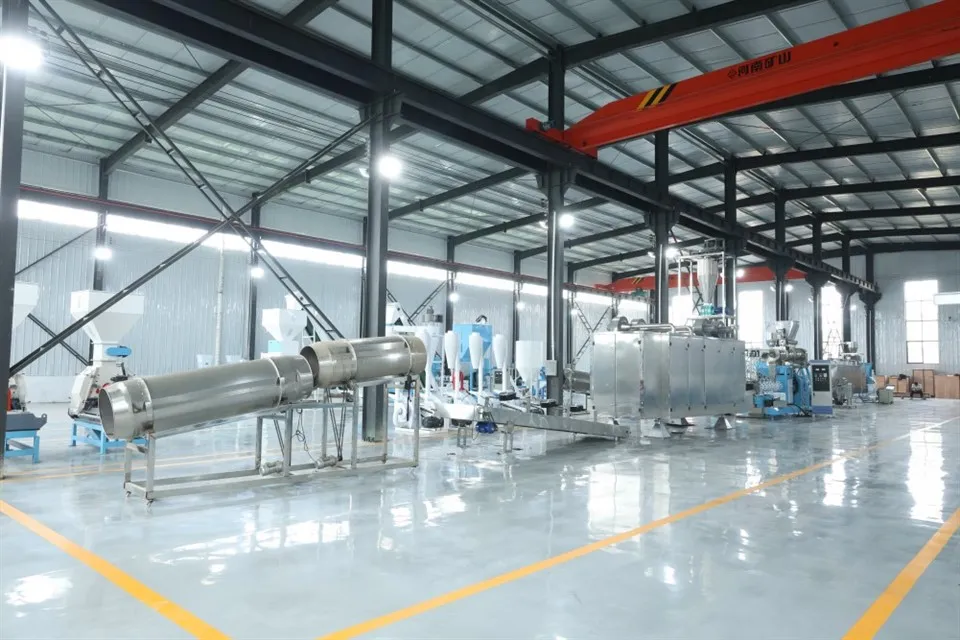
floating fish feed pellet making production line display
01
The 300-500kg/h Commercial Floating Fish Feed Line Unit by Unit
The 300-500kg/h commercial floating fish feed line runs nine driven stations in a fixed order, from a water-drop mill through mixing and feeding to extrusion, drying, coating, cooling with screening, lifting and bagging. The building sees one layout, one footprint and one set of chutes; the quotation simply states what each station draws at 300 kg/h and again at 500 kg/h. Five of the nine carry an identical drive at both ratings and drop out of the decision. Four change: the mixer, the barrel with its conditioner and cutter, the belt with its heater and fans, and the coater.
| Driven point | Model | 300 kg/h | 500 kg/h | Change |
|---|---|---|---|---|
| Crushing, water-drop mill | SFSP56X30 | 11 kW | 11 kW | none |
| Mixing, two-shaft paddle | SSHJ-0.5 / SSHJ-1.0 | 5.5 kW | 11 kW | batch and drive |
| Feeding, screw | KWX50YP | 1.5 kW | 1.5 kW | none |
| Extrusion, wet twin screw | 65 / 70 | 22 + 3.0 + 0.75 kW | 37 + 3.0 + 1.1 kW | barrel and cutter |
| Drying, mesh belt | 5 layers, 5 m / 5 layers, 8 m | 45 + 8.8 + 3 kW | 95 + 18 + 5.5 kW | heater and fans |
| Coating, drum | Single / Double | 5 kW | 6 kW | drum |
| Cooling and screening | LX-L550 | 8 kW | 8 kW | none |
| Lifting, bucket elevator | TDSG10-25 | 1.5 kW | 1.5 kW | none |
| Bagging, weighing | DCS-Z-W-50 | 4.5 kW | 4.5 kW | none |
| Listed drives | 119.55 kW | 203.1 kW | four rows |
Table 1: The nine driven points of the 300-500kg/h commercial floating fish feed line, and what each one does at the 300 and the 500 kg/h rating.
Read the two listing columns down the nine rows and the totals are 119.55 kW at 300 kg/h and 203.1 kW at 500 kg/h. The difference does not spread across nine units: it sits on four rows, and the other five show the same figure twice.
The same crushing, feeding and bagging logic runs through the full floating fish feed extruder range.
02
Front End at Either Rating from Mill to Feeder
Three stations prepare the mash before it reaches the barrel, and only one of them moves with the rating. Read in process order, the mill and the screw feeder are the same machines on both quotations. The mixer is the only front-end unit that grows, and it grows in batch size rather than in station count.
The 11 kW Mill and the Screen That Sets Particle Size
The mill is an 11 kW hammer crusher unit rated 1-2 t/h, and it is the same machine at 300 kg/h and at 500 kg/h. Against a 300 kg/h draw it carries the duty with room spare, and against a 500 kg/h draw it still sits inside its band, so particle size comes from the screen fitted in the mill rather than from running the motor flat out. A finer screen buys uniformity and costs throughput; a coarser one does the reverse.
That is why the screen is settled once, at order, and does not come up again when the output point changes. It is chosen against the pellet the farm sells and the raw material it buys, and the same screen then serves both ratings.

A 250 kg Batch at 300 kg/h and 1000 kg at 500
The mixer is where the front end changes, and it changes the crew's clock more than the machine. At 300 kg/h the mixer is a 5.5 kW two-shaft paddle unit on a 250 kg batch, and 250 kg covers just under an hour at that draw. The rhythm is one batch an hour. Drop a batch late and the barrel runs on the tail of the previous mix, which is where weight per bag starts to drift.
At 500 kg/h the same station is an 11 kW unit on a 1000 kg batch, which covers two hours. The rhythm is easier to hold and the consequence of a mistake is heavier: a blend fault at that batch size takes two hours of production to clear, and every bag inside those two hours carries it.
So the batch is a scheduling decision before it is a machine decision. One batch an hour suits a crew that can weigh and load on the hour. Two hours of buffer suits a crew that would rather change formula less often.
The third front-end station needs a paragraph rather than a section. A 1.5 kW screw feeder lifts mash from the mixer outlet into the conditioner, and it is the same unit on both quotations, so feed rate is set by screw speed working against the barrel's appetite and not by a larger motor at the higher rating. On either route the feeder is the unit that reports a mixer problem first: a starved barrel and a flooded conditioner both read here before they read anywhere else.

03
Back End at Either Rating from Barrel to Bagger
The barrel station is a wet twin-screw frame. At 300 kg/h the main motor is 22 kW, the conditioner 3.0 kW and the cutter 0.75 kW. At 500 kg/h the main motor is 37 kW, the conditioner stays at 3.0 kW and the cutter goes to 1.1 kW. Three drives are reported together because they are three separate items on three separate shafts, and the conditioner figure not moving is the tell: steam duty follows the formula, not the tonnage.

A Five-Layer Belt at 5 m and at 8 m
Both ratings run a five-layer mesh belt, and the layer count is the part that does not move. What moves is the length of each layer, 5 m at 300 kg/h against 8 m at 500 kg/h, with heating at 45 kW against 95 kW, fans at 8.8 kW against 18 kW and the belt drive at 3 kW against 5.5 kW.
More belt at the same layer count is more dwell at the same bed depth. The pellets cross the same number of decks at the same thickness and stay in the moving air longer, which is how a heavier throughput still lands on the 8-10% band at the outlet. Buying the higher rating therefore buys drying time rather than drying temperature, and a site that shortens the belt to save floor space gives that time back.

Single Drum and Double Drum on the Coater
The coater is a build change rather than a drive change. At 300 kg/h it is a single drum on 5 kW. At 500 kg/h it is a double drum on 6 kW. The extra kilowatt is not the point: the drum lengthens, so the pellets pass the oil spray over a longer shell, and the same oil volume spreads over more tonnage an hour without running wet at one end.
The oil goes on after the drier and before cooling, which is why the coater sits between the two. Water stability comes from the binder and from that coat, and a coat applied before the drier would be driven off with the moisture.
Three stations close the line and none of them changes. The cooler screener is an 8 kW unit passing 400-600 kg/h at both ratings. The bucket elevator is 1.5 kW at both. The bagger is a 4.5 kW weighing unit closing 200-300 bags an hour at both.
That last figure is worth holding on to. A wet week shows on the belt rather than at the bagger, because the bagger is sized past both ratings and the belt is sized against them.

04
What Changes at the 500 kg/h Rating
Four units move and five stay, and the whole of the difference between the two quotations sits on those four.
The mixer moves on buffer: a 250 kg batch becomes 1000 kg and the drive doubles, so the vessel takes four times the mash for twice the power. The barrel moves on bore, because bore is what sets throughput, and the cutter follows it because it cuts more strands a second. The drier moves on belt length, because drying time is bought in metres rather than in degrees. The coater moves on drum count, from a single drum to a double, for coat evenness at the higher tonnage.
The five that stay are the mill, the screw feeder, the cooler screener, the bucket elevator and the bagger. Each is sized for a band that brackets both ratings, which is why none of them appears twice in the order.
05
Is 300 kg/h or 500 kg/h the Right Output?
Three questions settle which rating to quote, and all three land on the same two units. The mixer decides how much mash is ready per batch, and the drier decides how much belt the pellets cross. Nothing else on the nine rows separates the two.
Shift Length and Bag Count Settle the Rating
The first question is how long the shift runs and how many bags it closes. The bagger cannot answer it. It is the same 4.5 kW unit at 200-300 bags an hour at both ratings, so it never argues for either. What separates them is whether one batch an hour is enough mash. A crew that can weigh and load on the hour holds 300 kg/h; a crew that wants two hours between formula changes is buying the larger mixer as much as the longer belt.
The second question is whether the belt stays on electrical heat or converts to a furnace later, because that decides the service the building needs. Heating is 45 kW at 300 kg/h and 95 kW at 500 kg/h, and it is the largest single change between the two ratings. Wiring a building for the lower figure and fitting the longer belt afterwards is the change that costs the most to undo.
The third question is whether the rated output holds in the wettest week. The belt is sized against a throughput and a moisture together, so a rating picked in a dry week leaves nothing for a wet one. Four rows of Table 1 are the ones that answer all three, and they are the four that carry a change.
Choosing between the two ratings
The five units that carry an identical drive cannot decide it, and the screener is the clearest case. It passes 400-600 kg/h on 8 kW at both ratings, so it never argues for either.
06
Pellet Sizes and the 8-10% Moisture Target
The rating decides how much the line makes; the die decides the shape it makes. The order is quoted around five hole sizes rather than one, because a farm buys this line for a grow-out cycle and not for a single grade. Below they run from the smallest to the largest, with the stock each one feeds and the way the die is bought.
| Die hole | Pellet diameter | What it feeds | Die supplied |
|---|---|---|---|
| 1.5 mm | 1.5 mm | first feeding fry | one die per size |
| 2 mm | 2 mm | fry and fingerling | one die per size |
| 3 mm | 3 mm | advanced fingerling | one die per size |
| 4.5 mm | 4.5 mm | grow-out | one die per size |
| 6 mm | 6 mm | finisher | one die per size |
Table 2: The five die hole sizes on this line, each bought as its own die.

Each size is a die, not a setting. The die changes as a set and the cutter is repositioned against it, so the change takes a stop. Five sizes mean five dies, and the cutter is set against the largest hole in the order.
Final moisture is held at 8-10% and read twice: at the drier outlet and after the cooler. A pellet inside the band at the outlet that climbs after the cooler has taken water back, and that points at belt speed rather than at the heater. Water stability comes from the binder and from the oil applied after expansion.
07
Wet Twin-Screw and Wet Single-Screw Barrels Compared
The die sets the pellet; the barrel decides how hard the mash is pushed through it. Both series are wet extrusion frames, and both are sold as the barrel station of the same line. The twin-screw series runs six frames from 0.3 to 2.0 T/H and publishes three drives on every row: the main motor, the conditioner and the cutter. The single-screw series runs eight frames from 0.3-0.4 to 4-5 T/H and publishes the main motor with the screw diameter and the machine weight.
A 300 kg/h duty reads the first row of either series. A 500 kg/h duty reads the second row of either series. The two tables below are the whole of what the catalogue gives on each, and they are read side by side rather than merged, because a merged table would carry columns that one series never published.
| Model | Capacity | Main motor | Conditioner | Cutter |
|---|---|---|---|---|
| 65 | 0.3 T/H | 22 kW | 3.0 kW | 0.75 kW |
| 70 | 0.5 T/H | 37 kW | 3.0 kW | 1.1 kW |
| 80 | 0.8 T/H | 55 kW | 5.5 kW | 1.5 kW |
| 85 | 1.0 T/H | 75 kW | 7.5 kW | 2.2 kW |
| 90 | 1.5 T/H | 90 kW | 11 kW | 3.0 kW |
| 120 | 2.0 T/H | 110 kW | 15 kW | 3.0 kW |
Table 3: The six wet twin-screw frames in the series.


| Model | Capacity | Main motor | Screw diameter | Weight |
|---|---|---|---|---|
| 75-B | 0.3-0.4 T/H | 22 kW | dia. 80 mm | 1000 kg |
| 85-B | 0.5-0.6 T/H | 30 kW | dia. 90 mm | 2000 kg |
| 90-B | 0.6-0.7 T/H | 37 kW | dia. 100 mm | 2100 kg |
| 100-B | 0.7-0.8 T/H | 55 kW | dia. 120 mm | 2200 kg |
| 135-B | 1-1.5 T/H | 75 kW | dia. 135 mm | 3200 kg |
| 145-B | 2-3 T/H | 90 kW | dia. 145 mm | 4000 kg |
| 160-B | 3-4 T/H | 110 kW | dia. 160 mm | 4500 kg |
| 175-B | 4-5 T/H | 132 kW | dia. 175 mm | 5000 kg |
Table 4: The eight wet single-screw frames in the series.

Reading the Two Series Tables Side by Side
The two tables record different things, and that is the whole of the difficulty. The twin-screw rows are written to describe a complete extrusion station: what the main motor draws, and what the conditioner and the cutter add to it. The single-screw rows are written to describe the barrel itself: what the main motor draws, what screw diameter runs inside it, and what the machine weighs for shipping.
Adding a twin-screw row across and setting the total against a single-screw main motor is therefore the one arithmetic this page rules out. Those two figures are not totals of the same items. The comparison that holds is main motor against main motor, at the same rating.
Why Both Series Need Steam Conditioning
Neither series is a dry extruder. The single-screw series is published as needing steam conditioning so the raw material cooks through and the starch gelatinises, with a single-layer or a double-layer conditioner offered with the frame. The twin-screw series carries a conditioner drive on every row of its table.
The difference between the two is the number of screws and the way they convey, not whether conditioning happens. Both gelatinise starch, both cut pellets at the die face, and both are quoted with a conditioner and a cutter in the station. A buyer who reads the short single-screw row as a machine without those two units is reading a column list, not a bill of parts.
Where a Twin-Screw Barrel Still Wins
The twin-screw frame earns its place on difficult formulas. Two intermeshing screws clean each other as they turn and convey with more efficiency than one, which suits mixes that are high in oil and fat or high in viscosity, where one shaft lets the mash slip against the barrel wall.
The frame also carries a steam manifold and sliding rails, so the barrel pulls forward for inspection and a formula change takes a shorter stop. On a plain floating feed at 300 or 500 kg/h a single-screw frame will hold the duty; the wet twin-screw floating fish feed extruder is bought for the formula, not for the tonnage.
08
Replacing the Twin-Screw Barrel with a Single-Screw Frame
The extrusion station is replaced and the other eight driven points stay where they are. The hammer mill, the two-shaft paddle mixer, the screw feeder, the mesh belt drier, the oil coater, the cooler screener, the bucket elevator, the bagger and the control cabinet are ordered exactly as they stood. Nothing upstream or downstream changes its drive, its footprint or its rate.
Choosing the Frame by Output Rating
The frame is picked by the output rating, not by the barrel that came before it. A 300 kg/h duty takes the row rated 0.3-0.4 T/H, and a 500 kg/h duty takes the row rated 0.5-0.6 T/H. Those are two machines and not two settings of one.
The 0.3-0.4 T/H frame cannot be run up to 500 kg/h by lifting screw speed. Its barrel, die area and drive are sized for the lower band, and pushing past it takes the moisture band and the pellet surface before it takes anything else. Stepping one row up is the only route that holds both.
The conditioner and the cutter travel with the frame. The single-screw series is published with steam conditioning as a condition of the duty, and the conditioner is offered in single-layer or double-layer form alongside it, so both items are ordered with the frame rather than left behind on the twin-screw row. In the twin-screw table they sit on the same line as the main motor; on a single-screw order they are separate items on the same quotation.
A change of main motor is a change at the cabinet. At 500 kg/h the main motor falls from 37 kW to 30 kW, so the contactor, the thermal overload and the incoming branch to that motor are re-sized to the new current at 60 Hz. At 300 kg/h the main motor is 22 kW on both frames and that branch stays exactly as drawn.
The die set does not move either. The five dies in the order serve a twin-screw barrel and a single-screw frame at the same output, so a frame swap neither adds a die nor retires one.
09
Lower Motor Draw and Fewer Rotating Parts
The electrical account is where a frame swap is most often misjudged, and the difference is smaller than most buyers expect. At 300 kg/h there is none at all. Both frames at that rating carry a 22 kW main motor, so a swap leaves the line at 119.55 kW of listed drives with not one kilowatt removed. This is the first thing to settle, because the assumption that a single screw must draw less is what sends a buyer to the wrong rating.
Where the 7 kW Comes From
At 500 kg/h the main motor falls from 37 kW to 30 kW, a 7 kW difference, and the line falls with it from 203.1 kW to 196.1 kW. Table 5 puts the two ratings side by side.
| Line rating | Twin-screw main motor | Single-screw main motor | Main motor difference | Line total, twin screw | Line total, single screw |
|---|---|---|---|---|---|
| 300 kg/h | 22 kW | 22 kW | none | 119.55 kW | 119.55 kW |
| 500 kg/h | 37 kW | 30 kW | 7 kW | 203.1 kW | 196.1 kW |
Table 5: Main motor and listed line total on each frame type, by line rating.
Where the saving actually sits
A swap at 300 kg/h removes nothing from the electrical total, because the main motor is 22 kW on both frames. The 7 kW appears only at 500 kg/h and comes entirely off the barrel; the 3.0 kW conditioner and the 0.75 / 1.1 kW cutter are fitted on both routes and never enter the difference.
Counting Rotating Parts by Family
The clearer difference is in parts, not in kilowatts. A twin-screw barrel turns two shafts, each with its own liner and bearing set, and the pair is held in step by a timing gear set. A single-screw frame turns one shaft with one liner and one bearing set. In the spares store the effect is arithmetic rather than argumentative: half the number of like parts to hold, half the number to identify at a rebuild.
| Part family | Twin-screw frame | Single-screw frame |
|---|---|---|
| Screw shafts | 2 | 1 |
| Barrel liners | 2 | 1 |
| Bearing sets | 2 | 1 |
| Timing gear sets | 1 | none |
Table 6: Rotating parts by family on the two frame types.
Weight is published on the single-screw side only: 1000 kg on the 300 kg/h row with a dia. 80 mm screw, 2000 kg on the 500 kg/h row with a dia. 90 mm screw. Table 3 carries capacity, main motor, conditioner and cutter, and no weight column, so this page does not set the two frame types against each other on mass. A shipping plan for a twin-screw frame is built from the packed weight taken at crating, which is the figure the packing list carries.
10
What Changes for the Operator on a single screw fish feed extruder machine
What the drive list does not show is the four jobs that move from the second shaft onto the crew. Each lands on a specific action at a specific point on the line, with a check the operator can run on the round.
Holding Feed Moisture and Rate by Hand
Moisture is the first. One shaft pushes the mash forward; with two shafts the Twin-Screw floating fish feed extruder machine carries part of the load and forgives a wetter mix. On a single screw floating fish feed pellet machine the feed moisture is held at the dry end of the band the formula allows, and it is checked at the mixer rather than corrected at the die, because by the die the pellet skin has already been set.
Feeder rate is the second. A single screw fish feed processing machine has less conveying margin, so a slug of mash that arrives unevenly reads at the die mouth within seconds, as a change in pellet diameter or a burst of fines. The two checks that catch it first are the level in the feed bin and the speed of the screw feeder, and both are watched on the round rather than at the end of the shift.
Expansion, Die Wear and Formula Changes
Expansion is bought with restriction instead of shaft speed. One shaft develops less shear than two, so the same formula runs at a lower expansion on a single-screw frame. To bring it back, the die holes are tightened and the dwell is lengthened, and both put more load on the die plate: the 1.5 mm die is the hardest of the five to hold and its wear shows first.
A formula change takes a stop. In a twin-screw barrel the two screws wipe each other and the barrel wall as they turn, so sticky mash does not settle on one side. A single screw floating fish feed machine leaves a film on the wall away from the flight, and that film carries into the next formula unless the barrel is opened and cleaned. Put the cleaning into the changeover plan rather than finding it in the first bag. Where those four jobs suit the crew, the wet single-screw floating fish feed machine holds the duty at either rating.
11
Why Does the Drier Take 37.6% of the Line's Power?
Nothing above shows where the electrical weight actually sits. Inside the 119.55 kW rating, 45 kW of resistance heating on the belt is 37.6% of everything the line lists, which is why the incoming service is sized on the drier and not on the extruder. One row outweighs the extrusion station and the mixing station together, so when a site's available capacity looks tight the belt is the row to check first.
The rest of the drier is mechanical: 8.8 kW of fans and a 3 kW belt drive. Fit a hot air furnace to the same belt and the heating leaves the electrical account, leaving 11.8 kW on it, while layers and dwell stay as they were. Fans and a belt drive run whenever the belt runs, and a service sized for the electric version carries that pair with room to spare.
Two consequences follow. Cable and transformer allowance to the drier are sized for the heater and shrink with it, and the decision belongs before the building is wired, because a furnace needs a flue, a fuel store and a footprint beside the belt.
The drier inside the electrical figure
The 45 kW heater is 37.6% of the 119.55 kW rating. On furnace heat, 11.8 kW of fans and belt drive stays electrical and evaporation moves to a separate account.
12
Site Utilities for a 60 Hz Line in Colombia
The electrical side is only part of what a site has to supply. Colombia runs a 60 Hz grid, so every motor on this line is wound for 60 Hz at order, and a 50 Hz winding on a 60 Hz supply runs 20% faster, lifting screw and cutter speed together.
Shear and expansion move with that extra speed, so a floating pellet set up on a 50 Hz machine no longer matches its own specification.
Steam is used at the conditioner and nowhere else, at the 2.2 bar class the steam-heated multi-layer drier in the same catalogue is built to; the boiler is a site item. Water is a cleaning utility, drawn at the mixer, the coater and the floor points. Compressed air has one number: the bagger takes 0.6-0.8 MPa at 0.2 Nm3/min.
13
The Factory Acceptance Test Before Shipment
Everything above is settled on paper, and seven results settle it on the test bed. The test runs a stand-in formula, not the formula the buyer will produce. Capacity is weighed over a timed stretch of belt, pellet size is checked against the die fitted, and moisture is read at the outlet and again after the cooler.
Buoyancy is a float test watched over time rather than at the moment of dropping, because a pellet that floats for a minute and sinks after ten has failed. Bulk density is weighed on a fixed volume, fines are screened and weighed against the sample, and stability is a soak test. The report travels with the shipment, so the site can repeat the seven checks against the same stand-in.
Packing is per machine. A single-screw frame ships at 1000 kg at 300 kg/h and 2000 kg at 500 kg/h. Twin-screw frames carry no published weight and are weighed when packed. To start the exchange, send the site voltage and the output point.
14
Questions Buyers Ask Before Ordering
1
Can the 300-500kg/h commercial floating fish feed line run on 60 Hz power?
Yes, and it is built for 60 Hz rather than adapted. A 50 Hz winding on a 60 Hz supply runs 20% faster, lifting screw and cutter speed together and moving shear and expansion.
2
Can the line at 300 kg/h take a Wet-type single screw fish feed extruder machine instead of the twin-screw barrel?
Yes. At that output the main motor is 22 kW on both frames, and the single-screw frame is published with a dia. 80 mm screw at 1000 kg. The conditioner and the cutter are supplied with the frame rather than dropped from it.
3
How much power does the single-screw substitution save?
Nothing at 300 kg/h, where both frames carry a 22 kW main motor and the line stays at 119.55 kW. At 500 kg/h the main motor falls from 37 kW to 30 kW, so the line falls from 203.1 kW to 196.1 kW, a 7 kW difference. The conditioner and the cutter are fitted on both routes and do not enter the difference.
4
How is 8-10% final moisture held at 1.5 mm and at 6 mm?
By belt speed and bed depth, with moisture read at the outlet and after cooling. The die and cutter change with hole size; the moisture target does not.
5
Can a hot air furnace replace the 45 kW heater on the mesh belt?
Yes. The heater is 37.6% of the 119.55 kW rating. On furnace heat, 11.8 kW of fans and belt drive stays electrical and evaporation moves to fuel.
6
What does the factory acceptance test check on floating pellets?
Seven results: capacity, pellet size, moisture, buoyancy, bulk density, fines and stability, all on a stand-in formula.
7
Which dies and cutters cover 1.5, 2, 3, 4.5 and 6 mm?
Five hole sizes mean five dies, one per size. The cutter is set against the largest size and repositioned as hole size drops.
Start from the site data rather than from a rating. Four items settle the configuration: line voltage and frequency, the floor space the building offers, the moisture of the raw material going into the mixer, and the tonnage the line has to hold through a shift. Send those and the reply is two configurations with the drive list, the belt sizing and the test plan attached to each.
Hot Tags: 300-500kg/H Commercial Floating Fish Feed Line For Colombia, China 300-500kg/H Commercial Floating Fish Feed Line For Colombia manufacturers, suppliers, factory, industrial fish pellet shaping machine, aquaculture feed production machine, automatic fish feed processing machine, commercial fish pellet making equipment, fish feed extrusion equipment, fish feed processing machine
Send Inquiry
You Might Also Like

