


Wholesale Price Fishing Pellet Making Floating Fish Shrimp Feed Pellet Machine
Leave a message
Product introduction
The working principle of fish feed extruder:
The feed extruder matures the feed through screw extrusion, and the volume becomes larger. After it is fully cooked, it kills some harmful bacteria in the material and produces a certain fragrance. The feed floats on the water surface and does not disperse for 12 hours, which is convenient for fish. When eating, it avoids the waste of feed, which is more economical. After the fish eats, it is easy to digest and gain weight quickly

What material can be used in the floating fish feed pellet machine
1.The floating fish feed pellet machine is a necessary tool for modern fish farming. It is designed to produce high-quality fish feed pellets that float on water for easy feeding. There are various materials that can be used in the production of fish feed pellets.
2.Fish feed pellets are commonly made from fish meal, soybean meal, corn meal, rice bran, wheat bran, and other cereal grains. The proportions of these materials depend on the type of fish being raised, their size, and nutritional requirements. Fish meal and soybean meal are rich in protein and essential amino acids, making them an ideal choice for fish feed production. Corn and rice bran are good sources of carbohydrates and fiber, which are important for energy and digestion.
3.Apart from these primary materials, the fish feed pellet machine requires binding agents to hold the pellets together. These binding agents include gelatin, starch, and other hydrocolloids. They ensure that the pellets hold their shape and do not disintegrate in water.
4.The floating fish feed pellet machine can also use a range of additives such as vitamins, minerals, and amino acids to provide a complete and balanced diet for fish. These additives can boost the nutritional value of fish feed pellets and improve fish growth and development.
Product parameters
|
Model (Electric) |
Capacity (kg/h) |
Main power |
Cutting blade power |
Cutting power |
Modulator power |
|---|---|---|---|---|---|
|
65 |
250-300 |
22KW |
1.5KW |
1.5KW |
3KW |
|
70 |
500-600 |
45KW |
1.5KW |
1.5KW |
3KW |
|
75 |
800-1000 |
55KW |
1.5KW |
1.5KW |
3KW |
|
85 |
1200-1500 |
90KW |
3KW |
2.2KW |
5.5KW |
|
95 |
2000-2500 |
110KW |
3KW |
3KW |
11KW |
|
120 |
3000-4000 |
160KW |
5.5KW |
3KW |
15+7.5KW |
|
136 |
5000-6000 |
200KW |
7.5KW |
5.5KW |
22+7.5KW |
Product advantages
Compared to traditional powdered feed, pelleted feed from the aquatic feed pellet production line offers superior storage and transport properties. Pellets have a compact structure, are less susceptible to moisture absorption, agglomeration, and oxidation deterioration. Under standard storage conditions (temperature 20-25°C, humidity below 60%), the shelf life can be extended to 3-6 months, significantly longer than the 1-2 months of powdered feed. Furthermore, pelleted feed has a high density (approximately 1.2-1.4g/cm³) and weighs more per unit volume, reducing packaging material usage (e.g., woven bags by 20%-30%) and storage space requirements (increasing storage efficiency by over 40%). During transportation, pelleted feed is dust-free, minimizing raw material loss, simplifying vehicle cleaning, and lowering logistics costs. This makes it particularly suitable for long-distance transportation, supporting feed companies in expanding their market reach.
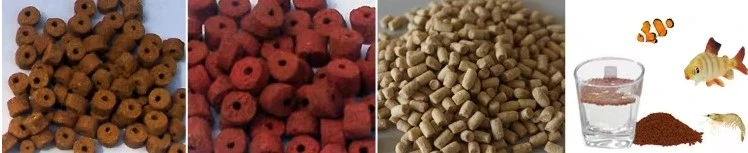
Finished product display


FAQ
1. What is the price of the fish feed pellet production line?
The price ranges from approximately US$12,999.00
2. Do you provide maintenance services for your customers?
Yes, we offer comprehensive after-sales maintenance services to our customers.
For more information on process flow design, equipment layout, factory construction plans, individual equipment pricing, or turnkey project proposals, please feel free to contact us!!!


