


200-400 kg/h Fish Feed Production Line
This 200–400 kg/h floating fish feed production line features a 13-step process from crusher to finished bin. Centered on a steam conditioner and wet single-screw extruder, it produces uniform fish feed pellets.
Description
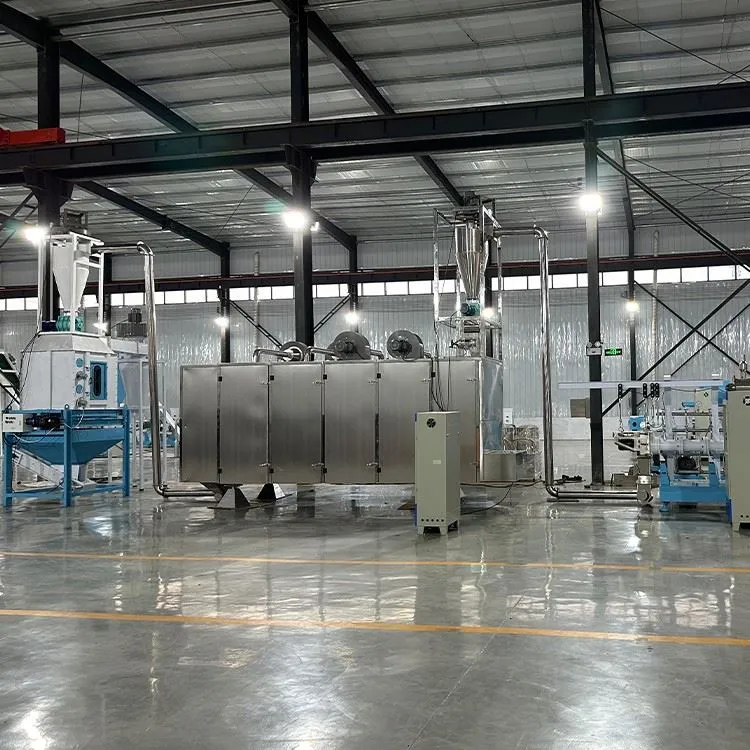
1–2 T/H Wet-type single screw floating fish feed pellet production line test
01What Does a 200-400 kg/h Fish Feed Production Line With Steam Conditioning Include?
Steam conditioning turns a 200-400 kg/h fish feed production line into a continuous train rather than a single machine. Material is crushed, conveyed and fed into a conditioner where steam and water raise its temperature and moisture, then into a wet single-screw extruder that cooks and forms the pellet. The wet pellet is dried, polished, cooled and finally stored in a finished product bin.
Amor Hadji's inquiry from Algeria named the steam conditioning step explicitly, asked for the dryer, and then asked for the utilities. That order of questions is telling: the buyer already knows the process and wants the engineering envelope - how much steam, how much power, how much water - before talking price.
The conditioning, extrusion, drying and cooling train

| Item | Value |
|---|---|
| Production efficiency | 200-800 kg/h |
| Total power | 86-152 kW |
| Footprint | 25*3*6 m |
| Operators | 2-3 |
| Transport | 40 ft container |
| Pellet diameter | 1-12 mm |
At 200-400 kg/h you are running the lower band of the 200-800 kg/h configuration.
Why steam conditioning defines this build
The conditioner is what separates this line from a dry extrusion plant. Adding steam before the extruder does three things at once. It pre-gels the starch, so the extruder has less work to do. It lubricates the mash, so it flows more evenly through the barrel. It lifts pellet durability, so fewer pellets break in handling. A dry line can make acceptable feed; a conditioned line makes feed that survives the trip to the pond.
Curious how a conditioned line compares with a dry one for your species? Send us your target species and pellet size and we will set out the two routes side by side.
02How Does Steam Conditioning Change Fish Feed Quality at 200-400 kg/h?
Steam conditioning is a retention process. Mash passes through the conditioner and spends a controlled time in contact with steam, during which heat and moisture penetrate the particles. The result is a mash that is partly cooked before it ever reaches the extruder barrel, which changes how the extruder behaves.
Reference: Wageningen research on steam conditioning and pellet quality
Heat, moisture and retention time in the conditioner
Three variables define conditioning: steam temperature, the moisture the mash picks up, and how long it stays in the conditioner. Too little retention and the mash arrives dry and under-cooked, forcing the extruder to do work that the conditioner should have done. Too much and the mash becomes sticky, which causes bridging and uneven feed to the barrel. The operator's job is to hold all three in balance, and the extruder then converts that conditioned mash into a consistent pellet.
Single-layer versus double-layer conditioners
Our steam-conditioned extruders are available with a single or a double-layer conditioner. A double-layer conditioner gives a longer retention path in the same floor space, which suits higher fat and higher inclusion recipes where even moisture distribution matters more. A single-layer unit is simpler and sufficient for straightforward recipes. The smallest wet single-screw in our range carries a double-layer conditioner at 1.5 plus 1.5 kW, which shows the option is available even at the low end.
Where a plant wants to push cook further again, an expander sits between the conditioner and the extruder. The aquafeed expander build explains where that step earns its place.
03Which Steam-Conditioned Extruder Covers the 200-400 kg/h Band?
For this capacity, a wet single-screw extruder with steam conditioning is the standard choice. The range runs from the small unit upward:
Reference: Purdue study on steam conditioning and pellet quality
| Model | Output | Main motor | Feeder | Cutter |
|---|---|---|---|---|
| 85-B | 0.3-0.5 t/h | 30 kW | 0.75 kW | 0.75 kW |
| 90-B | 0.5-0.6 t/h | 37 kW | 1.5 kW | 2.2 kW |
| 100-B | 0.6-0.8 t/h | 55 kW | 1.5 kW | 2.2 kW |
| 135-B | 1.2-1.5 t/h | 90 kW | 2.2 kW | 3 kW |
| 145-B | 2.0-2.5 t/h | 110 kW | 2.2 kW | 3 kW |
| 160-B | 3.0-4.0 t/h | 160 kW | 3 kW | 5.5 kW |
| 175-B | to be confirmed | 200 kW | 3 kW | 7.5 kW |
| Conditioner | Barrel |
|---|---|
| 1.5+1.5 kW (double layer) | 5 sections |
| 5.5 kW | 5 sections |
| 7.5 kW | 5 sections |
| 11 kW | 6 sections |
| 15 kW | 6 sections |
| 18 kW | 6 sections |
| 22 kW | 6 sections |
The output for the largest model is confirmed on the factory technical confirmation sheet.


Wet single-screw classes near 0.3-0.5 t/h
The smallest unit, rated 0.3-0.5 t/h on a 30 kW main motor, is the machine that covers a 200-400 kg/h line. Note the arithmetic: 0.3-0.5 t/h is 300-500 kg/h. A 200 kg/h operating point therefore runs at the bottom of that band, and the 200-400 kg/h range is met by holding the machine at its lower settings. We confirm the exact configuration and any capacity adjustment on the technical confirmation sheet rather than claim the machine delivers 200 kg/h straight out of the box.
When a twin-screw barrel becomes necessary
A twin-screw barrel becomes necessary when the recipe carries a lot of fat or moisture. It is also needed when the product needs very tight batch consistency, or when a single screw cannot hold the expansion needed for a particular floating pellet. The twin-screw range:
| Model | Output | Main motor | Cutter | Feed | Conditioner |
|---|---|---|---|---|---|
| 65 type | 250-300 kg/h | 22 kW | 1.5 kW | 1.5 kW | 3 kW |
| 70 type | 500-600 kg/h | 45 kW | 1.5 kW | 1.5 kW | 3 kW |
| 85 type | 1200-1500 kg/h | 90 kW | 3 kW | 2.2 kW | 5.5 kW |
| 95 type | 2000-2500 kg/h | 110 kW | 3 kW | 3 kW | 11 kW |
| 120 type | 3000-4000 kg/h | 160 kW | 5.5 kW | 3 kW | 15+7.5 kW |
Motor ratings for a given twin-screw type are confirmed on the factory technical confirmation sheet, because the same nominal size can be built to more than one drive specification. For a straight comparison of the wet single-screw and twin-screw routes, see aquaculture feed pellet extruder.


04How Do Steam, Electric and Water Utilities Balance a 200-400 kg/h Line?
You asked for the utility requirements, and they are three separate accounts. Treating them as one number is the most common source of budget surprises on a conditioned line.
Steam demand and the customer-supplied boiler
The steam boiler is supplied by the customer, not by us. That is a deliberate arrangement: boiler sizing and fuel choice depend on your site, your local fuel prices and your steam distribution, and a boiler is a locally sourced item almost everywhere. The line's steam demand follows the conditioner rating. The smallest wet single-screw conditioner draws 1.5 plus 1.5 kW as a double-layer unit. The rating then rises through 5.5 kW and 7.5 kW on the mid-range machines and 11 to 22 kW further up the range. We confirm the steam flow and pressure your boiler must deliver on the factory technical confirmation sheet, so your boiler supplier can size against a real figure.
Installed electrical load and water for conditioning
Line power for the 200-800 kg/h configuration is published as 86-152 kW total, with a 200-400 kg/h operation sitting at the lower end of that band. The electrical load is the sum of the drive motors across the 13 stages: the extruder main motor, the conditioner drives, the crusher, the air conveyors, the dryer drives, the granulator and the cooler. The per-machine figures are in the tables above. Water for conditioning is a process input rather than a fixed utility figure. It follows the moisture you want in the mash and the incoming moisture of your raw materials, so it is confirmed per project alongside the steam data. The utility sheet is what your plant engineer needs first, so Send us your steam pressure and site supply and we will return the steam, power and water figures with the quotation.
05Which Dryer Handles the Wet Output of a Steam-Conditioned Line?
Conditioned pellets leave the extruder wetter and denser than dry-line pellets, so the dryer has to be sized for that reality rather than for the finished rate. Our multi-layer steam dryers pass pellets down stacked trays, turning them as they fall:
| Model | Batch capacity | Drive | Note |
|---|---|---|---|
| LX-Z5-5-1 | 150-200 kg | 4 kW | Multi-layer steam dryer, 4 layers, 2.2 bar |
| LX-Z5-8-1 | 1500-2000 kg | 7.5 kW | Multi-layer steam dryer, 6 layers |
| LX-Z5-10-1 | 2500-6000 kg | 11 kW | Multi-layer steam dryer, 8 layers |
Multi-layer dryer capacities are production figures and are confirmed per order on the factory technical data sheet.
Multi-layer steam oven versus airflow drying
A multi-layer steam oven gives even, controllable drying and suits batch and semi-continuous operation, which is why it is the usual partner to a conditioned line. Airflow dryers are the alternative. A 219 unit with a 4 kW drive and a bend, a 325 unit with a 7.5 kW drive and three bends, or a 400 unit with a 7.5 kW drive and four bends, occupying 7.5*1.5*3 m up to 17*1.5*3.5 m respectively. Airflow suits longer continuous runs; the oven suits tighter moisture control.
Matching dryer throughput to 200-400 kg/h
Dryer sizing follows wet output, not finished tonnage. Wet pellets are heavier and need more dwell time, so a dryer matched to the dry rate will always fall behind. If in doubt, choose the larger unit and run it below capacity - the cost difference is small next to the cost of a line that waits on drying.
06Which Dies and Pellet Sizes Suit Steam-Conditioned Fish Feed?
Dies decide the product, and on a wet line they work alongside the conditioner rather than in place of it.
Sinking and floating pellet dies
Floating feed needs a die and setting combination that lets the conditioned pellet expand; sinking feed needs one that restrains expansion and produces a dense pellet. Both come off the same extruder. On a conditioned line the expansion window is wider than on a dry line, because the pre-cooked mash expands more predictably. That is one of the reasons a conditioned line is chosen when floating feed quality matters.

Die changeover on a wet line
On a wet line, die changeover is a planned stop that also involves re-stabilising the conditioner, since the mash state has to be re-established after a break in flow. Plan die changes at shift boundaries rather than mid-run.
07How Do Cooling and Conveying Close a 200-400 kg/h Aquaculture Feed Pellet Production Line?
The last stages of the train are unglamorous and easy to under-buy. After drying, pellets are polished, conveyed, cooled and dropped into the finished product bin.
Counterflow cooling for conditioned pellets
Counterflow coolers pass pellets downward against rising air, which cools them evenly and reduces cracking. Units suited to this scale include a 1-2 t/h cooler on 1.5 kW, a 2-4 t/h unit, and a 1000-3000 kg/h counterflow cooler drawing 5.5 kW plus a 2.1 kW fan. On a conditioned line, cooling matters more than on a dry line because the denser pellet holds heat longer.
Conveying wet and dry product
The line uses air conveying between the extruder, dryer, granulator and cooler, because air conveying moves wet, sticky product without the build-up that a mechanical conveyor suffers. Conveyor selection across the train determines how often the line has to be cleaned, which is a running-cost decision rather than a capital one. If you want to see how this train is applied to a specific production setting, the aquatic feed extruder line build covers the same process applied to pond-fish production.
08How Are the 200-400 kg/h Fully automatic feed puffing production line's Machines Specified in One Table?
The line, in one place:
| Item | Specification |
|---|---|
| Capacity band | 200-800 kg/h, with 200-400 kg/h as the lower operating band |
| Total power | 86-152 kW |
| Footprint | 25*3*6 m |
| Operators | 2-3 |
| Transport | 40 ft container |
| Extruder | Steam-conditioned wet single-screw, 0.3-0.5 t/h on 30 kW and upward |
| Conditioner | Single or double-layer; 1.5+1.5 kW on the smallest unit |
| Dryer | Multi-layer steam dryer, 150-200 kg to 2500-6000 kg per batch; airflow alternative |
| Cooling | 1-2 t/h to 1000-3000 kg/h counterflow |
| Pellet diameter | 1-12 mm |
| Steam boiler | Customer-supplied; demand confirmed on the factory technical confirmation sheet |
09Which Raw Materials and Fish Species Fit a 200-400 kg/h Steamed Fish Feed Line?
A line at this scale suits a pond or cage farm that makes its own feed, or a small regional feed business supplying several farms. Typical raw materials are maize, wheat, soybean meal, fishmeal, rapeseed cake, rice bran and vitamin or mineral premix, plus local protein sources where they are available and affordable.
Species fit follows pellet size and recipe rather than the machine:
- Tilapia, carp and catfish at 2-4 mm for juveniles and 4-6 mm for grow-out.
- Trout and other cold-water species at smaller diameters and higher protein inclusion.
- Shrimp and prawn feed where a finer, denser pellet is required.
- Pond polyculture where one formulation serves several species.
A conditioned line is particularly useful where pellet durability matters, such as cage farming, where feed is handled repeatedly before it reaches the fish. For a view of the same equipment applied to pond production, see fish feed production line for pond fish. Our floating fish feed extruder line covers the floating-feed version of this build in more detail.


10What Advantages Does a Steam-Conditioned 200-400 kg/h Extruded Aquatic Feed Pellet Production Line Bring a Feed Factory?
- Better pellet durability - pre-conditioning means fewer pellets break in handling and transport.
- Improved digestibility - starch is partly gelatinised before extrusion.
- Wider recipe window - the conditioner tolerates higher fat and moisture than a dry line.
- Consistent output - conditioned mash feeds the extruder more evenly than dry mash.
- Flexible product - floating and sinking feed from one extruder via die changeover.
- Modest footprint - 25*3*6 m with 2-3 operators, shipping in a 40 ft container.
Where the plant later wants the process run under tighter automatic control, the highly automated feed extruder build shows what is added. What changes when the same process is scaled up is covered by large extruder fish feed.
11Customer Requirements Addressed: The Algeria 200-400 kg/h Inquiry, Item by Item
Point 1-2: the 200-400 kg/h capacity and the steam-conditioned extruder
Your target of 200-400 kg/h sits inside the 200-800 kg/h configuration as its lower operating band. The steam-conditioned extruder for this duty is the wet single-screw class rated 0.3-0.5 t/h on a 30 kW main motor, with a single or double-layer conditioner. Because 0.3-0.5 t/h is 300-500 kg/h, a 200-400 kg/h operation runs at the low end of the machine's band, and we confirm the exact configuration in the technical annex to the offer.
Point 3: the dryer for wet conditioned pellets
The dryer for conditioned wet output is a multi-layer steam dryer. It is available from 150-200 kg per batch on a 4 kW drive up to 2500-6000 kg per batch on 11 kW, with airflow drying as the alternative for longer continuous runs. Dryer sizing follows wet output rather than finished tonnage.
Point 4-5: quotation and per-machine technical specifications
We price the line item by item, delivered on an EXW or FOB basis, and CIF is quoted on request. Per-machine specifications - main motor, feeder, cutter, conditioner and barrel sections for the extruders, plus dryer and cooler ratings - are in the tables on this page.
Point 6: steam, electric and water utility requirements
Three accounts, answered separately. Steam: the boiler is customer-supplied, and the line's steam demand follows the conditioner rating, from 1.5+1.5 kW on the smallest double-layer unit upward. The steam flow and pressure your boiler must deliver are confirmed on the factory technical confirmation sheet. Electric: total line power for the 200-800 kg/h configuration is 86-152 kW, with 200-400 kg/h at the lower end of that band, and per-machine motors in the tables. Water: a process input set by your target mash moisture and your raw material moisture, confirmed per project.
Point 7: delivery lead time after order
The lead time starts at the deposit and the confirmed technical sheet, and the exact schedule is attached to the offer. Because the line ships in a 40 ft container, plan your port and inland movement before the equipment is released.
Ready to get the utility sheet for your site? Send your target species, pellet size and site utilities and we will return the itemised quotation with the steam, power and water figures.
12How Are Installation, Commissioning and Delivery Handled for Algeria?
Commissioning a conditioned line is where the process settings get established, so it matters more than it does on a dry plant. The extruder and conditioner are run together, and the conditioner's steam, moisture and retention settings are tuned against your actual raw materials until the pellets hold the durability and size you specified. That commissioning period is also where the line's real output is verified against the capacity you ordered.
Delivery runs from deposit and technical confirmation. Because the boiler is customer-supplied, its installation and steam connection have to be ready before commissioning begins. That boundary item sits on the buyer's side on a conditioned line, and it is the most common cause of a delayed start. We recommend agreeing a spares package at order stage covering dies, cutter blades and the conditioner's wear parts.
13FAQ: Steam-Conditioned Line Quotation, Utilities and EXW/FOB/CIF Delivery
Q1: Does the price include the steam boiler?
No. The steam boiler is supplied by the customer, because boiler sizing, fuel choice and steam distribution are site-specific. We confirm the steam flow and pressure the line needs at factory acceptance so your boiler supplier can size to it.
Q2: What are the utility requirements for a 200-400 kg/h fish feed extruder line?
Three separate accounts. Steam follows the conditioner rating, and the boiler is customer-supplied. Total line power is 86-152 kW for the 200-800 kg/h configuration, with 200-400 kg/h at the lower end. Water is a process input set by your target mash moisture and raw material moisture, confirmed per project.
Q3: Which extruder covers 200-400 kg/h fish food pellet making production line?
The smallest steam-conditioned wet single-screw, rated 0.3-0.5 t/h on a 30 kW main motor with a single or double-layer conditioner. Since that band starts at 300 kg/h, a 200-400 kg/h operation runs at its low end, confirmed on the technical confirmation sheet.
Q4: Can the Automatic puffing feed production line make both floating and sinking feed?
Yes. Both come off the same steam-conditioned extruder by changing the die and the running settings.
Q5: How is the line shipped and how many operators does it need?
The 200-800 kg/h configuration ships in a 40 ft container, occupies about 25*3*6 m, and runs with 2-3 operators.
Q6: How is the Floating fish pellet feed production line quoted, and what delivery terms apply?
Each machine is itemised on an EXW or FOB basis, and CIF is quoted on request. Delivery is timed from the deposit and the technical confirmation, with the schedule fixed on the offer.


Hot Tags: 200-400 kg/h Fish Feed Production Line, China 200-400 kg/h Fish Feed Production Line manufacturers, suppliers, factory, fish pellet production machine, new fish pellet making equipment, new fish pellet processing machine, fish feed extrusion line, fish feed mill machine, fish feed making equipment
Send Inquiry
You Might Also Like
