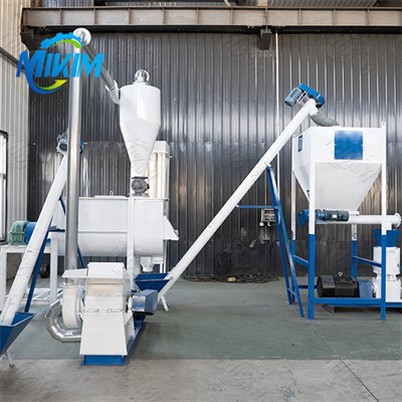
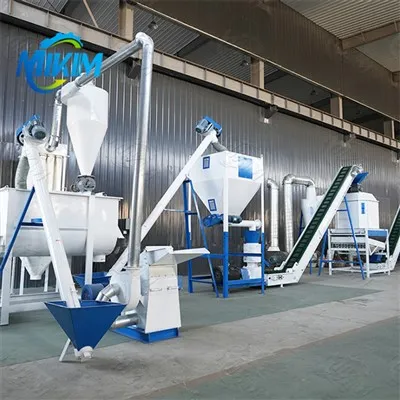
5t/h Fish Feed Product Line
The Aquafeed Pellet Extrusion Line has a high degree of automation and is simple to use and easy to operate.
Description
Extruded Aquatic Feed Pellet Production Line test
01What Does a 5 t/h Fish Feed Product Line Look Like Along the Full Process Chain?
Fifteen linked stages carry raw material in at one end and bagged floating pellets out the other. A 5t/h fish feed product line at this scale never stops for a batch change. Grain, meal and protein sources go in at the intake, and finished pellets come off the packing line. Between those two points sit 15 process stages, each of which has to be sized so the line never starves the extruder or floods the dryer.
The Uzbekistan inquiry this page answers is a step up from a farm line. The buyer already has an industrial site, adequate power and natural gas on hand, and asked for the whole line plus separate machinery and turnkey pricing. That is a mill-scale question, and it needs a process answer before a price answer.
The 15 stages from raw material intake to packing
The chain runs as follows:

Where 5 t/h sits between a 3-4 t/h and a 5-10 t/h build
The 5-10 t/h configuration is our largest standard automatic line, and 5 t/h is its lower operating band. Below it sits a 3-4 t/h build with a shorter batching train. The two differ in automation depth and container count as much as in tonnage:
| Item | 5-10 t/h line |
|---|---|
| Production efficiency | 5-10 t/h |
| Operators | 4-5 |
| Transport | 5 x 40 ft containers |
| Control system | Full automatic batching plus computer control |
A buyer who wants 5 t/h steady output but a smaller capital step should also weigh the shorter build. The 5-10 t/h aquafeed production plant and the 3-4 t/h aquafeed production line set out how the two configurations differ stage by stage, which is the fastest way to decide which one to price.
Want a stage-by-stage flow diagram with your own raw materials marked in? Send us the material list and we will map it onto the 15 stages.
02Stage by Stage: How Do Elevators and Buffer Bins Start a 5 t/h Aquaculture Feed Production Line?
The first stage is not a machine so much as a habit: keep the front end full. A bucket elevator lifts material to a buffer bin, which feeds the crusher under gravity. On a continuous line at this tonnage, buffer volume is what lets one stage stop briefly without starving the next. Buffer bins and hopper volumes are not fixed figures in our data, so they are confirmed per project on the factory technical data sheet.
Conveying and buffering for continuous 5 t/h flow
The line uses bucket elevators between the main vertical steps and screw or air conveying between horizontal ones. The engineering rule is simple: whichever machine is most sensitive to feed variation gets a buffer directly in front of it. On this line that is the grinder, then the extruder.
Weighing and batching at the front end
Automatic batching and weighing appears twice in the chain, once before the first mixing stage and once before the second mixing stage. Two weigh points let the plant build a base blend, break it again, then add the fine ingredients - protein concentrates, oils, vitamins - at a lower inclusion rate. That is standard practice for aquafeed, where a small protein or vitamin error changes feed performance more than a small energy error does.
03How Do the Crushers and Hammer Mills Handle 5 t/h of Raw Material?
At 5 t/h the front end runs two size-reduction steps in series: a coarse crusher first, then a hammer mill to bring material down to the fineness extrusion needs. Splitting the job protects the fine mill from shock loads and oversized foreign material.
Our hammer-type range that suits this duty:
| Model | Power | Throughput | Dimensions |
|---|---|---|---|
| SFSP56X36 | 22 kW | 3-4 t/h | 1430*860*1000 mm |
| SFSP56X40 | 37 kW | 5-6 t/h | 1630*860*1000 mm |
| SFSP65X45 | 45 kW | 7-8 t/h | 1720*870*1320 mm |
| SFSP65X60 | 55 kW | 10-12 t/h | 2000*960*1320 mm |
Rotor speeds run 2950 rpm with rotor diameters of 560 mm and 650 mm across the range.

Coarse crushing before fine grinding
The coarse stage takes whole grain and cake down to a feedable size, and the fine mill follows. Sizing the fine mill above the line rate is deliberate - a grinder is the machine most likely to fall behind when material is damp or the screen is worn.
Dust control and screen selection at high throughput
At 5 t/h, dust is a housekeeping and safety issue, not a nuisance. Enclosed conveying and a dedicated dust system belong in the scope. Screen selection then sets the grind curve: too coarse and extrusion suffers, too fine and throughput collapses against the mill's power. Because dust collectors are not fixed items in our data, we specify them against your site layout and confirm them with the order.
04How Does Twin-Screw floating fish feed extruder machine Produce Floating Pellets at 5 t/h?
Floating aquafeed needs cook and expansion, and that is the job of a Twin screw floating fish feed making machine. Two intermeshing screws convey and compress the conditioned mash, generating shear heat that gelatinises starch; the sudden pressure release at the die then expands the pellet, trapping air so it floats. Our published twin-screw range:
| Model | Output | Main motor | Cutter | Feed | Conditioner |
|---|---|---|---|---|---|
| 65 type | 250-300 kg/h | 22 kW | 1.5 kW | 1.5 kW | 3 kW |
| 70 type | 500-600 kg/h | 45 kW | 1.5 kW | 1.5 kW | 3 kW |
| 85 type | 1200-1500 kg/h | 90 kW | 3 kW | 2.2 kW | 5.5 kW |
| 95 type | 2000-2500 kg/h | 110 kW | 3 kW | 3 kW | 11 kW |
| 120 type | 3000-4000 kg/h | 160 kW | 5.5 kW | 3 kW | 15+7.5 kW |
Motor ratings for a given type are confirmed on the factory technical confirmation sheet, because the same nominal size can be built to more than one drive specification.


Why a twin-screw barrel floats feed better than a single screw
A twin-screw barrel handles a wider moisture and oil window than a single screw, and it self-cleans as it turns. That matters for floating feed because expansion depends on getting moisture and heat consistent from the first pellet to the last; a barrel that fouls drifts out of spec as the shift wears on.
Conditioning, shear and cook at 5 t/h
Cook comes from three places: steam added in the conditioner, mechanical shear in the barrel, and the retention time you allow. At 5 t/h the conditioner is the coarse control and the screw speed is the fine control. Which extruder size carries a 5 t/h floating line, and how many units run in parallel, is a configuration decision we fix per project rather than assume from a table.
If floating feed is your main product, the fish extruder machines range shows how the barrel and die options change across the family.
05How Do 3, 4, 6 and 8 mm Dies Serve Different Fish Species?
Pellet diameter follows fish mouth size, and mouth size follows age. As a working rule for the species named in this inquiry:
- 3 mm - fry and fingerling stages of carp, grass carp and silver carp.
- 4 mm - advanced fingerlings and smaller grow-out fish.
- 6 mm - standard grow-out feed for carp, grass carp and silver carp.
- 8 mm - larger trout and pikeperch, and fast-growing market fish.
Below 3 mm, feed is normally a crumble rather than a pellet, and the die and cutter settings change accordingly.


Matching pellet size to carp, grass carp, pikeperch, silver carp and trout
Carp, grass carp and silver carp are the classic warm-water trio and run a similar size ladder from 3 mm to 6 mm. Pikeperch is a predatory fish and takes larger, denser pellets. Trout sit outside the warm-water group and are usually fed smaller pellets at higher protein, so a trout line is a formulation and die question rather than a tonnage question. One twin-screw line covers all five species by changing dies and recipes.
Die changeover and spare die planning
Die changeover is a planned stop, not a running adjustment. Buy the die sizes you will actually run - most mills start with two and add a third within a year. Spare dies belong in the initial order because die lead time runs longer than machine lead time. For a fuller look at floating-pellet production on a line at this scale, see aquaculture extruded pellet feed production.
06Which Drying, Screening and Cooling Units Balance a 5 t/h Aquaculture Extruded Pellet Feed Production Line?
Drying, screening and cooling are where a nominally fast line loses its tonnage. Each of the three stages must be sized for the wet throughput arriving from extrusion, not for the finished dry rate, because wet pellets are heavier and need more dwell time.
| Unit | Duty | Power |
|---|---|---|
| NKSL11x11 counterflow cooler | 1000-3000 kg/h | 5.5 kW plus 2.1 kW fan |
| NKSL14x14 counterflow cooler | 2000-5000 kg/h | 7.5 kW plus 2.3 kW fan |
| SKLN 17x17 counterflow cooler | 4-7 t/h | 2.1KW |
| SKLN 20x20 counterflow cooler | 7-12 t/h | 2.2 kW |


| Model & Specification | Heating Power | Fan Power | Transmission Power | Description |
|---|---|---|---|---|
| Electric Heating Dryer (Stainless Steel Chain Mesh Belt Dryer)5 layers / 8 m | 95 kW | 3 kW × 6 units | 5.5 kW | Mesh belt with chain plate and side skirt |
| Automatic Dryer3 layers / 3 m | 21 kW | 0.75 kW × 2 units | 1.5 kW | Built-in 3-layer automatic drying conveyor belt. Particles fall from the top layer to the lower layers sequentially. Supports temperature setting and automatic constant temperature. The conveyor speed is variable frequency adjustable to control particle drying time. Stainless steel structure for easy cleaning. |
| Automatic Dryer5 layers / 5 m | 45 kW | 2.2 kW × 4 units | 3 kW | Built-in 5-layer automatic drying conveyor belt, 5 meters per layer. Other features same as above. |


Drying capacity matched to 5 t/h wet output
Drying is the stage most often under-bought. A dryer sized for finished tonnage rather than wet tonnage leaves the line waiting, and no amount of extruder speed recovers that. Whether your feed is dried on a drum, in a multi-layer oven or in an airflow path depends on pellet shape and your heat source - which brings the natural gas question into focus.
Cooling and screening before packing
Screening removes fines and oversize before cooling, and cooling brings the pellet down to bagging temperature so it does not sweat in the bag. Counterflow cooling is standard here: pellets fall against rising air, which cools evenly and reduces cracking.
07What Gas and Electric Loads Does a Natural-Gas-Fired 5 t/h Line Need?
Your site has natural gas, which is the right way to supply line heat. Gas typically fires the drying and conditioning heat rather than driving machinery, so it does not reduce the electric load much - it just makes the drying stage cheaper to run than electric heating at scale.
Gas burner and motor power to be calibrated per line
Here we have to be direct. Burner specification and heat consumption for a natural gas-fired line are not fixed figures we publish, because they depend on dryer type, pellet moisture in, target moisture out and your local gas calorific value. They are calibrated per project and confirmed on the factory technical confirmation sheet. We will not quote you a gas consumption figure that we cannot stand behind.
What a 5 t/h line draws from an industrial grid
The electric load is the sum of the motors across the 15 stages - bucket elevators, crushers, the fine grinder, two mixers, the extruder, the dryer drives, the screener, the cooler and the packing line - plus conveyors and controls. For the 5-10 t/h configuration, total installed power and footprint are confirmed per project on the factory technical confirmation sheet rather than published as a single number. What we can give you now is the per-machine motor data in the tables above, which is what a plant engineer needs to plan the incoming supply and the switchgear.
08How Is the 5 t/h Aquaculture Automatic Pellet Feed Production Line Quoted Separately as Machinery Only or Turnkey?
You asked for two prices, and they cover two different things. Both are issued as itemised quotations on an EXW or FOB basis, with CIF priced on request.
What the machinery-only scope covers
Machinery only means the equipment list: every machine across the 15 stages, the conveying between them, motors, starters and controls, the die set ordered, the operation and maintenance manual, and packing for shipment. You handle civil works, foundations, site power and gas connections, erection and commissioning labour.
What a turnkey scope adds: civil, installation and commissioning
Turnkey adds the site side: layout and foundation design input, installation and erection, electrical and gas connection work, commissioning, trial production to confirm capacity, and operator training. Because turnkey cost depends heavily on your site, we need the plant layout and utility connection points before we can put firm numbers on it - which is exactly why the two scopes are quoted separately rather than blended. Ready to compare the two scopes side by side? Send your site layout and utility connection points and we will price both on the same equipment list.
09 Where Can You See the Complete Specifications of the 5 t/h Aquatic Extruded Feed Pelletizing Production Line?
The complete specs of the 5 t/h fish feed production line, side by side:
| Item | 3-4 t/h line | 5-10 t/h line |
|---|---|---|
| Production efficiency | 3-4 t/h | 5-10 t/h |
| Operators | 2-3 | 4-5 |
| Transport | 4 x 40 ft containers | 5 x 40 ft containers |
| Pellet diameter | 1-12 mm | 1-12 mm |
| Control system | Full automatic batching plus computer control | Full automatic batching plus computer control |
For a 5 t/h operating point, the 5-10 t/h configuration is the parent build. Total installed power and footprint are not published for this configuration and are confirmed per project in the technical annex to the offer. Machine-level data - crushers, mixers, the twin-screw extruder range, dryers and coolers - is in the tables above.
10 Which Raw Materials and Fish Farming Scenarios Fit a 5 t/h Aquatic Fish And Shrimp Pellet Feed Production Line?
A line at this scale suits a commercial feed mill, a large integrated farm with its own hatchery, or a regional feed supplier. Raw materials typically include maize, wheat, soybean meal, rapeseed or cottonseed cake, fishmeal, rice bran and vitamin or mineral premix - broad enough that a mill can follow local price movements in energy and protein without re-engineering the plant.
Reference: Feedipedia feed ingredient composition database

Scenarios that fit:
- Regional aquafeed mill serving several fish farms within delivery range.
- Large integrated farm that feeds its own ponds and sells surplus feed.
- Contract manufacturer producing feed for other brands under their specifications.
- Multi-species supplier running warm-water carp and grass carp alongside trout, using dies and recipes rather than separate lines.
Sites at this scale are usually studying how large-scale farming pellet production lines are configured before committing to a capacity band. A line at 5 t/h does not suit a farm feeding a handful of ponds - that is the small-line build, and buying at this scale would leave most of the capacity idle.
11 What Advantages Does a Fully Automatic 5 t/h Aquaculture Farm Pellet Feed Production Line Bring a Feed Mill?
The value of automation at this scale is consistency, not headcount reduction. A fully automatic batching and computer-controlled line reproduces the same formulation batch after batch, which is what lets a mill sell on specification. On a fish feed production line of this size, that repeatability is what turns a plant from a job shop into a supplier.
- Repeatable formulation - two weigh points and computer control hold inclusions within tight bands.
- Continuous flow - 15 connected stages mean stable output rather than batch peaks and troughs.
- Labour efficiency - 4-5 operators run the whole plant.
- Multi-species flexibility - 1-12 mm pellets and interchangeable dies.
- Gas-fired heat - natural gas supplies line heat, cutting running cost where gas is cheaper than power.
The fully automatic fish feed production line build shows what full automation adds over a semi-automatic plant at the same capacity, which helps when you are deciding how much control system to buy.
12 Customer Requirements Addressed: The Uzbekistan 5 t/h Inquiry, Answered Point by Point
Point 1-2: the full 5 t/h line and machinery versus turnkey pricing
You asked for the 5 t/h line including the mechanical and installation systems, with separate prices for the equipment and the turnkey package. The line is 15 stages, listed at the top of this page; the 5-10 t/h configuration is the parent build at your operating point. Machinery-only and turnkey are quoted as two separate itemised offers on an EXW or FOB basis, CIF priced on request, so you can compare what each adds.
Point 3-4: capacity, specs and gas or electric load with burner and motor ratings
Capacity is 5 t/h, in a 5-10 t/h configuration, with 1-12 mm pellets and full automatic batching plus computer control. On natural gas and electricity: per-machine motor ratings for the crushers, extruder range, dryers and coolers are in the tables above. Burner specification and heat consumption, and total line installed power and footprint, are calibrated per project and confirmed on the factory technical confirmation sheet - those are the figures your plant engineer will want, so we confirm them rather than estimate.
Point 5-6-7: delivery after contract, installation service and payment terms
We open the offer with the delivery window; it starts at your deposit and your signed technical sheet, and the exact schedule travels with the offer. Installation and commissioning are available and, for your site, sit inside the turnkey scope with layout input, erection, electrical and gas connections, commissioning, trial production and operator training. Payment is agreed with the offer; standard international terms include bank transfer and letter of credit, and we confirm the final structure against your bank before the contract.
Point 8-9-10: floating feed, 3/4/6/8 mm sizes and the carp to trout species list
Floating feed is produced by twin-screw extrusion with steam conditioning. Dies for 3 mm, 4 mm, 6 mm and 8 mm cover the species you named - carp, grass carp, pikeperch, silver carp and trout - with changeover between sizes on the same line, and 1-12 mm overall. For the warm-water trio, 3 mm to 4 mm is the younger size band and 6 mm the grow-out band; pikeperch and trout take the larger, denser end.
Point 11-12: industrial-zone power readiness and on-site natural gas
Your industrial site and adequate power are the right starting conditions, and natural gas on site is what lets us heat the line cheaply rather than electrically. Because your supply is already in place, send the incoming supply capacity and the gas connection pressure and we will confirm the utility interface points on the technical sheet that accompanies the offer. Send an inquiry with those two figures and we will return the itemised quotation.
13 How Are Installation, Commissioning, Payment Terms and Delivery Handled for Uzbekistan?
On a line of this size, installation is a scheduled activity rather than an afterthought. Commissioning runs through the 15 stages in order, then a trial production run to confirm output against the specification you signed. Our engineers stay until the line holds capacity and the operators can run it unaided.
Count delivery from the deposit plus the signed technical confirmation, and container count matters here: the 5-10 t/h configuration ships in five 40 ft containers, so port and inland clearance should be planned before the equipment leaves. Payment terms are fixed with the offer, and we confirm them against your bank. For a plant at this scale, we recommend agreeing a spare-parts package at order stage - dies, screens, cutter blades and bearings - so commissioning is never held up waiting on a shipment.
14 FAQ: Lead Time, Gas and Power Costs and EXW/FOB/CIF Quotation for the 5 t/h Line
Q1: Can you quote the equipment and the turnkey package separately?
Yes. Machinery-only covers all machines across the 15 stages plus conveying, motors, controls, the die set and documentation. Turnkey adds civil and foundation input, erection, electrical and gas connection work, commissioning, trial production and training. Both are itemised, on an EXW or FOB basis, with CIF priced on request.
Q2: What are the gas and electricity consumption figures for a 5 t/h Aquaculture Feed Pellet Production Line?
Per-machine motor ratings are published in the tables above. Burner specification and heat consumption, and total installed power and footprint for the 5-10 t/h configuration, are calibrated per project and confirmed on the factory technical confirmation sheet, because they depend on your dryer type, moisture targets and local gas calorific value.
Q3: Which pellet sizes can the Aquaculture Feed Extrusion Production Line produce, and for which fish?
1-12 mm overall, with 3 mm, 4 mm, 6 mm and 8 mm dies covering carp, grass carp, silver carp, pikeperch and trout. Sizes change by die changeover on the same line.
Q4: Does the line make floating feed?
Yes. Floating aquafeed is produced by twin-screw extrusion with steam conditioning, with the expansion set by die geometry, screw speed and feed moisture.
Q5: What is the transport configuration and operator requirement?
The 5-10 t/h configuration ships in five 40 ft containers and runs with 4-5 operators; the shorter 3-4 t/h build ships in four containers with 2-3 operators.
Q6: How is the Extruded Aquafeed Production Line quoted, and what payment terms apply?
All quotations are itemised on an EXW or FOB basis with CIF priced on request. Payment terms are agreed with the offer - standard international terms include bank transfer and letter of credit - and are confirmed against your bank before contract.


Hot Tags: 5t/h Fish Feed Product Line, China 5t/h Fish Feed Product Line manufacturers, suppliers, factory, stabilizer feed pellet machine, balanced feed pellet machine, feed pellet machine training service, energy efficient feed pellet machine, feed pellet machine technical support, feed pellet machine wholesaler
Send Inquiry
You Might Also Like