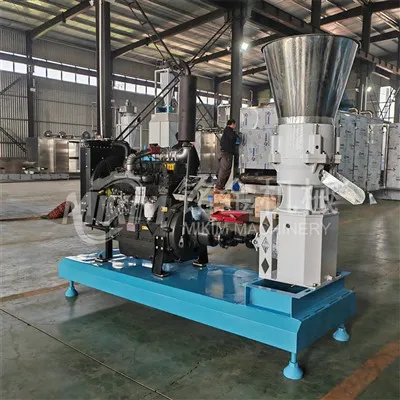
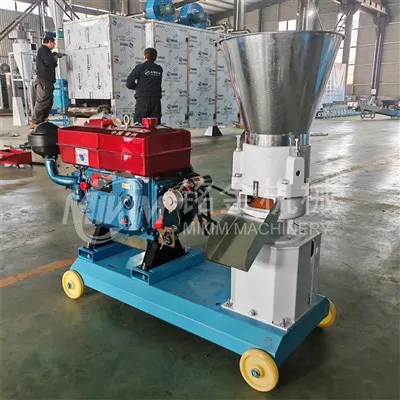
How Do The Die Head And Pressure Roller Of A Machine That Produces Chicken Pellets Work?
Leave a message
The die head and pressure rollers in an animal feed pellet mill are the components that directly contact the raw materials and complete the extrusion molding. Their structural compatibility, material hardness, and surface treatment processes collectively determine the pellet quality, equipment production efficiency, and the frequency of replacement of wear parts.
The core of the die head's structural design lies in the die holes and channels. The diameter of the die holes is determined according to the feed type; for example, 2-2.5mm is used for piglet feed, and 4-5mm for beef cattle feed. The distribution of the die holes must be uniform to ensure balanced force during pressure roller extrusion and avoid excessively rapid local wear. Channel structures are divided into straight-hole and stepped types. Straight-hole structures are simple and easy to process, suitable for processing concentrates; stepped channels have a larger inlet diameter that gradually narrows towards the interior, reducing resistance to raw material entry, lowering the risk of blockage, and are more suitable for coarse-fiber raw materials. The thickness of the die head also needs to be properly matched, typically 8-12 times the die hole diameter. Excessive thickness can cause the raw material to remain in the channels for too long, resulting in over-gelatinization; insufficient thickness results in insufficient extrusion pressure and loose pellets.
The structural design of the pressure rollers in a poultry pellet making machine focuses on their surface morphology and shaft connection method. The roller surface often features a textured, striped, or diamond pattern to enhance friction with the raw material, prevent slippage during extrusion, and improve feeding efficiency. The depth and density of the texture need to be adjusted according to the raw material. A shallow texture (0.5-1mm depth) is used when processing wet materials to prevent material adhesion; a deep texture (1-1.5mm depth) is used when processing dry materials to enhance gripping ability. The pressure roller is connected to the main body of the machine via a roller shaft. Bearings are installed at both ends of the shaft to ensure flexible rotation of the roller. Some machines also have an adjustable roller shaft, allowing adjustment of the gap between the roller and the die head according to die wear, ensuring optimal extrusion effect.
Material selection is crucial for the durability of the die head and pressure roller. Ordinary dies are mostly made of 45# steel, which, after quenching, can reach a hardness of HRC45-50, suitable for small-scale production. Medium- to large-scale production requires alloy steel dies, such as Cr12MoV, with a hardness increased to HRC55-60, and a service life 3-5 times longer than ordinary dies. The pressure roller is usually matched to the die, made of high-chromium cast iron or alloy steel, with a surface hardness slightly lower than the die to avoid rigid collisions that would accelerate wear.
During operation, the die and pressure roller form an "extrusion chamber." After the raw material enters the chamber, it is forcibly compressed under the relative rotation of the two. The starch in the raw material gelatinizes, producing viscosity, and under pressure, it passes through the die holes to form columnar particles, which are eventually cut into particles of the set length by the cutter. Adjusting the gap between the two is crucial. The normal gap should be controlled between 0.1-0.3mm. Too large a gap results in insufficient extrusion pressure and loose particles; too small a gap will accelerate wear and shorten the service life.


about Us
We offer:
One-Year Whole Machine Warranty Service
On-site Installation, Commissioning, and Technical Guidance
24/7 Online Technical Support
Qualifications and Honors

Customer visit

FAQ
1. What is the price of the small animal food pellet machine?
The price ranges from approximately $2,500-$20,000
2. Do you provide maintenance services for your customers?
Yes, we offer comprehensive after-sales maintenance services to our customers.