

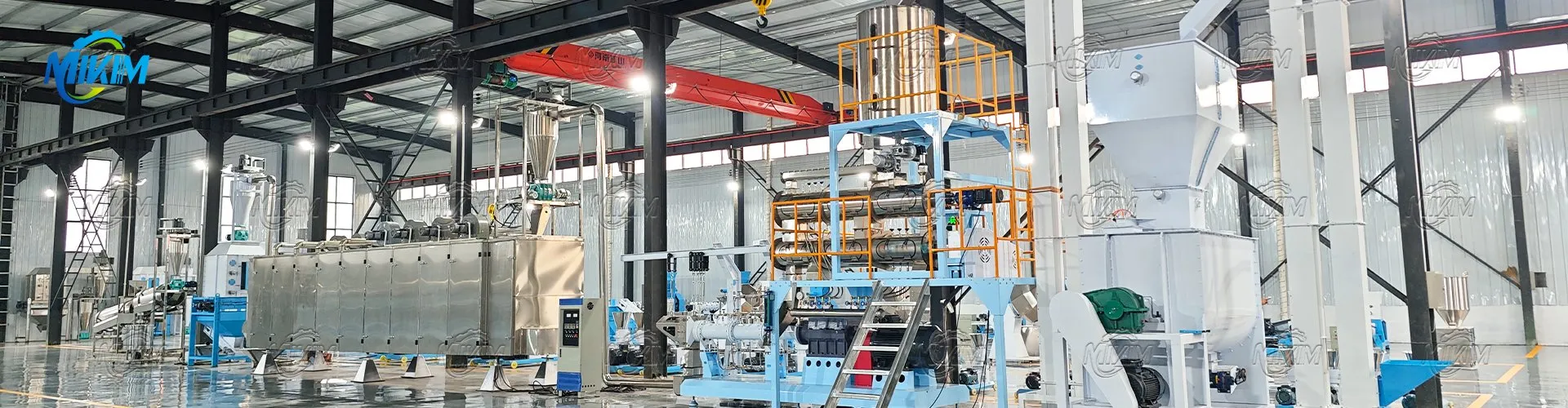
Process Improvement Of Fish Floating Feed Production Line
Leave a message
Improvement methods
Method 1: Make the fish fry feed "fineer and softer" by modifying the fish feed machine mold and extrusion parameters. Fish fry have small mouths, so the original 2mm mold was changed to 1mm, and the mold holes were smoothed to prevent rough edges from scratching their mouths. The extrusion temperature was lowered from 140℃ to 120℃, and the pressure was reduced to 4MPa to make the pellets softer, so the fry can easily peck at them. 3% milk powder was added to increase viscosity and prevent the pellets from crumbling upon soaking.
Method 2: Make the adult fish feed "firmer and more uniform" by adding premixing and shaping processes. Adult fish eat a lot, and the pellets were originally uneven in size. A premixer was added after the mixer to further mix the fish meal, soybean meal, and other ingredients for 3 minutes to ensure that each pellet has the same nutritional value. After extrusion, a shaping machine was added to round off the irregular pellets, and then the pellets were sieved through an 8mm screen, leaving only uniformly sized pellets. Adult fish will eagerly eat them, leaving no crumbs.
Method 3: Add a "flavor spraying" process to enhance palatability. Fish are sensitive to fishy smells. Spray a layer of fish paste (5 catties for every 100 catties of feed) onto the cooled pellets, stirring constantly to ensure each pellet is coated with the fishy aroma. The fish will be attracted and swim to eat. This reduces the feed's time in water from 2 hours to 1 hour, decreasing waste by 60%.
Precautions
① Don't add too much protein to fry feed: Some people add over 40% fishmeal to accelerate fry growth, making the pellets too hard for the fry to eat. A safe ratio is 30% fishmeal for fry feed and 20% for adult fish feed.
② Don't apply flavor coating before drying: Fish paste contains water. Spraying before drying will cause the pellets to absorb moisture and become heavier. Always spray after cooling, and then let them air dry in a ventilated area for 5 minutes to allow the surface to dry completely.


Product Parameters
|
Model |
Main motor (kw) |
Feeder (KW) |
Cutter(KW) |
Capacity (kg/h) |
Machine size (m) |
Weight(kg) |
|
DGP-40 |
5.5 |
0.4 |
0.4 |
40-50 |
1.36*1.3*0.8 |
320 |
|
DGP-60 |
15 |
0.4 |
0.4 |
120-150 |
1.36*1.33*0.86 |
420 |
|
DGP-70 |
18.5 |
0.4 |
0.4 |
200-250 |
1.36*1.33*0.86 |
550 |
|
DGP-80 |
22 |
1.5 |
0.55 |
300-350 |
2.3*1.7*1.4 |
720 |
|
DGP-90 |
30 |
1.5 |
0.55 |
400-450 |
2.3*1.7*1.4 |
1100 |
|
DGP-100 |
37 |
1.5 |
1.5 |
500 |
2*2.8*1.2 |
1500 |
|
DGP-120 |
55 |
1.5 |
1.5 |
600-700 |
2.2*2.9*1.2 |
1800 |
|
DGP-135 |
75 |
1.5 |
2.2 |
800-900 |
2.2*3.1*1.37 |
2000 |
|
DGP-160 |
90 |
2.2 |
2.2 |
1000-1200 |
2.3*3.15*1.38 |
2500 |
|
DGP-200 |
132 |
3 |
3 |
1800-2000 |
2.35*3.45*1.65 |
3200 |
about Us
Qualifications and Honors

Customer visit

FAQ
1. What is the price of the floating fish pellet machine?
The price ranges from approximately $6,000-$25,000
2. Do you provide maintenance services for your customers?
Yes, we offer comprehensive after-sales maintenance services to our customers.


