Reasons For Uneven Nutrition in Fish Feed Pellets
Leave a message
reason
1. Batching Stage: Insufficient accuracy of the batching scale (error exceeding 0.5%), incorrect order of raw material addition (e.g., micro-additives added directly without being mixed with the carrier), and raw material clumping that is not broken up (e.g., vitamin premix clumping, with a diameter exceeding 3mm). Poor batching scale accuracy leads to deviations in the amount of main ingredients (e.g., soybean meal, fishmeal) or additives added; incorrect order of addition prevents micro-additives (e.g., vitamins, minerals) from being evenly dispersed; raw material clumping results in concentrated nutrients in the clumped areas, while other areas lack nutrients.
2. Mixing Stage: Overload of the mixer (exceeding 80% of the rated capacity), insufficient mixing time (less than 3 minutes), and wear of the mixer blades (blade height wear exceeding 10%). Overload prevents the material from being fully agitated, resulting in "layering"; short mixing time prevents additives from being fully integrated with the main ingredients; blade wear leads to insufficient mixing force in the mixer, resulting in poor material uniformity (uniformity variation coefficient exceeding 10%).
3. Extrusion Stage: Uneven temperature in the extruder barrel (temperature difference exceeding 20℃ in different areas) and wear on the screw threads (thread clearance exceeding 0.5mm). Uneven temperature leads to excessive destruction of nutrients (such as vitamins) in some areas of the material, while nutrients are fully preserved in others; wear on the screw threads causes uneven material transport within the extrusion chamber, resulting in excessively long residence time of material in some areas, different degrees of nutrient degradation, and ultimately, differences in the nutritional content of the finished product.


Solution
1. Ingredient Control:
Regularly (once a week), calibrate the batching scale to ensure an accuracy error ≤0.3%. After calibration, test with standard weights (e.g., adding a 10kg weight should result in an error of ≤30g on the scale).
Optimize the feeding sequence: Add the main ingredients (corn, soybean meal) first, then the premix (which needs to be mixed evenly with 5-10 times its volume of carrier, such as bran), and finally the coarse fiber raw materials. This avoids uneven dispersion caused by direct contact between trace additives and large amounts of main ingredients.
For agglomerated raw materials (especially premixes), first crush them to a particle diameter ≤1mm using a crusher before adding them to the batching system. After crushing, filter them with a sieve (1mm aperture) to ensure no agglomeration.
2. Mixing Process Optimization:
Control the mixer capacity. Each feed should not exceed 70% of the rated capacity (e.g., for a 1000L mixer, each feed should not exceed 700kg) to ensure sufficient space for material to turn over.
Extend the mixing time to 4-5 minutes. After mixing, sample and test the mixing uniformity (using the chloride ion selective electrode method; the coefficient of variation should be ≤7%). If the coefficient of variation exceeds the standard, check the mixer blades; replace the blades if wear exceeds 10%.
Install baffles inside the mixer to improve material turning efficiency and prevent material stratification (especially for raw materials with large density differences, such as fishmeal and wheat bran).
3. Adjustments during the puffing process:
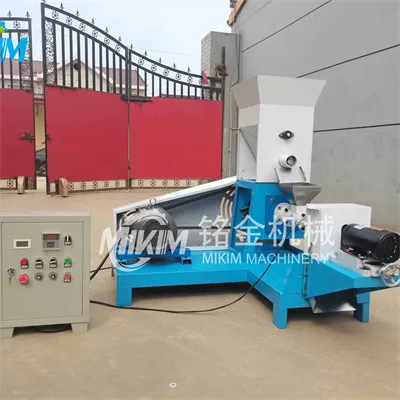
Inspect the heating device of the puffer barrel (such as electric heating tubes and steam jackets), replace any damaged heating elements, and ensure that the temperature difference between different areas of the barrel is ≤10℃ (use an infrared thermometer to check one point every 10cm);
Disassemble the screw and check the wear of the screw threads. If the gap between the screw threads exceeds 0.5mm, replace the screw or screw thread sleeve to ensure that the material is conveyed evenly in the puffing chamber, with a residence time difference of ≤2 seconds (adjust the screw speed for auxiliary control, stabilizing the speed at 350-450r/min);
Final product display

about Us
MIKIM is a high-tech enterprise integrating R&D, production, and sales. Its feed extrusion equipment utilizes a high-temperature, high-pressure process, which sterilizes, improves puffing density and digestibility, and saves 8%-15% on feed costs. Pellet diameters are adjustable from 1-16 mm, and it features controllable cutting and floating adjustment to suit the needs of fish, shrimp, crab, and pet food. Core components are sourced from international brands and undergo special treatment, ensuring stability and durability while balancing safety, efficiency, and peace of mind.
Qualifications and Honors

Customer visit


FAQ
1. What is the price of the fish feed extruder line?
The price ranges from approximately $25,000-$65,000
2. Do you provide maintenance services for your customers?
Yes, we offer comprehensive after-sales maintenance services to our customers.