What Are The Functions And Quality Requirements Of The Core Components Of A Floating Fish Food Making Machine?
Leave a message
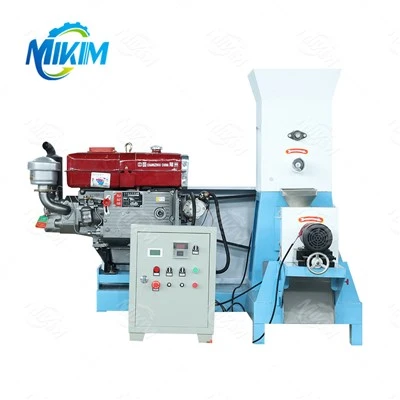
The screw is the "heart" of a fish floating food machine. Defined as a "spiral component installed inside the barrel, which rotates to convey, compress, and mix raw materials," its function is to propel the raw materials and generate extrusion pressure. The screw's structural design is extremely critical, typically divided into three sections: the feeding section, the compression section, and the discharge section. The feeding section has a larger pitch for rapid material transport; the compression section's pitch gradually decreases, reducing the gap between the screw and the barrel to achieve material compression and initial mixing; the discharge section has the smallest pitch, where pressure and temperature reach peak levels, ensuring thorough gelatinization of the raw materials.
The screw material directly affects its service life. Ordinary equipment often uses 45# steel that has been quenched, achieving a hardness of HRC45-50, suitable for processing refined materials. Mid-to-high-end equipment uses 38CrMoAl alloy steel, which, after nitriding treatment, increases its hardness to over HRC60, capable of withstanding the wear of coarse fibrous materials and extending its service life by 3-5 times. In addition, the screw speed can be adjusted via a variable frequency motor, typically between 50-300 r/min. Higher speeds result in higher production efficiency, but must be matched with the feed rate to avoid overloading the equipment.
The barrel works in conjunction with the screw, defined as a "cylindrical component that surrounds the screw, providing processing space and providing heating." Its function is to work with the screw to generate extrusion pressure and gelatinize the raw material through heating. The inner wall of the barrel usually has axial grooves to enhance friction with the raw material and improve the extrusion effect. An external heating device is installed, divided into 2-4 heating zones depending on processing requirements, allowing for segmented temperature control, such as controlling the feed zone temperature at 70-80℃ and the discharge zone at 100-120℃. The barrel material matches the screw, using high-strength alloy steel, with the inner wall precision-machined to a surface roughness controlled below Ra0.8 to prevent raw material adhesion. Some large barrels are also equipped with cooling jackets, allowing cooling water to be introduced to lower the raw material temperature when it is too high, preventing carbonization.
The die and cutter are the "final checkpoints" in feed forming. The die is defined as "a forming component with a uniform aperture, installed at the end of the barrel," its function being to form the extruded raw material into pellets of a fixed shape. The cutter is installed on the outside of the die and cuts the continuously extruded strip into pellets of a set length through rotation. The aperture of the die depends on the type of feed; aquatic feed commonly uses a 2-3mm aperture, livestock and poultry feed uses a 3-5mm aperture, and ruminant feed uses a 5-8mm aperture. The die is made of high-chromium cast iron or alloy steel, and its hardness must be higher than that of the screw to prevent wear that could cause the aperture to enlarge. The cutter is usually a circular blade, driven by a high-speed motor, with a speed adjustable between 100-500 rpm. The faster the speed, the shorter the pellet length, which can be flexibly adjusted according to customer needs.
Although the feeder does not directly participate in extrusion forming, it is crucial for ensuring the stable operation of the equipment. It is defined as "a component that uniformly conveys raw materials into the barrel," its function being to prevent raw material accumulation or interruption. Floating fish feed pellet making machines typically use a spiral structure for their feeders, driven by a variable frequency motor. The feeding speed is controlled in conjunction with the screw speed to ensure uniform filling and stable pressure within the machine. High-quality feeders are also equipped with a level sensor that automatically alarms when the feed in the hopper is insufficient, reminding the operator to add feed.


about Us
We offer:
One-Year Whole Machine Warranty Service
On-site Installation, Commissioning, and Technical Guidance
24/7 Online Technical Support
Qualifications and Honors

Customer visit

FAQ
1. What is the price of the floating fish pellet maker?
The price ranges from approximately $4,500-$50,000
2. Do you provide maintenance services for your customers?
Yes, we offer comprehensive after-sales maintenance services to our customers.