

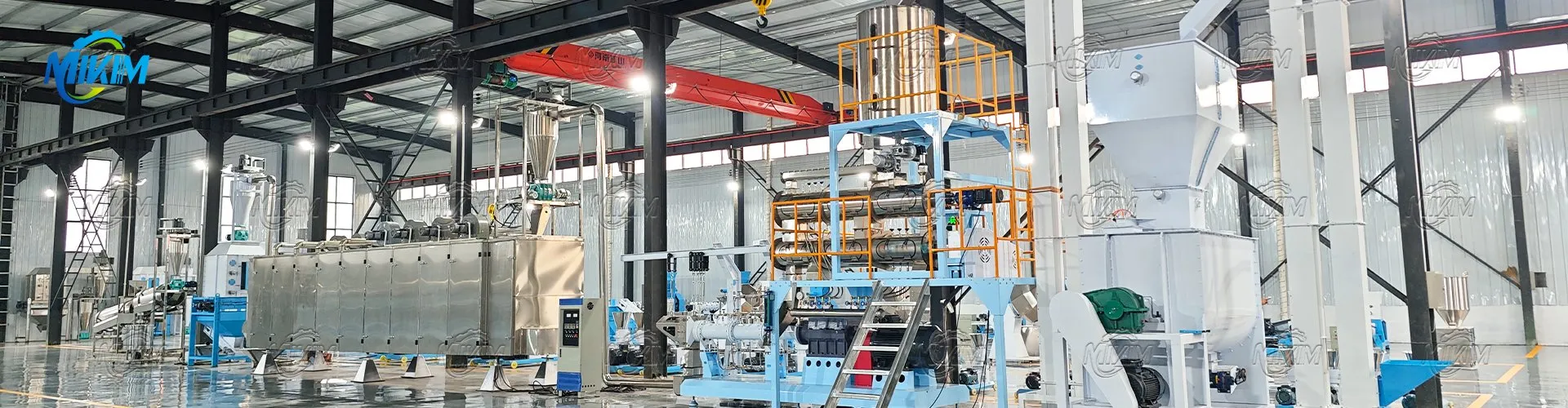
What Are The Key Considerations When Picking An Automatic Pelletizing Production Line For Cattle And Sheep Feed?
Leave a message
Cattle and sheep pellet feed has a high proportion of crude fiber in its raw materials. Small cattle feed machines need to have strong extrusion capabilities to shape the raw materials while retaining an appropriate fiber structure to aid rumen digestion. Equipment selection should focus on the performance of core components such as the die head, pressure rollers, and screw.
Firstly, ring die pellet mills should be preferred over flat die pellet mills. Ring die pellet mills generate strong extrusion through the relative rotation of the ring die and pressure rollers, effectively compacting raw materials such as straw and soybean meal into pellets with high density, good stability, and a forming rate of over 95%. Flat die pellet mills, due to their smaller extrusion area and insufficient pressure, have a weaker ability to handle coarse fiber raw materials, with a forming rate typically below 85%, and the pellets are prone to loosening, making them only suitable for small-scale production of concentrate pellets.
The selection of core components is crucial. The die head is key to pellet quality and should be made of alloy steel with a hardness of HRC55 or higher and a lifespan of 800-1000 hours. The die orifice diameter should be 3.5-5.0mm, with the length-to-diameter ratio controlled at 10:1 to ensure compact pellets and easy demolding. Die orifice selection varies depending on the cattle and sheep population: 3.5-4.0mm orifices are used for calves and lambs, resulting in softer, more digestible pellets; 4.0-5.0mm orifices are used for adult cattle and sheep, producing slightly firmer pellets for increased satiety. The pressure rollers should be made of high-chromium cast iron with a textured surface to enhance friction with the raw material, prevent slippage, and improve extrusion efficiency.
The pellet mill's transmission system also requires close attention. Gear drives are preferred due to their higher efficiency (over 98%) and more stable operation compared to belt drives, and their ability to withstand the impact loads from coarse fibrous raw materials. The motor should be a national standard copper wire motor, with power matched to the output. A machine with an hourly output of 500kg requires a 15kW motor to ensure sufficient power.
The selection of supporting equipment is equally important. A grading screen is required before the pellet mill to remove impurities such as stones and metal from the raw materials, protecting the die and pressure rollers. A cooler is needed after the pellet mill to cool the freshly pelleted 80℃ high-temperature pellets to room temperature, preventing moisture absorption and mold growth after packaging. A counter-flow cooler is the best choice, offering high cooling efficiency and reducing pellet breakage.
Selection considerations: First, process parameter control: Choose equipment with temperature and pressure adjustment functions. When producing cattle and sheep feed, control the extrusion temperature at 80-90℃ and the pressure at 3-5MPa to avoid high temperatures damaging feed nutrients or excessive pressure causing fiber breakage. Second, supply of consumable parts: Choose brands with high market share to ensure quick procurement and replacement of consumable parts such as the die and pressure rollers. Third, ease of operation: Prioritize equipment equipped with a touchscreen control system, which allows preset production parameters for different formulas, enabling beginners to quickly learn how to use it. Furthermore, for producing high-fiber pellet feed, equipment with a large-diameter ring die (e.g., 300mm or more) is required to improve raw material processing capacity.


about Us
We offer:
One-Year Whole Machine Warranty Service
On-site Installation, Commissioning, and Technical Guidance
24/7 Online Technical Support
Qualifications and Honors

Customer visit

FAQ
1. What is the price of the fsmall chicken feed pellet machine?
The price ranges from approximately $1,500-$35,000
2. Do you provide maintenance services for your customers?
Yes, we offer comprehensive after-sales maintenance services to our customers.


