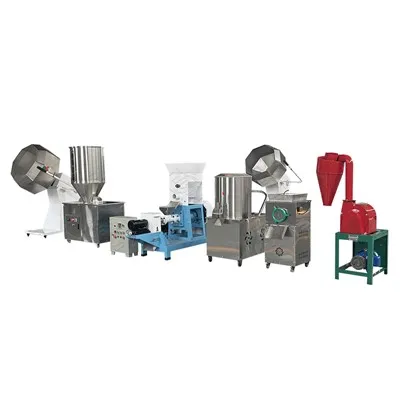
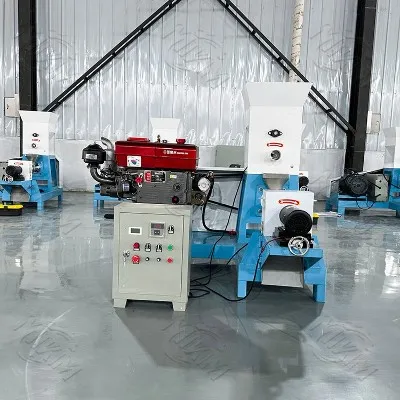
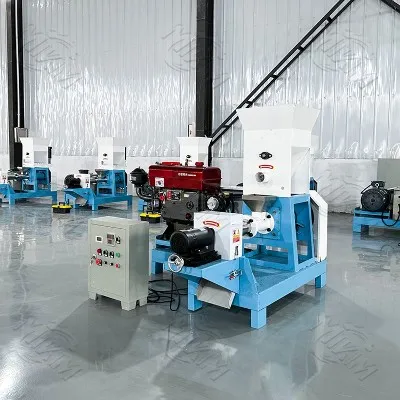
Diesel Fish Feed Machine Floating Unit User Guide
Leave a message
The core parameter control of fish feed manufacturing machinery needs to be combined with the fish species and feed requirements. Regarding speed control, diesel-powered floating fish feed pellet machines control the spindle speed by adjusting the throttle. Different feed sizes require corresponding speeds: for tilapia feed with a particle size of 3-5mm, the speed should be controlled at 280-320 r/min to ensure dense pellets; for shrimp feed with a particle size of 2-3mm, the speed should be reduced to 220-250 r/min to avoid excessive compression and damage to nutrients. Temperature control requires attention to the ring die temperature. Floating fish feed requires a ring die temperature of 85-95℃ to ensure starch gelatinization and improve buoyancy. This can be judged by touching the outer wall of the barrel (it should feel hot but be able to be touched briefly). If the temperature is too low, the feeding speed can be reduced to allow the raw materials to generate sufficient heat through friction within the machine; if the temperature is too high, the feeding speed should be increased or the machine should be stopped for cooling to prevent feed carbonization.
The feeding speed adjustment must be matched with the production capacity of the floating feed machine for fish. Use a frequency converter feeder or manually adjust the feed gate to control the feeding speed, ensuring the raw materials enter the machine evenly. Avoid feeding too quickly, which can overload the motor (manifested as a dull diesel engine sound and decreased speed), or feeding too slowly, which can cause idling (manifested as increased equipment noise and no feed output). During normal operation, the feeding speed should be controlled at 80%-90% of the equipment's rated capacity. For example, for a machine with an hourly capacity of 500 kg, a feeding speed of 400-450 kg/h is recommended.
Troubleshooting during operation requires timely and decisive action. If the feed is loosely formed and has poor buoyancy, immediately check the moisture content of the raw materials and the temperature of the ring die. If the moisture content is insufficient, stop the machine and add water; if the temperature is insufficient, reduce the feeding speed. If the ring die is clogged, first close the feed gate, run the machine idle for 30 seconds to discharge residual raw materials, then stop the machine and clean the ring die holes. A special cleaning needle can be used to clear the blockage; do not touch the high-temperature ring die directly with your hands. If the equipment experiences abnormal vibration or noise, immediately press the emergency stop button and check if the pulley is misaligned and if the gearbox is low on oil. Restart only after troubleshooting. Meanwhile, feed quality is sampled and tested every hour, and indicators such as pellet formation rate and floating time are recorded. Parameters are fine-tuned based on the test results to ensure stable production.
Related equipment




about Us
MIKIM's fish feed pellet production lines and supporting machinery offer excellent value for money. Not only are they affordable, eliminating middlemen markups and allowing small and medium-sized enterprises (SMEs) and fish farmers to purchase complete sets of equipment at reasonable costs, but they also boast exceptional efficiency. The fully automated process, from raw material crushing and precise ingredient mixing to extrusion pelleting and maturation, is completed in one continuous flow. This results in high starch gelatinization rates and uniform pellet formation, significantly improving production efficiency and feed quality, truly achieving "low cost, high output." Choosing a MIKIM fish feed pellet production line means enjoying comprehensive pre-sales and after-sales service, including 24-hour online customer support, a one-year warranty on the entire machine, professional on-site installation, commissioning, and maintenance, and a stable supply of spare parts. Customers can buy with confidence and use with peace of mind, with both excellent value and service quality!
Customer visit

Certificate of Honor

FAQ
1. What is the price of the diesel fish feed machine floating?
The price ranges from approximately $3,500-$55,000
2. Do you provide maintenance services for your customers?
Yes, we offer comprehensive after-sales maintenance services to our customers.
If you would like to learn more about MIKIM machinery, please contact us. We offer one-stop service and welcome your inquiries!!!