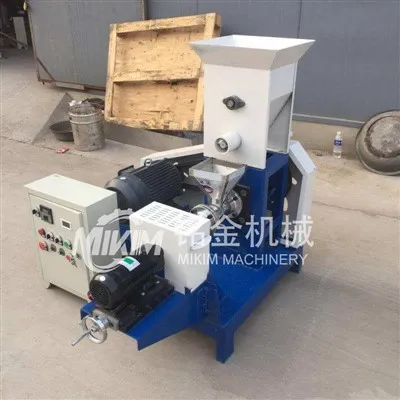
What are the steps for using a diesel fish floating feed pelletizer machine?
Leave a message
Tilapia feed production suitability: Tilapia are mid-to-lower-level fish, requiring feed to float for at least 30 minutes with a particle size of 3-5mm. The raw material formula should include 60%-70% corn and soybean meal to provide sufficient starch and improve buoyancy; and 20%-25% fishmeal to meet protein requirements. Fish feed manufacturing machine parameter settings: Diesel engine throttle adjusted to medium-high speed, spindle speed 280-320 r/min, ring die with a 3-5mm aperture and a 1:8 compression ratio; feed speed controlled at 400-450 kg/h, ensuring the ring die temperature remains stable at 90-95℃, and starch gelatinization rate reaches over 85%. Check feed buoyancy every 2 hours during production; if the floating time shortens, appropriately increase the ring die temperature or increase the starch proportion.
Shrimp feed production suitability: Shrimp are bottom feeders, requiring feed to sink slowly with a floating time of 15-20 minutes and a particle size of 2-3mm. The raw material formula contains 40%-50% fishmeal and shrimp meal, 25%-30% starch, and 1%-2% seaweed powder to enhance palatability. Parameter settings for the floating fish feed machine in China: Throttle set to medium speed, spindle speed 220-250 r/min to reduce extrusion intensity; select a ring die with a 2-3mm aperture and a 1:10 compression ratio to improve pellet density; control the ring die temperature at 85-90℃ to avoid damaging the active ingredients in the shrimp meal. Reduce the feeding speed to 300-350 kg/h to extend the residence time of the raw material in the machine and ensure uniform pellet size. After production, test the settling speed in clean water. If it settles too quickly, appropriately reduce the compression ratio; if it floats for too long, increase the proportion of fishmeal.
Suitable for bass feed production: Bass are carnivorous fish, and the feed has a high protein content (over 45%). It needs to float for more than 40 minutes, with a pellet size of 4-6mm. The raw material formula includes 50%-60% fishmeal, 15%-20% soybean meal, and 5% fish oil to enhance nutrition. Sinking fish feed pellet equipment parameter settings: throttle set to high speed, spindle speed 320-350 r/min to enhance extrusion effect; ring die with 4-6mm aperture and a 1:9 compression ratio; ring die temperature controlled at 95-100℃ to ensure compact pellets. Feeding speed 450-500 kg/h, using a forced feeder to avoid uneven feeding due to the poor flowability of high-protein raw materials. During production, focus on monitoring pellet hardness, maintaining it at 25-30 N. If too hard, reduce the compression ratio; if too soft, increase the speed.
Adaptation principles for other species: For herbivorous fish (e.g., grass carp), increase the proportion of crude fiber in the feed and reduce the speed and temperature; for carnivorous fish (e.g., snakehead), increase the protein ratio and use a large-aperture ring die to ensure the feed meets growth requirements.
Related equipment


about Us
MIKIM's fish feed pellet production lines and supporting machinery offer excellent value for money. Not only are they affordable, eliminating middlemen markups and allowing small and medium-sized enterprises (SMEs) and fish farmers to purchase complete sets of equipment at reasonable costs, but they also boast exceptional efficiency. The fully automated process, from raw material crushing and precise ingredient mixing to extrusion pelleting and maturation, is completed in one continuous flow. This results in high starch gelatinization rates and uniform pellet formation, significantly improving production efficiency and feed quality, truly achieving "low cost, high output." Choosing a MIKIM fish feed pellet production line means enjoying comprehensive pre-sales and after-sales service, including 24-hour online customer support, a one-year warranty on the entire machine, professional on-site installation, commissioning, and maintenance, and a stable supply of spare parts. Customers can buy with confidence and use with peace of mind, with both excellent value and service quality!
Customer visit

Certificate of Honor

FAQ
1. What is the price of the diesel fish feed making machine?
The price ranges from approximately $3,500-$55,000
2. Do you provide maintenance services for your customers?
Yes, we offer comprehensive after-sales maintenance services to our customers.
If you would like to learn more about MIKIM machinery, please contact us. We offer one-stop service and welcome your inquiries!!!