How do I maintain a Twin-Screw fish feed extruder machine?
Leave a message
content
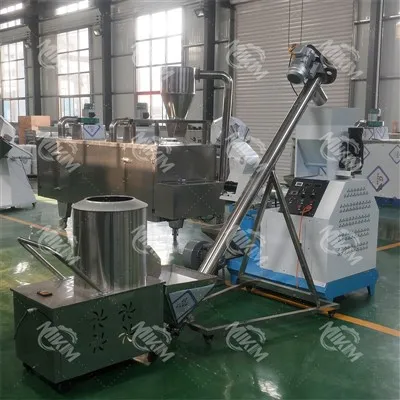
Daily maintenance is fundamental to preventing floating fish feed extruder machines from malfunctioning. Key aspects include equipment cleaning, parameter checks, and component tightening. After production, thoroughly clean the feed hopper, screw, extrusion chamber, die, and other components of the small fish feed pellet extruder. Remove the die and screw, and use a soft brush with warm water to remove any remaining material to prevent clumping and jamming during the next startup. After cleaning, check the screw and die for wear; record any minor wear, and replace any severely worn parts immediately. Simultaneously, check the temperature controller and pressure sensor displays for proper function, and tighten all screws, especially those on electrical terminals and transmission components, to prevent loosening and malfunctions.
Weekly maintenance of the small floating fish feed machine focuses on lubrication and transmission system checks. For the Small Home Use Dog Food Making Machine, replenish lubricating oil to rotating parts such as motor bearings, drive belts/chains, and screw shaft ends. Add high-temperature grease to the motor bearings, chain-specific oil to the chain, and high-temperature resistant lubricating oil to the screw shaft ends. Check the tension and wear of the drive belts; adjust them promptly if loose, and replace them if cracked or aged. Clean the heat sinks of the motor and reducer to ensure good heat dissipation and prevent the motor from overheating and triggering protection shutdown. In addition, conduct weekly sampling checks on the quality of raw material pretreatment to ensure that moisture and particle size meet requirements, preventing equipment malfunctions caused by raw material issues.
Monthly maintenance of the floating fish food extruder requires a comprehensive component inspection and parameter calibration. Check the wear of the screw and measure the screw thread thickness; replace it if wear exceeds 2mm. Check the inner diameter of the extrusion chamber; replace the bushing if excessively worn. Calibrate the temperature and pressure sensors to ensure accurate measurements; repair or replace them if calibration is unsatisfactory. Conduct a comprehensive inspection of the equipment's electrical system, checking for aging wiring, poor contact, and dust accumulation in the control cabinet; clean and repair as needed. Establish a maintenance log to record the content of each maintenance, the parts replaced, and parameter adjustments, facilitating traceability during subsequent troubleshooting.
Furthermore, it is necessary to develop equipment operation procedures to avoid improper operation such as overload operation and frequent start-stop cycles; operators must undergo professional training to master basic equipment operation and troubleshooting skills; the equipment should be stored in a dry and well-ventilated environment to avoid damage to components caused by moisture and excessive dust. Through systematic daily maintenance and standardized operation, the failure rate of the small floating fish feed pellet machine can be reduced by more than 60%, significantly improving production efficiency.
Related equipment


about Us
MIKIM's fish feed pellet production lines and supporting machinery offer excellent value for money. Not only are they affordable, eliminating middlemen markups and allowing small and medium-sized enterprises (SMEs) and fish farmers to purchase complete sets of equipment at reasonable costs, but they also boast exceptional efficiency. The fully automated process, from raw material crushing and precise ingredient mixing to extrusion pelleting and maturation, is completed in one continuous flow. This results in high starch gelatinization rates and uniform pellet formation, significantly improving production efficiency and feed quality, truly achieving "low cost, high output." Choosing a MIKIM fish feed pellet production line means enjoying comprehensive pre-sales and after-sales service, including 24-hour online customer support, a one-year warranty on the entire machine, professional on-site installation, commissioning, and maintenance, and a stable supply of spare parts. Customers can buy with confidence and use with peace of mind, with both excellent value and service quality!!!
Customer visit

Certificate of Honor

FAQ
1. What is the price of the Best home use dog food making machine?
The price ranges from approximately $1,500-$55,000
2. Do you provide maintenance services for your customers?
Yes, we offer comprehensive after-sales maintenance services to our customers.
If you would like to learn more about MIKIM machinery, please contact us. We offer one-stop service and welcome your inquiries!!!