How Does a small pet food extrusion machine Work?
Leave a message
content
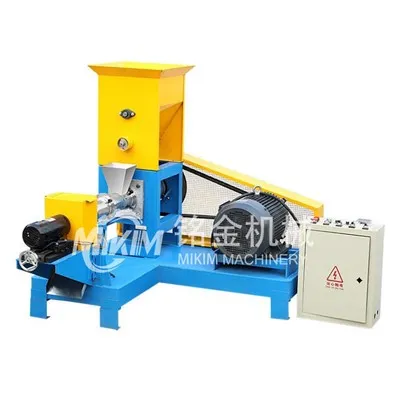
Small fish feed maker machines (50-200kg/hour capacity) have a relatively simplified workflow, prioritizing ease of operation, making them suitable for home-based production or small workshops. Their operation is primarily manual or semi-automatic: raw material pretreatment (screening, crushing, mixing) requires manual completion, using simple tools to control moisture and particle size; feeding uses a manual or small automatic hopper, requiring manual monitoring of the feeding speed to avoid interruptions; preheating and temperature adjustment of the extruder are handled via a simple touchscreen, with relatively rudimentary parameter adjustments (temperature error ±5℃); cutting and cooling of the formed pellets requires manual assistance, such as using a fan to dry them or natural air drying. The core advantages of small extruders are simple operation, no need for professional training, production can be completed by one person, and low equipment investment (5000-30000 yuan); the disadvantages are low production efficiency, low parameter control precision, and relatively poor product quality stability.
Industrial-grade pet food extruder production lines (over 500kg/hour capacity) achieve fully automated workflows, emphasizing efficiency and quality stability. Its entire operation is controlled by an intelligent control system: raw material pretreatment is completed through an automated production line, from screening, crushing, mixing to moisture adjustment, all without manual intervention, and raw material quality is monitored in real time by sensors; the feeding system uses an intelligent feeding system, adjusting the feeding speed in real time according to the pressure and temperature of the extrusion chamber to ensure a stable supply; the extruder is equipped with a multi-zone precise temperature control system (temperature error ±1℃) and an automatic pressure adjustment system, and the screw speed can be precisely controlled by a PLC control system; the cutting, cooling, screening, and packaging of the formed granules are all automated, transported by conveyor belts, and the quality of the granules is monitored by sensors, with unqualified products automatically rejected.
The core differences in their working mechanisms lie in three aspects: degree of automation, parameter control precision, and production capacity and quality stability. In terms of automation, pet food extrusion equipment machines rely on manual operation, while industrial-grade equipment achieves full automation, significantly improving production efficiency. Regarding parameter control precision, small machines rely on coarse parameter adjustments, while industrial-grade equipment achieves precise control through intelligent systems, ensuring uniform product quality. In terms of capacity and stability, small machines have low capacity, suitable for small-batch production, and their quality is greatly affected by human factors; industrial-grade equipment has high capacity, can operate continuously 24 hours a day, has strong quality stability, and is suitable for large-scale commercial production.
Suitable scenarios for different sizes of equipment: For home DIY and pet store owners' personal use, small pet food extruders are preferred due to their ease of operation and low investment; small entrepreneurs and those producing small batches of high-end pet food can choose medium-sized semi-automatic dog food production machines (capacity 200-500kg per hour), balancing quality and cost; large pet food companies and large-scale production require industrial-grade fully automated extruder production lines to ensure efficiency and quality stability. Understanding the differences in operation between different sizes of equipment is crucial for accurately selecting the right model to meet your needs and achieve efficient production.
Related equipment


about Us
MIKIM's fish feed pellet production lines and supporting machinery offer excellent value for money. Not only are they affordable, eliminating middlemen markups and allowing small and medium-sized enterprises (SMEs) and fish farmers to purchase complete sets of equipment at reasonable costs, but they also boast exceptional efficiency. The fully automated process, from raw material crushing and precise ingredient mixing to extrusion pelleting and maturation, is completed in one continuous flow. This results in high starch gelatinization rates and uniform pellet formation, significantly improving production efficiency and feed quality, truly achieving "low cost, high output." Choosing a MIKIM fish feed pellet production line means enjoying comprehensive pre-sales and after-sales service, including 24-hour online customer support, a one-year warranty on the entire machine, professional on-site installation, commissioning, and maintenance, and a stable supply of spare parts. Customers can buy with confidence and use with peace of mind, with both excellent value and service quality!!!
Customer visit

Certificate of Honor

FAQ
1. What is the price of the single screw pet food extruder?
The price ranges from approximately $1,500-$55,000
2. Do you provide maintenance services for your customers?
Yes, we offer comprehensive after-sales maintenance services to our customers.
If you would like to learn more about MIKIM machinery, please contact us. We offer one-stop service and welcome your inquiries!!!