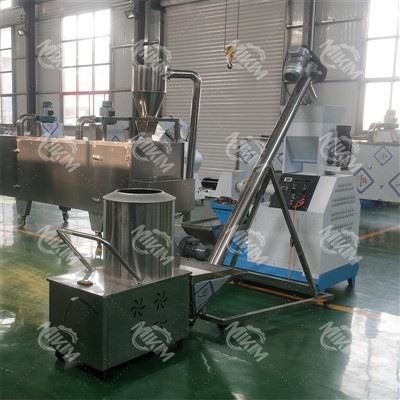
150kg/h Medium Dog Food Production Line with Pre-Mixed Ingredient
150kg/h Medium Dog Food Production Line with Pre-Mixed Ingredient suppliers
150kg/h Medium Dog Food Production Line with Pre-Mixed Ingredient factory
150kg/h Medium Dog Food Production Line with Pre-Mixed Ingredient best
150kg/h Medium Dog Food Production Line with Pre-Mixed Ingredient high quality
1/0
150kg/h Medium Dog Food Production Line with Pre-Mixed Ingredient
A medium dry dog food line built for pre-mixed ingredient. The meal arrives already proportioned, so the line starts at the mixer rather than at a batching bank: no ingredient bins, no weighing hoppers, no dosing screws and no recipe computer.
A medium dog food line running pre-mixed ingredient skips the batching section and starts at the mixer. At 150 kg/h the line makes 3 tonnes in a 20 hour day on a 15 kW dry single screw extruder, and it draws 53.15 kW across extrusion, drying, fat coating, cooling and bagging.
Across 20 working hours, yes. The extruder holds 150 kg/h through the day and the dryer clears the same flow, so the tonnage follows the working hours rather than a larger machine.
Pet food production lines rated 150 kg/h carry one extruder and one dryer, so a plant that needs more than 3 tonnes a day buys working hours, not a second press.
02
What Changes on a Pre-Mixed Dog Food Production Line?
The batching section comes off the line. No ingredient bins, no weighing hoppers, no dosing screws, and no computer recipe system, because the proportions were settled before the meal left the supplier.
NO BATCHING SECTION
A pre-mixed line starts at the mixer. What stays is the mixer for added fat and water, the extruder, the dryer, the coater, the cooler and the bagger, which is five driven stages rather than nine.
What a pre-mixed line still needs is a check on the meal itself. Particle size and moisture are read at intake, because the extruder cannot correct a premix that arrives at 16 percent moisture or with hard lumps that will not pass a die.
What the mixer still does on a pre-mixed line
It takes added fat, water and any heat sensitive additive that must not pass through the extruder. The mixer is the last point where the formula can be adjusted, so it stays even though the weighing does not.
Where the saving shows up in the quotation
The batching section is the largest single block of steel on a conventional dog food line. Removing it takes both capital and floor space out of the project, and it is why a pre-mixed medium dog food production line costs less than a line of the same output that batches from raw grain. Removing it is also what leaves an automated pet food production line in the useful sense: feed rate, dryer temperature, fat dose and bag weight hold their setpoints, while the recipe change stays a manual die and cutter job.
03
Why a Dry type Single Screw Extruder for Dog Food?
Because at 150 kg/h one screw carries the melt on its own, and a dry barrel removes the boiler, the steam line and the water treatment that a wet line needs behind it.
Model
Capacity
Main Power
Cutter
Weight
LX-45
50 kg/h
5.5 kW
0.4 kW
350 kg
LX-65
150 kg/h
15 kW
0.4 kW
500 kg
LX-75
200-300 kg/h
18.5 kW
0.4 kW
650 kg
LX-85
400-500 kg/h
22 kW
0.75 kW
850 kg
Table 2: Dry single screw extruders covering the 150 kg/h build and the two sizes above it.
ONE SCREW, DRY PROCESS
A single screw conveys, compresses and cooks the melt in one barrel without steam conditioning. The dry route is what keeps a 150 kg/h plant inside a shed rather than a boiler house.
What a twin screw adds and what it costs
A twin screw cleans itself between recipes and holds a stable melt at high fat inclusion, and both of those earn their keep when a plant changes formula every day. At 150 kg/h the same capability is paid for on every kilowatt hour, and a line running one or two recipes a week does not recover it. The twin screw becomes the right answer above 300 kg/h, or where the formula changes daily.
Dry process against wet process
A Dry Type dog food pellet extruder machine cooks on friction and heater bands and needs no boiler. A wet extruder adds a conditioner and a steam line ahead of the barrel, and it produces a denser pellet with a higher starch gelatinisation.
At 150 kg/h the boiler, its fuel line and its operator cost more than the difference in kibble quality earns, which is why the dry route is the one quoted here.
04
What Kibble Shapes Can the Die Produce?
The die sets the shape, and a dog food die can carry a bone, a star, a ring or a plain round hole. Shape is a die purchase rather than a machine change.
SHAPE IS A DIE
One extruder runs every shape in the catalogue. A new profile is a die order and a cutter reset, not a second machine, which is how a plant keeps six retail shapes off one line.
Diameter, length and the cutter
The cutter sets kibble length against the die diameter. A small diameter kibble cut long reads as a stick; a large one cut short reads as a crumb. Both are corrected at the cutter rather than at the die.
What the die does to density
A longer hole against its diameter packs the kibble harder and raises the motor load. Density is set by the die, and the dryer then sets the final texture, which is why the two are specified together.
05
Why Must Kibble Be Dried Before Coating?
Because fat will not bond to a wet surface. Kibble leaves the extruder at 20-25 percent moisture, and coating at that point puts the fat into the water film rather than onto the kibble.
DRY, THEN COAT
The dryer takes kibble down to 8-10 percent before the coater sees it. Fat applied to a dry, warm kibble soaks into the outer layer and stays there, which is what the buyer sees and smells in the bag.
What the dryer removes and what it costs
A three layer dryer with 21 kW of heating, two 0.75 kW fans and a 1.5 kW belt carries the water load for a 150 kg/h line. The 24 kW that block adds up to is still the largest electrical item on the plant, ahead of the extruder motor.
The dryer is also the stage that sets the building height, because three layers stacked need clear headroom above the extruder discharge.
Why the dryer cannot be shortened
Kibble that leaves the dryer at 14 percent still feels dry to the hand and still fails in the bag within a month. The moisture target is a shelf life decision, not a texture one.
06
How Is Fat Coated Onto the Kibble?
Fat is coated in a rotary drum that sprays heated oil onto a tumbling bed, with the fat metered rather than poured.
SPRAY, NOT POUR
A drum coater with an injector heats, stirs and sprays the fat in one pass. Pouring fat onto a still bed wets one layer and leaves the rest dry, and that layer then blocks in the bag.
The spray drum on this line is a 1.1 kW unit rated 250-300 kg/h, so the bed in front of the nozzle is full at 150 kg/h and the fat is atomised into a falling curtain rather than onto a thin stream.
Coating before cooling, not after
Fat goes on while the kibble is still warm from the dryer, because a warm surface takes the fat into its outer layer. Coating after the cooler leaves a greasy skin that rubs off in the bag.
What the coater does to the packing line
Coated kibble is sticky, so the cooler that follows the coater has to run long enough to bring the surface down before the bagger. On this line the horizontal cooler handles 250-350 kg/h on 2.95 kW, which sits above the extruder output.
07
How Much Power Does a 150kg/h Dog Food Line Draw?
The line draws 53.15 kW connected, with the dryer block at 24 kW and the extruder at 15.4 kW.
Stage
Machine
Power
Mixing
LX-HY0.3 ribbon mixer, 150 kg per batch
2.2 kW
Conveying
KWX50YP screw conveyor, 2.5 m
1.5 kW
Extrusion
LX-65 main motor
15 kW
Cutting
LX-65 cutter
0.4 kW
Transfer
TDSG10-16 bucket elevator
1.5 kW
Drying heat
3 layer, 3 m dryer heaters
21 kW
Drying air
Two dryer fans
1.5 kW
Drying drive
Dryer belt drive
1.5 kW
Fat coating
LX-BZ25 spray drum
1.1 kW
Cooling
GMC-LQSF50 horizontal cooler
2.95 kW
Bagging
DCS-Z-W-50 weigher and sealer
4.5 kW
Total
53.15 kW
Table 3: Connected power of the 150 kg/h dog food line.
THE DRYER STILL LEADS
24 kW of the 53.15 kW sits in the dryer block, against 15.4 kW on the extruder with its cutter. The incoming supply is sized against the total, and the heater bank is what makes it larger than the extrusion stage alone suggests.
Floor space and building height
The line runs in a single row with the dryer as the tallest item and the coater as the shortest. It covers about 16 m from mixer to bagger on a 3.5 m wide strip, and the dryer sets the clear height at 4.5 m. A shed laid out this way is a corridor rather than a hall, and the walkway beside the dryer stays clear for the fan and filter service.
Where the supply is checked
The extruder start draws several times its running current, and the heater bank draws a steady load beside it. Those two are sized separately: the cable against the heater and fan load, the start arrangement against the extruder motor.
08
What Does a 150kg/h Medium Dog Food Production Line Include?
Eight driven units, six of them process stages and two of them transfers. The list below is the equipment side of the quotation, in the order material moves.
Stage
Machine
Duty
Mixing
U-type ribbon mixer
Added fat, water and sensitive additives
Conveying
Screw conveyor
Mixer discharge to extruder hopper
Extrusion
Dry single screw extruder
Cook, expand and form the kibble
Transfer
Bucket elevator
Extruder to dryer top
Drying
Three layer dryer
Moisture down to 8-10 percent
Coating
Spray seasoning drum
Heated fat onto warm kibble
Cooling
Horizontal cooler
Surface down before bagging
Bagging
Weigher and sealer
Retail and bulk sacks
Table 4: The eight units of the pre-mixed dog food line.
SIX STAGES, TWO TRANSFERS
Both transfers are mechanical, and neither one is a process stage. A buyer counting machines often counts the transfer units as stages, which overstates what the line does and understates what the dryer costs.
Why the lift is a bucket elevator
Kibble is fragile between the extruder and the dryer, and the lift is short. At 150 kg/h one 1.5 kW elevator raises the kibble to the top layer without the air volume and the filter that a pneumatic system needs, so the transfer costs one motor rather than two. The boot fills by gravity and the kibble drops into the dryer entry without a chute.
09
Can One Dog Food Production Line Make Cat Food Too?
Yes. Cat kibble and fish feed run on the same barrel with a different die, a different cutter setting and a different dryer time.
ONE BARREL, THREE PRODUCTS
The extruder sets shape and expansion, and the die sets diameter. A plant running dog kibble, cat kibble and floating fish feed keeps three die sets and one barrel, which is what makes an automated pet food production line worth its capital.
What changes between the three products
Dog kibble runs at a moderate expansion and a larger diameter. Cat kibble runs smaller and denser. Floating fish feed runs at a higher expansion so the pellet holds air, and it needs a longer dryer pass.
What does not change
The mixer, the transfers, the coater and the bagger. A plant moving between products changes the die, the cutter and the drying time, and nothing else on the line.
10
What Spare Parts Does a Dog Food Production Line Need?
One die per shape in production, a spare cutter set, dryer belts and bearings, and a spare set of heater bands. The wear list is short because a dry extruder has no boiler and no conditioner to maintain.
WEAR PARTS, NOT STRUCTURE
Dies, cutters and heater bands are consumables and are quoted as their own lines. Frames, drives and the barrel sit under a one year warranty that runs from commissioning.
What the operator checks daily
Die and cutter condition, extruder barrel temperature, dryer temperature by layer, fat temperature at the injector, and bag weight against a check sack. Those five checks carry most of the first year.
11
What Comes With a Medium Dog Food Production Line?
A line by line quotation in process order, with the dryer and the heater bank shown as their own lines because they carry the largest electrical load. The pet food production line price follows those two items before any other, because the dryer and the extruder are what move the figure.
QUOTED BY STAGE
Each line names the machine, the motor that drives it, and what travels in the crate with it. A single lump figure hides where the 53.15 kW comes from, and that is the figure an electrician quotes against.
A dry pet food production line supplier is worth comparing on the spares list and the commissioning slot rather than on the machine price alone.
Send the premix specification, the daily tonnage and the shift pattern. Send the premix particle size and moisture and the quotation comes back against a build rather than a range.
The order of the stages is the whole design. Premix arrives already proportioned, the mixer adds fat and water, the single screw cooks and forms the kibble, the dryer takes the moisture down, the coater puts fat on the surface, and the cooler and bagger deliver a pallet of sacks.
Two figures decide whether the plant holds its tonnage. The extruder has to hold 150 kg/h, which is its nameplate rating rather than a figure below it, so a plant that wants reserve steps up to the next size at 200-300 kg/h. The dryer has to clear the same 150 kg/h without the kibble arriving at the coater warm and wet.
Start with the premix and the shift pattern, not with the machine. A medium dog food production line for pre-mixed ingredient is six stages and two transfers, and it works when the dryer is sized against the extruder rather than against the daily tonnage.
1
Is 150 kg/h enough for 3 tonnes a day?
Yes, over 20 working hours. 150 kg/h for 20 hours is 3.0 tonnes, and one 8 hour shift gives 1.2 tonnes. Holding 3 tonnes inside a single shift needs 375 kg/h and the next two extruder sizes up.
2
What does pre-mixed ingredient remove from the line?
The batching section: ingredient bins, weighing hoppers, dosing screws and the recipe system. The mixer stays for added fat and water, and the extruder, dryer, coater, cooler and bagger are unchanged.
3
Can one line make dog kibble, cat kibble and fish feed?
Yes. Three die sets and three cutter settings run on one barrel. Floating fish feed needs a longer dryer pass because it carries more expansion.
4
How much power does the line draw?
53.15 kW connected, of which 24 kW is the dryer block and 15.4 kW the extruder with its cutter. The dryer heaters, not the extruder, decide how large the incoming supply has to be.
5
What kibble shapes are available?
Any profile the die carries: bone, star, ring or plain round. Shape is a die order, and the cutter sets length against the die diameter.
6
Why is the kibble dried before the fat goes on?
Fat will not bond to a wet surface. Kibble leaves the extruder at 20-25 percent moisture and the dryer takes it to 8-10 percent, which is the point where the coater can put fat into the outer layer.
7
What is the warranty and what counts as a wear part?
One year on frames, drives and the barrel, running from commissioning. Dies, cutters and heater bands are wear parts and are quoted with the line.
8
Can I buy the line without the dryer?
The line ships without it, and the plant then has to dry by another means to 8-10 percent before coating. The dryer is the stage that sets shelf life, so leaving it out changes the product rather than the process.
9
Who Builds the Line?
One dry pet food production line manufacturer builds the barrel, the dryer and the coater, so the extruder discharge and the dryer inlet are matched on one drawing set. A dry pet food production line factory that also builds the dryer owns that interface, which is where a mismatched build shows up first.
10
Where Does the Line Ship From?
China. A dry pet food production line China order loads at a named Chinese port, and the dry pet food production line for sale price is quoted FOB that port. The dryer ships in its own case, so the freight quote follows the case list rather than a single packed volume.