


In terms of production efficiency and energy usage, how do flat die pellet mills differ from ring die pellet mills?
Leave a message
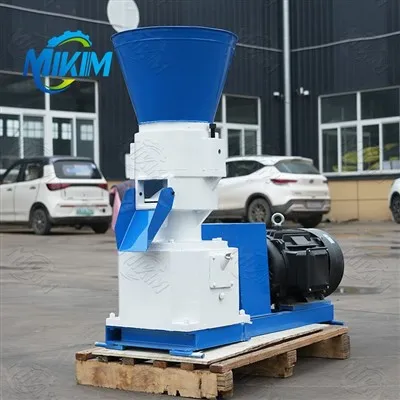
The difference in production efficiency is reflected in capacity and continuous operation capability. In terms of capacity per unit time, for the same power, a ring die pellet mill has 2-3 times the capacity of a flat die pellet mill. For example, a 15kW flat die pellet mill has an hourly capacity of approximately 300-500kg, while a 15kW ring die pellet mill can reach 800-1200kg per hour. This is because the contact area between the pressure roller and the die in a ring die pellet mill is larger, resulting in higher extrusion molding efficiency and more uniform pressure distribution, avoiding the localized material accumulation and efficiency reduction caused by uneven pressure in flat die pellet mills.
In terms of continuous operation capability, ring die pellet mills have a more sophisticated heat dissipation system and stronger wear resistance in the die and pressure roller, enabling 24-hour continuous production. Flat die pellet mills, on the other hand, experience faster wear on the die and pressure roller, requiring shutdown for cooling after 4-6 hours of continuous operation to prevent overheating and component damage. For users engaged in large-scale production, the high capacity and continuous operation of ring die pellet mills can significantly improve production efficiency and shorten production cycles.
The difference in energy costs mainly lies in the energy consumption per unit of feed and the consumption of wear parts. In terms of energy consumption per unit of feed, flat die pellet mills have relatively higher energy consumption, typically consuming 40-60 kWh to produce 1 ton of feed, while ring die pellet mills consume only 20-30 kWh, saving 16-24 yuan in electricity costs per ton of feed (calculated at an industrial electricity price of 0.8 yuan/kWh). This is because the extrusion method of flat die pellet mills is less efficient, requiring the motor to consume more energy to overcome the frictional resistance between the raw material and the die; while the extrusion method of ring die pellet mills is more efficient, resulting in less energy loss. Regarding the consumption of consumable parts, the flat die pellet mill has a shorter service life for its flat die and pressure rollers. The flat die's service life is approximately 500-800 hours, and the pressure roller's is approximately 800-1000 hours. The cost of replacing a set of consumable parts is approximately 500-800 yuan. The ring die pellet mill has a longer service life for its ring die and pressure rollers. The ring die's service life is approximately 1500-2000 hours, and the pressure roller's is approximately 2000-2500 hours. The cost of replacing a set of consumable parts is approximately 1500-2000 yuan. Although the cost of replacing consumable parts per cycle is higher for ring die pellet mills, the cost per unit of feed is actually lower. The cost of consumable parts for producing 1 ton of feed is approximately 0.75-1 yuan, while for flat die pellet mills it is approximately 1-1.6 yuan.
Initial investment costs also differ. Flat die pellet mills have a simple structure and lower manufacturing cost. Small flat die pellet mills cost approximately 5,000-15,000 yuan, while medium-sized ones cost approximately 15,000-30,000 yuan. Ring die pellet mills have a complex structure and higher manufacturing cost. Small ring die pellet mills cost approximately 30,000-50,000 yuan, while medium-sized ones cost approximately 50,000-100,000 yuan. For small-scale users with limited budgets, flat die pellet mills offer a significant initial investment advantage. However, for medium to large-scale users, the long-term operating cost advantage of ring die pellet mills can offset the higher initial investment, resulting in a higher overall cost-performance ratio.
Related equipment



about Us
Customer visit

Certificate of Honor

FAQ
1. What is the price of the feed mill pellet machine?
The price ranges from approximately $1,500-$35,000
2. Do you provide maintenance services for your customers?
Yes, we offer comprehensive after-sales maintenance services to our customers.


