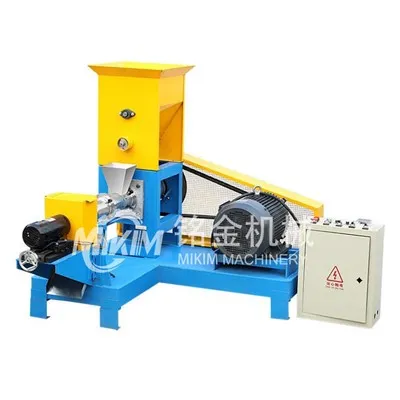
Is Producing Aquatic Pellet Feed More Profitable? Cost, Price and Sales Compared
Leave a message
Pellet Versus Powder Feed: Three Sources of Advantage
Aquatic pellet feed is more profitable than ordinary powdered feed for three connected reasons. It lowers unit cost through mass production, it commands a higher selling price because the pellet quality is visibly better, and it sells more steadily because buyers can rely on consistent quality from batch to batch. The three advantages reinforce one another: stable sales keep the line running near capacity, and running near capacity reduces unit cost further.
The reference figures below come from a small fish feed production line and are illustrative. They should be reworked with local ingredient prices, local selling prices and local labour rates before they are used for an investment decision.
Cost Advantage: Mass Production and Automation
Mass production on a fish floating feed production line reduces the input cost per unit of feed. The line requires an initial investment, but it also allows raw materials such as corn and soybean meal to be bought in wholesale quantities. In the reference case, bulk purchasing saves roughly 1000 RMB on five tons of feed compared with retail buying.
Automation contributes a second saving. A small line needs only one operator, replacing three workers who would otherwise be needed for manual mixing and pelleting. At 5000 RMB per worker per month, that is a saving of about 15,000 RMB per month, or 180,000 RMB a year. After the investment is recovered, the cost per kilogram of pellet feed is about 0.1 RMB lower than for ordinary powdered feed, which is the structural reason pellets can be sold at a premium while still leaving a wider margin.
Raw material saving: wholesale buying of corn and soybean meal instead of retail, about 1000 RMB per five tons in the reference case.
Labour saving: one operator replaces three manual workers, about 15,000 RMB per month at 5000 RMB per worker.
Recovery window: six months to one year on the line investment in the reference case.
Unit cost after recovery: roughly 0.1 RMB per kilogram lower than powdered feed.
Price Advantage: Water Resistance and Feed Performance
Pelleted feed is of higher quality and can therefore be sold at a higher price. Ordinary aquatic powder feed has poor water resistance, so it loses material into the water before the fish eat it, which wastes feed and pollutes the pond. In the reference case, powder feed sells for about 1.2 RMB per kilogram.
Aquatic pellet feed holds together in water, is eaten cleanly by fish and shrimp, and supports faster growth, so farmers accept a higher price. In the same reference case, pellet feed sells for about 1.5 RMB per kilogram, which is 0.3 RMB per kilogram more than powder feed. A supplier that previously sold 2 tons of powder feed a day with a profit of 200 RMB switched to 3 tons of pellet feed a day; with the extra 0.3 RMB per kilogram, daily profit reached about 900 RMB, some 700 RMB per day more than before.
Pellets can also be sold as a customised product, for example sinking small pellets formulated for shrimp farmers. That specialisation adds roughly 0.1 RMB per kilogram to the selling price and widens the margin further, as long as the plant can hold the pellet size and density consistently.
Sales Advantage: Consistent Quality Builds Repeat Orders
Pellet feed earns a good reputation, and steady sales generate long-term profit. The inconsistent quality of ordinary feed powder causes dissatisfaction, and farmers respond by switching suppliers. Pelleted feed offers uniform quality, which gives farmers confidence, encourages long-term partnership and results in more predictable repeat orders.
In the reference case, after a supplier switched from powder to pellets, the number of regular aquaculture farms it served grew from 10 to 30 and monthly sales tripled from 50 tons to 150 tons, doubling profit. Stable sales also let the production line run at high utilisation, which lowers unit cost in turn and creates a cycle of lower cost, higher margin and stable volume.
A Worked Comparison
| Item | Ordinary powder feed | Aquatic pellet feed |
|---|---|---|
| Water resistance | Poor, material leaches into the water | Good, pellets hold shape until eaten |
| Reference price (RMB/kg) | About 1.2 | About 1.5 |
| Reference daily volume (tons) | 2 | 3 |
| Reference daily profit (RMB) | About 200 | About 900 |
| Effect of customisation | Limited differentiation | About 0.1 RMB/kg added by species-specific sizing |
| Effect on buyer loyalty | Frequent supplier switching | Long-term repeat orders |
Read together, the three advantages explain why pellet feed can be more profitable even at the same feeding cost for the farmer: the price premium is paid for measurable feed performance, and the cost base falls because the same line runs longer at high utilisation.
What to Verify Before Investing
The reference figures assume a specific local context, so four points must be checked before an investment decision.
Wholesale saving: confirm the real bulk discount on corn and soybean meal in your region, and recalculate the numbers on a single unit system rather than mixing pounds and kilograms.
Labour saving: count the workers actually released by automation. A saving only exists where manual mixing and pelleting were genuinely being done by hand.
Selling prices: validate local prices for both powder and pellet feed for your target species, because the 1.2 to 1.5 RMB per kilogram gap varies by region, species and season.
Payback and utilisation: treat six months to one year as conditional on utilisation and on the sales case being typical rather than exceptional.
A simple sensitivity check makes the decision clearer: build a small table of ingredient cost per ton, achievable selling price and realistic monthly volume, and test the project at the low, mid and high end of each. If the project remains profitable at the low end, the model is robust enough to proceed.
Frequently Asked Questions
Q: Why is aquatic pellet feed more profitable than powder feed?
Three reasons act together: mass production lowers the unit cost, better quality supports a higher selling price, and consistent quality produces stable repeat sales that keep the line busy.
Q: How much more can pellet feed be sold for?
In the reference case, about 1.5 RMB per kilogram against 1.2 RMB for powder feed, a 0.3 RMB per kilogram premium. Customised pellet sizes for shrimp can add roughly another 0.1 RMB per kilogram.
Q: How long does the line investment take to recover?
The reference case projects six months to one year, depending on utilisation and selling prices. Verify both locally, because the payback period is the most utilisation-sensitive figure in the model.
Q: Where does the labour saving come from?
From automation. A small line needs about one operator, replacing roughly three workers who would otherwise carry out manual mixing and pelleting, which at 5000 RMB per worker per month is about 15,000 RMB saved monthly.
Q: Does water resistance matter commercially?
It matters directly. Powder feed leaches into the water, wasting feed and polluting the pond, whereas pellets are eaten cleanly and support faster growth, which is what persuades farmers to pay more.
Q: What is the main assumption to test first?
The achievable selling price in your target market and the achievable utilisation of the line. Tested together with ingredient cost per ton, these three values decide most of the outcome.