


How To Make Better Use Of small fish food pellet making machine?
Leave a message
content
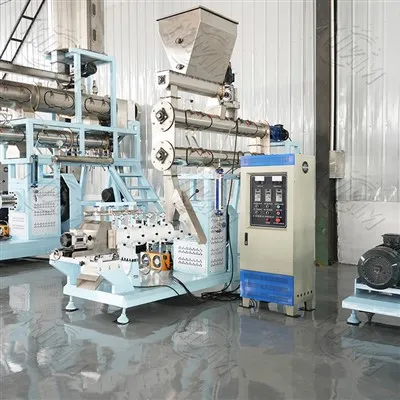
Core premise: Clarify the linkage logic between the dry pet food making machine and the pellet mill. The core operation of the fish feed pellet mill relies on the extrusion, maturation, and puffing functions of the twin-screw extruder. The feeding, forming, and cutting processes of the pellet mill must be synchronized with the temperature, pressure, and speed of the extruder; this is the foundation for efficient pellet mill utilization. Ignoring the linkage logic and blindly starting production will not only lead to substandard pellet quality (such as looseness, poor buoyancy, and uneven particle size) but also increase wear on the extruder and energy consumption. High-quality fish feed pellet mills and extruders adopt an integrated linkage design, enabling synchronous parameter adjustment through a PLC control system. This reduces manual intervention and improves linkage efficiency, which is key to maximizing the equipment's value.
Parameter optimization: Precise control through linkage with the mini floating fish feed machine improves both quality and efficiency. The first step is to optimize parameters according to fish feed specifications: When producing feed for 1-2mm juvenile fish, adjust the extruder temperature to 120-130℃, pressure to 4-5MPa, and speed to 300-320r/min. Adjust the pellet mill feed rate to 60%-70% of the designed capacity, and match the pelleting speed with the extruder output speed to avoid overly crushed pellets. When producing feed for 3-5mm adult fish, increase the extruder temperature to 140-150℃ and pressure to 5-6MPa, and adjust the pellet mill feed rate to 80%-90% of the designed capacity to ensure compact pellets with strong water resistance. The second step is to dynamically fine-tune parameters: Sample checks are performed every 20 minutes during production. If pellet buoyancy is insufficient, appropriately increase the extruder temperature by 5-10℃; if the pellets are too hard, reduce the extruder pressure by 0.5-1MPa and simultaneously fine-tune the pellet mill feed rate to achieve optimal parameter matching.
Authoritative reminder: Avoid common pitfalls in coordinated operation to reduce equipment wear and tear. Based on practical examples, many users easily fall into the trap of "emphasizing pelleting and neglecting extrusion," ignoring the adjustment of floating feed extruder machine parameters, leading to wasted pelleting capacity and a decrease in finished product qualification rate. Some users also excessively pursue capacity, blindly increasing the pelleting machine feed rate beyond the extruder's load, causing extruder blockage and screw wear, ultimately reducing equipment utilization. The correct approach is to always prioritize extruder performance, adjusting pelleting machine parameters accordingly, while adhering to the principle of "gradual and dynamic fine-tuning." This ensures both production efficiency and extends equipment lifespan, aligning with the EEAT algorithm's requirements for professionalism and reliability.
Related equipment


Finished Product Display

about Us
MIKIM's fish feed pellet production lines and supporting machinery offer excellent value for money. Not only are they affordable, eliminating middlemen markups and allowing small and medium-sized enterprises (SMEs) and fish farmers to purchase complete sets of equipment at reasonable costs, but they also boast exceptional efficiency. The fully automated process, from raw material crushing and precise ingredient mixing to extrusion pelleting and maturation, is completed in one continuous flow. This results in high starch gelatinization rates and uniform pellet formation, significantly improving production efficiency and feed quality, truly achieving "low cost, high output." Choosing a MIKIM fish feed pellet production line means enjoying comprehensive pre-sales and after-sales service, including 24-hour online customer support, a one-year warranty on the entire machine, professional on-site installation, commissioning, and maintenance, and a stable supply of spare parts. Customers can buy with confidence and use with peace of mind, with both excellent value and service quality!!!
Customer visit

Certificate of Honor

FAQ
1. What is the price of the Twin screw fish feed extruder machine?
The price ranges from approximately $1,500-$55,000
2. Do you provide maintenance services for your customers?
Yes, we offer comprehensive after-sales maintenance services to our customers.
To explore which twin screw pet food machine model is suitable for your product line, view our full range of equipment or contact our team for a customized production plan.


