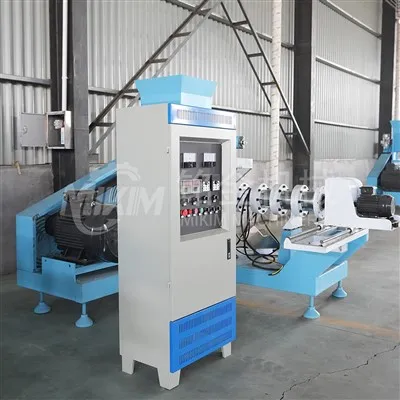
How to Maximize the Efficiency of a dog food maker machine?
Leave a message
content
Raw Material Screening and Grinding: Adapting to Pet Food Extruder Machine Operating Standards
Raw material screening is fundamental, requiring the removal of impurities such as sand and metal to prevent them from entering the extruder, causing wear on the screw and barrel, and reducing wear on the pellet mill cutter. Screened raw materials need to be ground, with the particle size controlled to 80-100 mesh. This is a core requirement for adapting to the extrusion and maturation processes of a twin-screw extruder-particles that are too large will lead to insufficient extrusion, difficulty in pelleting, and increased equipment load; particles that are too small will cause material agglomeration and easily clog the extruder die. It is recommended to use a graded grinding process to ensure uniform raw material particle size, laying the foundation for efficient pellet mill production and improving the digestibility and absorption rate of fish feed.
Raw Material Mixing and Moisture Control: Ensuring Pelletizing and Extrusion Effects
Raw material mixing must be uniform. Fish meal, soybean meal, corn flour, multivitamins, and other raw materials should be precisely proportioned according to the formula. The mixing time should be no less than 15 minutes to avoid localized nutritional imbalances and ensure full integration of raw materials and additives, improving the quality of fish feed. Moisture control is crucial; raw material moisture content must be maintained between 12% and 14%. Excessive moisture will cause material to clump together, clogging the feed channels of the extruder and pellet mill. Insufficient moisture will result in incomplete extrusion and loose, brittle pellets. Moisture can be adjusted through drying or water spraying to ensure the raw material moisture meets the standard, allowing for more efficient extrusion and maturation in the dog food extruder and more stable pelleting.
Special Raw Material Adaptation: Optimize pretreatment to improve equipment utilization
For high-fiber raw materials (such as alfalfa meal and bran), the addition amount should be controlled at 10%-15%. During pretreatment, the grinding time should be extended to control the particle size above 100 mesh, while appropriately increasing the moisture content to 14%-15% to prevent excessively hard fibers from clogging the extruder. For high-moisture raw materials (such as fresh minced meat), pretreatment should involve drying to 12%-14% moisture content, or adding an appropriate amount of corn flour to improve fluidity and prevent material from sticking to the pellet mill and dog food manufacturing machine. Precise pretreatment of special raw materials can reduce equipment failures, enable efficient linkage between the pellet mill and the extruder, and maximize equipment utilization.
Related equipment

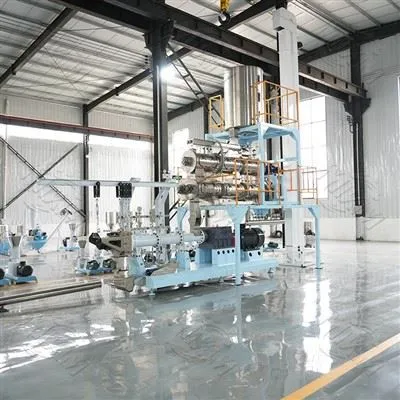
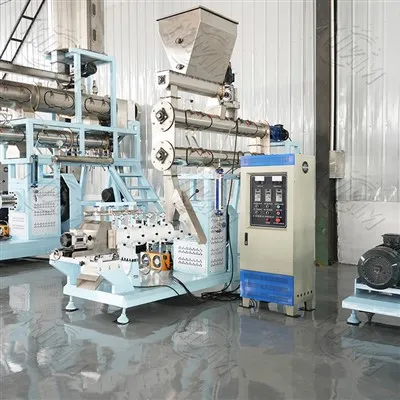

Finished Product Display

about Us
MIKIM's fish feed pellet production lines and supporting machinery offer excellent value for money. Not only are they affordable, eliminating middlemen markups and allowing small and medium-sized enterprises (SMEs) and fish farmers to purchase complete sets of equipment at reasonable costs, but they also boast exceptional efficiency. The fully automated process, from raw material crushing and precise ingredient mixing to extrusion pelleting and maturation, is completed in one continuous flow. This results in high starch gelatinization rates and uniform pellet formation, significantly improving production efficiency and feed quality, truly achieving "low cost, high output." Choosing a MIKIM fish feed pellet production line means enjoying comprehensive pre-sales and after-sales service, including 24-hour online customer support, a one-year warranty on the entire machine, professional on-site installation, commissioning, and maintenance, and a stable supply of spare parts. Customers can buy with confidence and use with peace of mind, with both excellent value and service quality!!!
Customer visit

Certificate of Honor

FAQ
1. What is the price of the mini fish feed machine?
The price ranges from approximately $1,500-$55,000
2. Do you provide maintenance services for your customers?
Yes, we offer comprehensive after-sales maintenance services to our customers.
To explore which twin screw pet food machine model is suitable for your product line, view our full range of equipment or contact our team for a customized production plan.