Factors That Determine Pellet Machine Output Capacity and Longevity
Leave a message
Four Factors That Decide Pellet Machine Output Capacity
Pellet machine output is not a single number taken from a nameplate. It is the result of four interacting factors: raw material condition, machine design and power configuration, process parameter matching, and daily operation and maintenance. When all four are aligned, a pellet mill reaches its rated throughput and holds it across long production runs. When any one of them drifts, output falls long before the machine itself shows a fault.
Raw material condition – moisture, particle size, formula and impurities
Machine design – die area, roller arrangement, geometry and rated motor power
Process matching – temperature, pressure and feed rate set as one system
Operation and maintenance – procedures, wear control and cleaning discipline
The sections below take each factor in turn and show what an operator can actually change.
Raw Material Condition and Machine Design
Raw materials sit at the centre of the pelletizing process. Moisture content, particle size, composition and impurity level all change how the material flows through the conditioning chamber and how it behaves at the die.
Moisture: material that is too dry crumbles and fails to bind, while material that is too wet sticks, bridges and slows the feed flow.
Particle size: oversized particles jam the die holes and raise motor load, while an excessively fine grind can cut throughput per pass.
Composition: high-fat or high-fibre formulas need different conditioning than standard grain recipes.
Impurities: stones, metal fragments and foreign matter accelerate die and roller wear and increase unplanned downtime.
Conditioning the material, controlling the grind and cleaning the ingredients before they enter the machine are therefore the first practical step towards stable, high output.
Machine design sets the ceiling for capacity. Die area, roller arrangement, ring-die or screw geometry and rated motor power must be matched to each other and to the planned throughput. A large die driven by an undersized motor cannot reach its potential, while an oversized motor on a small die wastes energy and increases the risk of die damage. Selecting the machine against a clear target capacity and against the typical raw materials it will process avoids both mistakes.
| Design parameter | Why it limits output |
|---|---|
| Effective die area | Determines the number of extrusion openings and the open area per revolution |
| Roller to die clearance | Too wide reduces bite and throughput, too tight raises wear and power draw |
| Rated motor power | Caps the mechanical work available for compression |
| Transmission ratio | Sets the die speed range available for different formulas |
Process Parameter Matching
Output also depends on how the process is set. Temperature, pressure and feed rate must be adjusted together so that the material and the equipment reach an optimal matching state. Steam conditioning temperature and added moisture decide how easily the material passes through the die, and the feed rate must be balanced against motor load and die capacity. Poor settings can cut output sharply even on a well-designed machine, while careful tuning raises production efficiency and pellet quality at the same time.
Practical starting points for a typical grain-based recipe are a conditioning temperature of 75–85 °C, a mash moisture of 15–17 % after conditioning, and a die compression ratio chosen to suit the formula. From there, the operator adjusts feed rate in small steps while watching motor load and pellet durability rather than chasing a single peak reading.
Daily Operation and Maintenance
Standardized daily work and timely maintenance protect effective production time and long-term output stability.
| Check point | Frequency | Effect on output |
|---|---|---|
| Die and roller wear | Every shift | Worn surfaces reduce bite and raise power per tonne |
| Lubrication of main shaft and rollers | Per schedule | Prevents seizure and unscheduled stops |
| Start-up and shut-down sequence | Every run | Avoids blocked dies and hard starts |
| Line cleaning and magnet check | Daily and weekly | Stops contamination, bridging and metal damage |
Following a fixed procedure and keeping the machine in its design condition matters as much as the hardware choice. The discipline of the operating crew is what turns a correctly sized pellet mill into a dependable production asset.
Components of a Complete Pellet Line
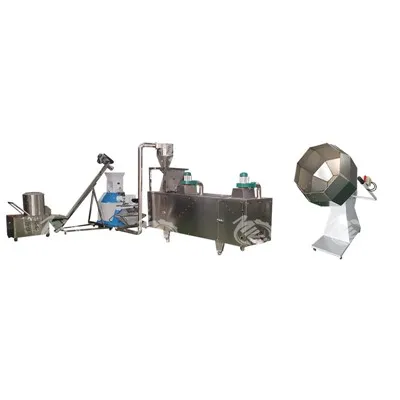
A complete pellet production line combines several machines, each with a defined role in the process.
| Component | Function |
|---|---|
| Hammer mill | Grinds straw, grain, soybean meal and other raw materials into powder |
| Screw conveyor | Transfers grain and powdery materials in a sealed, clean flow |
| Stainless steel mixer | Mixes powdered raw materials evenly and quickly |
| Feed pellet machine | Forms the conditioned powder into pellets of various sizes |
| Cooler | Cools the pellets evenly with countercurrent air |
| Packer | Weighs and bags the finished product |
As a reference for a large commercial line, one typical configuration runs at 15–20 t/h, is operated by about 4–5 workers, ships in approximately six 40 ft containers, and produces pellets selectable from 1 mm to 12 mm with automatic batching and direct packaging. The footprint is arranged according to the available land and layout.
FAQ
Q: What moisture content gives the best pellet output?
For most grain-based feeds a mash moisture of 15–17 % after conditioning balances die lubrication against steam demand, but the correct value always depends on the formula and the die in use.
Q: Does a bigger motor always mean higher output?
No. Motor power must match die area and roller geometry. An oversized motor on a small die wastes energy and can damage the die, while an undersized motor limits a large die to a fraction of its capacity.
Q: How often should the die be replaced?
Replace the die when pellet durability falls, motor load rises at the same feed rate, or the hole pattern shows uneven wear. Typical service life ranges from several hundred to well over a thousand hours, depending on abrasive content and operating discipline.
Q: Why does output drop in humid weather?
Ambient humidity raises the moisture of stored ingredients and of the conditioned mash, which makes the material sticky at the die. Reducing added steam and tightening grind control normally restores throughput.
Q: Can one line produce several pellet sizes?
Yes. Pellet diameter is set by the die, so a plant can change between 1 mm and 12 mm pellets by fitting different dies and rebalancing cooling and screening settings.
Q: What is the single biggest cause of lost output?
In most plants it is inconsistent raw material, followed by worn dies and rollers. Both are addressed by incoming material control and a strict wear inspection routine rather than by buying a larger machine.