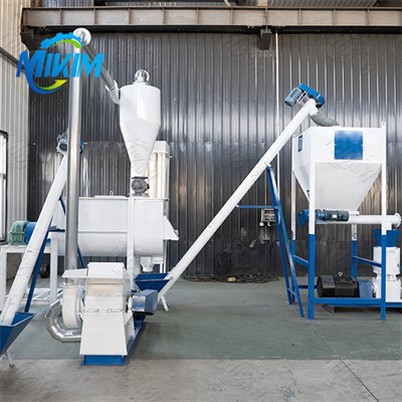
What are the differences in structure and working principle between screw and twin-screw fish feed extruders?
Leave a message
When buying a fish feed extruder, many people struggle with the choice between a single-screw and a twin-screw extruder. Sellers claim twin-screw extruders are "more advanced," while single-screw extruders are "cheaper." However, many people don't understand the differences in their internal structure and operation. In fact, the differences in structure and operating principle directly affect the extruder's production efficiency. For example, whether the fish feed can be made more uniform and more water-resistant depends on these two factors.
First, let's look at the structure: the core differences lie in the "number of screws" and the "barrel design."
Single-screw extruder: Simple structure, just one "spindle." The core of a single-screw extruder is "one screw + one barrel"-the screw, like a threaded iron rod, is installed inside a cylindrical barrel; the barrel has only one feed inlet. After the raw material enters through the feed inlet, it is entirely "pushed" forward by the threads of this screw. At the same time, the barrel heats and softens the raw material, extrudes it, and finally extrudes it into granules through the die. The overall structure is simple, with few parts, such as the screw, barrel, and die, without too many complex components.
Twin-screw extruder: Two screws working together, more complex structure
A twin-screw extruder consists of "two parallel screws + a double-hole barrel"-the threads of the two screws mesh together (like two gears meshing), and the barrel may have 2-3 feed ports (main feed port plus auxiliary feed port); after the raw material enters, it is not pushed by one screw, but rather "clamped" by the two screws and fed forward, and the shearing force of the threads can also make the raw material more finely chopped and more uniformly mixed. Structurally, it has an extra screw and a synchronizing gear (to ensure that the two screws rotate at the same speed), and the number of parts is twice that of a single-screw extruder.
Let's look at the working principle: The "pushing method" determines the raw material processing effect.
Single screw: Pushing material by "friction," weak mixing force. When a single screw extruder is working, the raw material moves forward by the friction between the screw thread and the inner wall of the barrel. For example, after fishmeal and cornstarch are mixed in, when the screw rotates, the thread pushes the raw material forward, and the barrel heats up the raw material to make it into a "soft dough," which is finally extruded through the die to form granules. However, this method has weak mixing force. If the raw material contains fine powder or additives, it is easy to have uneven mixing. For example, vitamins may only be on the surface of the granules and not inside.
Twin-screw extruders rely on "meshing and shearing" to push materials, resulting in strong mixing force.
The two screws of a twin-screw extruder rotate in opposite or the same direction. When the threads mesh, they generate "shearing force"-after the raw material enters, it is not only pushed forward but also "crushed and mixed" by the two screws. For example, added fish oil and probiotics can be stirred into the raw material by the shearing force, resulting in a particularly uniform mixture. Furthermore, the barrel heating is more uniform (twin-screw extruders have segmented barrel heating), the raw material softens more thoroughly, and the extruded particles have a more consistent density.

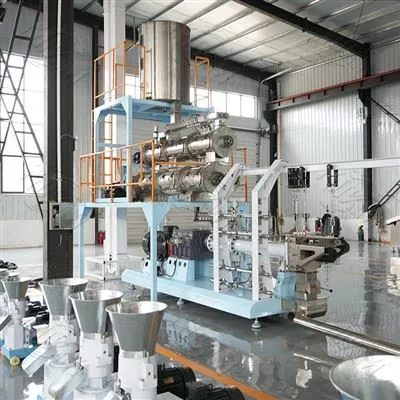
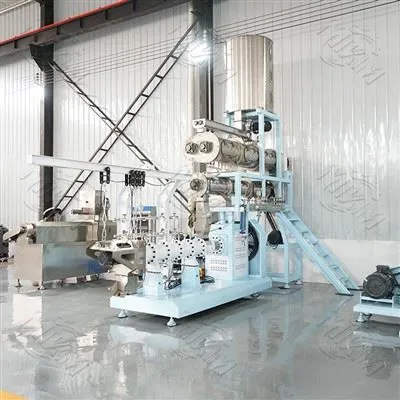

Impact of Structure and Principle on Fish Feed Production: Twin-Screw Extruders Are More Suitable for "Refined Needs"
For example, when making sinking feed for sea bass, high particle density and uniform nutrition are required. The shearing and mixing action of a twin-screw extruder allows fishmeal and starch to be fully integrated, resulting in better water resistance of the particles. However, when making floating feed for ordinary grass carp, the requirements are not as high, and the simple structure of a single-screw extruder can meet the needs, as long as the particles can be extruded.
Why Choose Us
MIKIM boasts extensive experience in poultry feed pellet production lines, significantly reducing the incidence of poultry diseases. Its equipment is not only widely used across various industries domestically but also exported to Southeast Asia, Europe, Africa, and South America, earning a high reputation internationally. This global presence not only demonstrates the adaptability and competitiveness of its products, but also demonstrates the company's experience in adapting to diverse market standards and logistics conditions, enabling it to provide a stable supply chain for its overseas customers. Whether serving large domestic farms or cross-border feed companies, MIKIM can leverage its global service network to ensure a consistent, high-quality experience.
For more information on process flow design, equipment layout, factory construction plans, individual equipment pricing, or turnkey project proposals, please feel free to contact us!!!

FAQ
1. What is the price of the fish feed manufacturing machine?
The price ranges from approximately $5,000-$26,000
2. Do you provide maintenance services for your customers?
Yes, we offer comprehensive after-sales maintenance services to our customers.