


What’s the proper way to pick a Reptile pet turtle feed production line?
Leave a message
Key Selection Points
The feed pellet hardness should be adapted to the chewing ability of turtles: For juvenile turtles with softer beaks, the pellet hardness needs to be controlled at 1-2 kg/cm². The production line needs to adjust the extruder pressure (reducing it to 2-3 MPa) and use a low compression ratio die (1:4-1:6). For adult turtles with harder beaks, the pellet hardness can be increased to 2-3 kg/cm², requiring a corresponding increase in extruder pressure and die compression ratio. Furthermore, the pellet production line must be equipped with a hardness testing device to sample and test each batch, avoiding improper hardness that could cause difficulty in feeding or damage to the turtles' beaks.
The raw material processing module should be optimized to suit the omnivorous nature of turtles: Turtle feed needs to be a mixture of plant-based ingredients (such as pumpkin powder and alfalfa powder) and animal-based ingredients (such as shrimp powder and silkworm pupa powder). The production line needs to be equipped with a dual-shaft paddle mixer to achieve a mixing uniformity of over 95%, preventing picky eating and nutritional imbalances. Simultaneously, to address the coarse fiber in the plant-based ingredients, the production line needs a secondary grinding system to grind the coarse fiber to 60-80 mesh, ensuring smooth digestion for the turtles' digestive system.
Choose the pellet form according to the turtles' feeding habits: Turtles mostly feed in water or on land. If producing aquatic turtle feed, refer to the fish feed process and add a simple coating process to improve stability in water (it only needs to keep it from collapsing for 2 minutes). If producing tortoise feed, the pellets can be designed to be cylindrical (4-5mm in diameter). The production line needs to be equipped with "irregular shape molds" and "surface roughening treatment" to make it easier for turtles to bite and grab.
Main equipment of Floating turtle feed pellet production line
extruder pellet machine

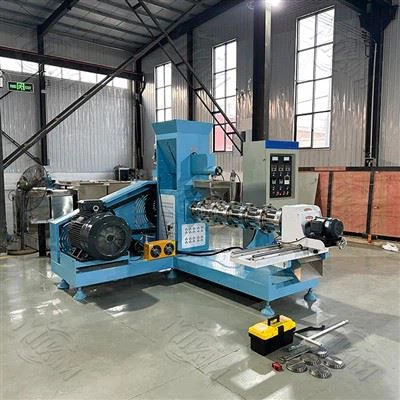


parameter
|
|
|
|
|
|
|
|---|---|---|---|---|---|
|
|
|
|
|
|
|
|
|
|
|
|
|
|
|
|
|
|
|
|
|
|
|
|
|
|
|
|
|
|
|
|
|
|
|
|
|
|
|
|
|
|
|
|
|
|
|
|
|
about Us
MIKIM boasts extensive experience in poultry feed pellet production lines, significantly reducing the incidence of poultry diseases. Its equipment is not only widely used across various industries domestically but also exported to Southeast Asia, Europe, Africa, and South America, earning a high reputation internationally. This global presence not only demonstrates the adaptability and competitiveness of its products, but also demonstrates the company's experience in adapting to diverse market standards and logistics conditions, enabling it to provide a stable supply chain for its overseas customers. Whether serving large domestic farms or cross-border feed companies, MIKIM can leverage its global service network to ensure a consistent, high-quality experience.
Customer visit

FAQ
1. What is the price of the animal floating meal extruder line?
The price ranges from approximately $13,000-$39,000
2. Do you provide maintenance services for your customers?
Yes, we offer comprehensive after-sales maintenance services to our customers.


