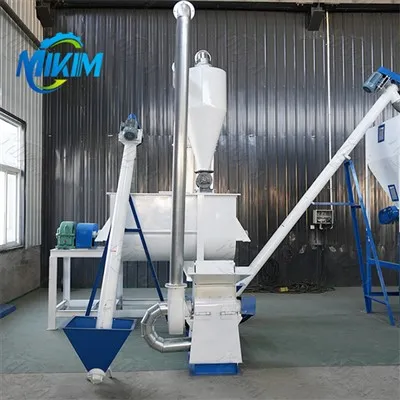
Why Can a Fish Food Pellet Making Production Line Produce Water-Resistant Feed?
Leave a message
Introduction
Water resistance is the difference between feed and water pollution: pellets that disintegrate in the water sink to the bottom, decay and harm the pond, while pellets that hold together are eaten before they degrade. The fish and shrimp feed production line, building upon the aquaculture line, incorporates several specialized pieces of equipment tailored to the feeding characteristics of fish and shrimp. This article explains the four devices that create water resistance and the farming problems that follow when they are omitted.
An ultrafine grinder reduces raw materials to at least 100 mesh for weak fish and shrimp digestion.
A dual-shaft conditioner mixes steam thoroughly, giving pellets that survive 3-5 minutes of soaking.
A fine-pore ring die of 1-3 mm matches the small mouths of fish and shrimp.
An oil spraying machine coats cooled pellets with fish oil for palatability.
Without these devices: diarrhea from coarse feed, water pollution from disintegrating pellets, and shell rot in shrimp.
1. The Ultrafine Grinder: 100 Mesh for Weak Digestion
Fish and shrimp have weak digestive systems, requiring raw materials to be ground to at least 100 mesh, a level ordinary grinders cannot achieve. This equipment grinds the raw materials into a fine powder that is easily digestible for fish and shrimp. In shrimp farming, without an ultra-fine grinder the raw materials are not ground finely enough, the shrimp cannot digest them, and diarrhea easily occurs, slowing growth and increasing mortality.
2. The Dual-Shaft Conditioner: Steam Mixed Thoroughly
The dual-shaft conditioner has an additional stirring shaft compared with ordinary conditioners, ensuring more thorough mixing of steam and raw materials, resulting in more uniform moisture and temperature. The consequence is pellets with exceptional water resistance that do not disintegrate even after soaking in water for 3-5 minutes. Without a dual-shaft conditioner, the pellets disperse in the water, sink to the bottom and pollute the water, making shrimp more susceptible to shell rot.
3. The Fine-Pore Ring Die: 1-3 mm for Small Mouths
The pellet mill uses a fine-pore ring die with a 1-3 mm aperture, perfectly fitting the small mouths of fish and shrimp, unlike the larger apertures of livestock feed ring dies. Matching pellet size to mouth size is a basic rule of aquaculture feeding: oversized pellets are rejected, and undersized pellets waste energy. The fine-pore die also increases the pellet's density, which supports its water stability.
4. The Oil Spraying Machine: Palatability and Attractiveness
An oil spraying machine coats the cooled pellets with fish oil, making them fragrant and appealing and attracting fish and shrimp eagerly. Oil application after cooling, rather than during mixing, protects heat-sensitive oils and maximizes aroma, which improves feed intake and reduces the feed that is left uneaten.
Supporting Equipment of the Line
Other components are similar to the aquaculture line: a raw-material silo and cleaning machine ensure cleanliness, a mixing and blending machine precisely dispenses nutrients, a cooling and drying machine extends shelf life, and a screening machine selects qualified pellets. Together these specialized devices make fish and shrimp feed more palatable and make farming easier, which is why a purpose-built fish feed line outperforms a converted livestock line on both growth and pond-water quality.
Frequently Asked Questions
Why is 100 mesh grinding needed for fish feed? Fish and shrimp have weak digestive systems; material ground to at least 100 mesh is fine enough to digest, preventing diarrhea and poor growth.
How long should fish feed resist water? Quality pellets survive 3-5 minutes of soaking without disintegrating, which is enough time for fish to consume them before they degrade.
What does the dual-shaft conditioner do? Its additional stirring shaft mixes steam and raw materials more thoroughly, giving uniform moisture and temperature and producing water-resistant pellets.
Why a 1-3 mm ring die for fish feed? It matches the small mouths of fish and shrimp; oversized pellets are rejected and wasted, and the fine-pore die also increases pellet density and water stability.
Why spray oil after cooling? Post-cooling application protects heat-sensitive oils, maximizes aroma and palatability, and attracts fish and shrimp to eat the feed promptly.
What happens without an ultrafine grinder in shrimp farming? Coarse raw material cannot be digested, causing diarrhea, while disintegrating pellets pollute the water and make shrimp more susceptible to shell rot.