Why Invest in an Animal Feed Pellet Production Line for Modern Livestock Farms
Leave a message
Why Manual Mixing and Pelleting Cannot Keep Up
Feed production on many farms still follows two very different patterns. In the first, operators weigh, blend and press feed by hand, daily output stays low, and quality depends on whoever is on shift. In the second, cleaning, grinding, dosing, mixing, conditioning, pelleting, cooling and packing are linked into one continuous flow that runs on fixed process parameters. An animal feed pellet production line replaces the variability of manual work with repeatable settings, which is why a small family farm, a regional feed mill and a large integrated producer can all turn out pellets to the same technical standard.
The gap between the two patterns is not only about speed. Manual pelleting also leaves the operator to judge moisture, die clearance and cooling time by eye, so two batches made on the same day can differ in hardness and durability. A production line removes that judgement from the critical path by fixing the settings that matter.
Five Core Benefits of a Feed Pellet Production Line
Continuous output: a linked line lifts daily capacity far beyond manual mixing and pelleting, and the number of operators per shift falls because conveying, dosing and packing run automatically.
Stable nutrition: accurate dosing, uniform mixing and steam conditioning keep every batch close to the formula, so nutrient imbalance is prevented instead of being discovered later through slow growth or reduced egg production.
Lower cost and lower risk: enclosed conveying and dust collection control dust and noise, bulk purchasing of corn and soybean meal lowers raw material cost, and energy per ton drops once the line runs near its rated load.
Better animal performance: conditioned and compressed pellets are denser and more digestible, which supports feed intake, survival rate and a shorter growth cycle.
Room to grow: the line can start at farm scale and be extended later with extra silos, a second pellet mill or an automatic packing unit as the herd or the customer base grows.
The Five Process Steps Inside a Feed Pellet Line
Cleaning and crushing: corn, soybean meal, bran and straw are screened to remove stones, metal and lumps, then ground by a hammer mill into a fine, uniform powder.
Dosing and mixing: every ingredient is weighed to the formula and blended until the mix is homogeneous; premixes and additives enter the flow at this stage.
Conditioning and pelleting: steam and moisture soften the starch, and the pellet mill presses the mash through the die into dense pellets of the required diameter.
Cooling and drying: a counterflow cooler brings pellet temperature down towards ambient and moisture to a safe level, so pellets stay firm in storage.
Screening and packing: fines and broken pellets are screened out and returned to the mill, while the finished pellets are weighed, bagged and sewn for delivery.
Core Equipment and What Each Machine Does
| Machine | Function | Practical note |
|---|---|---|
| Hammer mill | Grinds grain, straw and oilseed meal into powder | Sieve aperture sets the final particle size |
| Screw conveyor | Moves grain and powder in a sealed tube | Enclosed design keeps the material clean and dust-free |
| Mixer | Blends weighed ingredients into a homogeneous mash | Stainless steel contact parts suit small and medium mills |
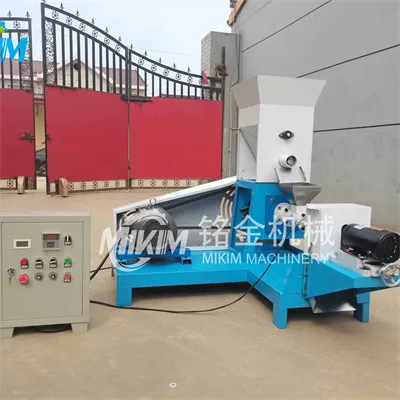
| Feed pellet machine | Compresses conditioned mash through a ring die or flat die | Die hole size decides pellet diameter and hardness |
| Counterflow cooler | Cools hot pellets evenly with ambient air | Smooth discharge avoids pellet cracking |
| Automatic packer | Weighs, fills and sews bags of finished pellets | Handles granular and mixed materials |
Each machine can also be bought and installed on its own. A farm that already owns a grinder can add a mixer and a pellet mill first, then extend to cooling and packing when volumes justify it.
Matching Line Capacity to Farm Scale
Small farm or cooperative: a compact line around 200 kg per hour covers daily needs and can be operated by one or two people.
Medium feed mill: lines of roughly 1 to 5 tons per hour, usually built around a ring-die mill with steam conditioning, serve several farms or a growing herd.
Industrial plant: lines above 20 tons per hour combine buffer silos, automatic dosing and high-capacity packing for continuous operation.
When comparing quotations, check the automation level, the free floor space, the local electricity price and the dust and noise control that local environmental rules require. A line that is slightly oversized for today and correctly sized for the next three years is usually cheaper than rebuilding twice.
Frequently Asked Questions
Q: How much space does a feed pellet production line need?
A compact 200 kg/h line can fit into a workshop of roughly 60 to 100 square metres, while a 1 to 5 t/h mill usually needs a two-level building so that material can flow down through the process by gravity.
Q: Can I add machines to the line later?
Yes. Crushing, mixing, pelleting, cooling and packing are separate modules, so a farm can buy the grinder and pellet mill first and add the cooler, screener or packer when output grows.
Q: Which pellet diameter suits poultry and livestock?
Poultry and piglets normally take 2 to 3 mm pellets, growing pigs and dairy cattle are usually fed 4 to 6 mm pellets, and adult cattle rations often run from 6 to 8 mm.
Q: Is steam conditioning necessary on every line?
For poultry and swine feed, steam conditioning improves starch gelatinisation, pellet durability and throughput. Small farm lines sometimes run without a conditioner, but accept lower durability.
Q: How long does installation and commissioning take?
A compact farm line is normally installed and test-run within one to two weeks, while a multi-storey mill needs longer for civil work, steel structure and electrical installation before the first trial batch.
Q: What maintenance does the line need?
Daily checks cover die wear, roller clearance, belt tension and lubrication points; weekly checks cover screw conveyor seals, dust collector filters and electrical terminals.