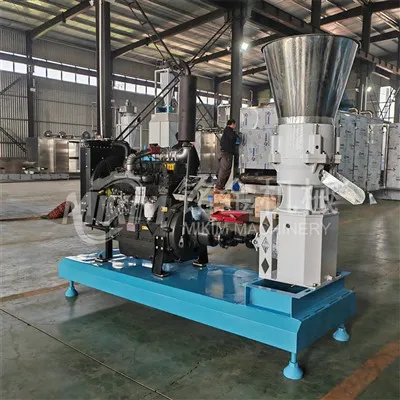
What Are The Core Structural Features Of A Small Feed Granulator Machine?
Leave a message
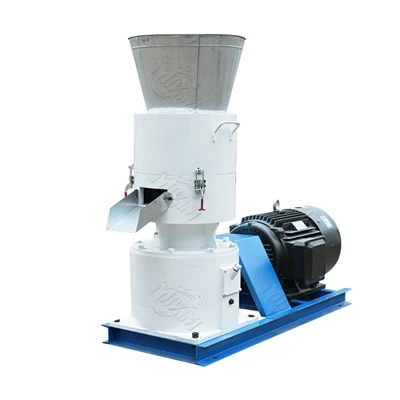
While Diesel feed pellet mills vary in model, their core structure revolves around the logic of "power transmission - raw material extrusion - pellet forming." They are mainly composed of five core parts: a power system, an extrusion system, a transmission system, a feeding system, and a control system. These parts work together to transform raw materials into pellets.
The power system is the "heart" of the pellet food machine, primarily consisting of a motor and a reducer. The motor, as the power source, is selected based on the equipment's capacity. Small pellet mills (with an hourly output below 500kg) typically use 11-15kW standard copper wire motors, while larger machines require 37-90kW motors to ensure sufficient power. The reducer converts the high-speed rotation of the motor into the low-speed, high-torque required by the extrusion system. Gear reduction or belt reduction is commonly used. Gear reduction offers higher transmission efficiency (over 98%), suitable for high-load production; belt reduction provides a buffering effect, protecting the motor from impact.
The extrusion system is the "core battlefield" of pellet forming, composed of the die head, pressure rollers, and pressure roller shafts. This is the key structure determining pellet quality. The die head is annular or disc-shaped, with uniformly sized pores throughout. Under pressure, the raw material passes through these pores to form granules. The pore diameter can be selected from 2-8mm depending on requirements; for cattle and sheep feed, it is typically 3.5-5mm, while for poultry feed, it is 2-3mm. The pressure roller is tightly fitted to the die head, and its relative rotation extrudes the raw material. The textured design on the roller surface enhances friction with the material, preventing slippage and improving extrusion efficiency.
The transmission system transmits power to the extrusion system and mainly includes the main shaft, bearings, and couplings. The main shaft is made of high-strength alloy steel, capable of withstanding the immense pressure during extrusion and preventing deformation. The bearings are high-temperature resistant tapered roller bearings, allowing stable operation in the high-temperature environment generated during equipment operation and extending their service life. The coupling connects the motor and the main shaft, ensuring smooth power transmission.
The feeding system consists of a hopper, feeder, and a mixer, responsible for evenly conveying the raw material to the extrusion system. The hopper capacity is designed according to production capacity, ranging from 50-100L for small equipment to over 500L for large equipment. Feeders typically use frequency converters to adjust the feeding speed based on the extrusion system load, preventing raw material accumulation or insufficient supply. Agitators perform preliminary mixing of the raw materials during feeding, ensuring uniform moisture content and composition.
The control system is the "brain" of the equipment. Small chicken feed processing machines often use button controls for basic functions such as start-up, stop, and speed adjustment. Large automated equipment is equipped with a PLC touchscreen control system, which can precisely set parameters such as temperature, pressure, and feeding speed, monitor equipment operation status in real time, and automatically alarm in case of malfunction.


about Us
We offer:
One-Year Whole Machine Warranty Service
On-site Installation, Commissioning, and Technical Guidance
24/7 Online Technical Support
Qualifications and Honors

Customer visit

FAQ
1. What is the price of the pellet making machine for poultry feed?
The price ranges from approximately $2,500-$20,000
2. Do you provide maintenance services for your customers?
Yes, we offer comprehensive after-sales maintenance services to our customers.