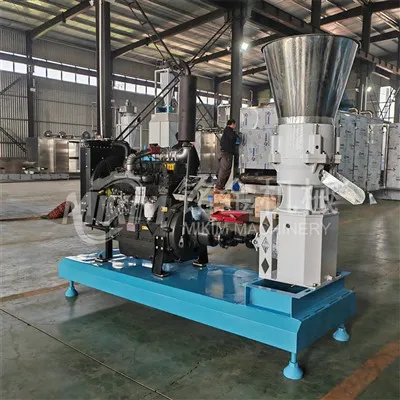
What Is The Process Flow And Main Equipment Of The Floating Fish Feed Making Production Line?
Leave a message
The production of aquatic fish and shrimp feed follows the core principle of "protecting nutrition and enhancing pelleting." The entire process is interconnected, with each step requiring specialized equipment to meet the feeding needs of fish and shrimp in the water. The complete fish pellet production line process mainly includes eight stages: raw material receiving and cleaning, crushing, ingredient mixing, conditioning, pelleting, drying and cooling, screening and grading, and finished product packaging. Each stage has strict standards for equipment selection and parameter settings.
The raw material receiving and cleaning stage is the first line of defense for quality control. Fish and shrimp feed raw materials mainly consist of fishmeal, shrimp meal, soybean meal, and corn. Fishmeal is prone to impurities such as shells and sand, requiring initial impurity removal using a vibrating screen (1-2mm screen diameter) followed by permanent magnet adsorption of metallic impurities to prevent wear on subsequent equipment. The core equipment in this stage is an automatic feeder and a grading and cleaning screen. The feeder uses a sealed design to prevent dust from being emitted from lightweight raw materials such as fishmeal, while the cleaning screen separates impurities of different particle sizes through multiple layers of mesh, ensuring a raw material purity of over 99%.
The grinding and mixing stages directly determine the feed's digestibility and absorption rate. Fish and shrimp feed requires extremely fine particle sizes; fish fry feed needs to be ground to at least 100 mesh, while adult fish feed requires 60-80 mesh. Therefore, an ultrafine grinder is necessary, using high-speed rotating hammers (3000 rpm) to grind the raw materials to the specified particle size. A matching cyclone separator quickly separates dust and fine powder, reducing raw material loss. The mixing stage uses a fully automatic electronic weigher to accurately weigh fishmeal, premixes, and other ingredients according to the formula, with an error controlled within ±0.1%. The mixture is then fed into a twin-shaft paddle mixer for 4-5 minutes to ensure uniform distribution of vitamins, minerals, and other trace components, with a coefficient of variation of less than 7%.
Conditioning, pelleting, and drying/cooling are crucial for fish and shrimp feed formation. The conditioning stage uses a steam conditioner to raise the raw material temperature to 95-100℃ and control the humidity at 16%-18%, ensuring thorough starch gelatinization and laying the foundation for subsequent forming. The pellet mill needs to be equipped with a special ring die. For shrimp feed, a 2-3mm aperture ring die with a compression ratio of 1:8 is used; for grass carp feed, a 3-5mm aperture ring die with a compression ratio of 1:6 is used. The raw materials are compressed into pellets under a pressure of 10-15MPa. The freshly made pellets reach a temperature of 80-100℃ and need to be sent to a rotary drum dryer for segmented temperature-controlled drying: 70-80℃ in the feeding zone, 80-90℃ in the intermediate zone, and 60-70℃ in the discharge zone, ultimately reducing the moisture content to 12%-13%. Then, they are cooled to room temperature by a counter-current cooler. Finally, broken particles are removed by a vibrating grading screen, and the pellets are packaged in 20kg bags by an automatic packaging machine. The entire screw feed production line needs to be equipped with an online moisture analyzer and particle size analyzer to monitor product quality in real time.
Why choose us?
The MIKIM extruder is constructed entirely of food-grade 304 stainless steel, fully complying with food processing hygiene standards. It is corrosion-resistant, easy to clean, and eliminates potential contamination at the source. The core screw is made of high-quality alloy steel through special heat treatment, offering outstanding wear resistance and corrosion resistance. Combined with its integrated structural design, this significantly extends its service life. The entire machine has passed CE and ISO international authoritative certifications, aligning with global quality standards and ensuring safer and more reliable processing.
Our equipment


Our Services
We offer:
One-Year Whole Machine Warranty Service
On-site Installation, Commissioning, and Technical Guidance
24/7 Online Technical Support
Qualifications and Honors

Customer visit

FAQ
1. What is the price of the floating feed production line?
The price ranges from approximately $8,500-$50,000
2. Do you provide maintenance services for your customers?
Yes, we offer comprehensive after-sales maintenance services to our customers.