



Automated Feed Production Line Equipment | PLC Controlled 1-20 t/h

Automated Feed Production Line Equipment | PLC Controlled 1-20 t/h

Automated Feed Production Line Equipment | PLC Controlled 1-20 t/h

Automated Feed Production Line Equipment | PLC Controlled 1-20 t/h

Automated Feed Production Line Equipment | PLC Controlled 1-20 t/h
Automated Feed Production Line Equipment | PLC Controlled 1-20 t/h
Fully automated feed production lines with PLC batching, automatic micro-dosing and central control from 1 to 20 t/h. Section layout, installed power, labour and commissioning scope from Mikim.
Description
An automated feed production line is a plant in which raw material intake, grinding, batching, mixing, pelleting, cooling, screening and packing run under central control, with recipes stored in the system and every batch recorded. Automation is not about replacing the pellet mill - it is about removing the operator decisions between the raw material and the finished bag. Mikim builds these lines from 1 t/h to 20 t/h, with PLC batching, automatic dosing of micro-ingredients and full batch traceability.


What Counts as an Automated Feed Production Line?
"Automated" is used loosely in this industry, so it is worth being precise. Three levels exist, and the price gap between them is large.
| Level | What is automatic | What the operator still does | Typical output range |
|---|---|---|---|
| Manual / standalone machines | Nothing - each machine is started and stopped by hand | Weighs ingredients, carries material between machines, sets every parameter | 0.1–1 t/h |
| Semi-automatic line | Batching scale and mixer run a stored recipe; machines interlocked | Loads raw material into intake, moves bags at packing, monitors the process | 1–3 t/h |
| Fully automated line | Intake through packing under PLC; auto dosing, auto pellet mill load control, auto packing and palletising | Supervises, handles exceptions, enters recipes | 3–20 t/h |
The jump that matters most for most buyers is from manual to semi-automatic. That is where recipe consistency and batch accuracy become system-controlled rather than operator-dependent, and it costs a fraction of full automation.
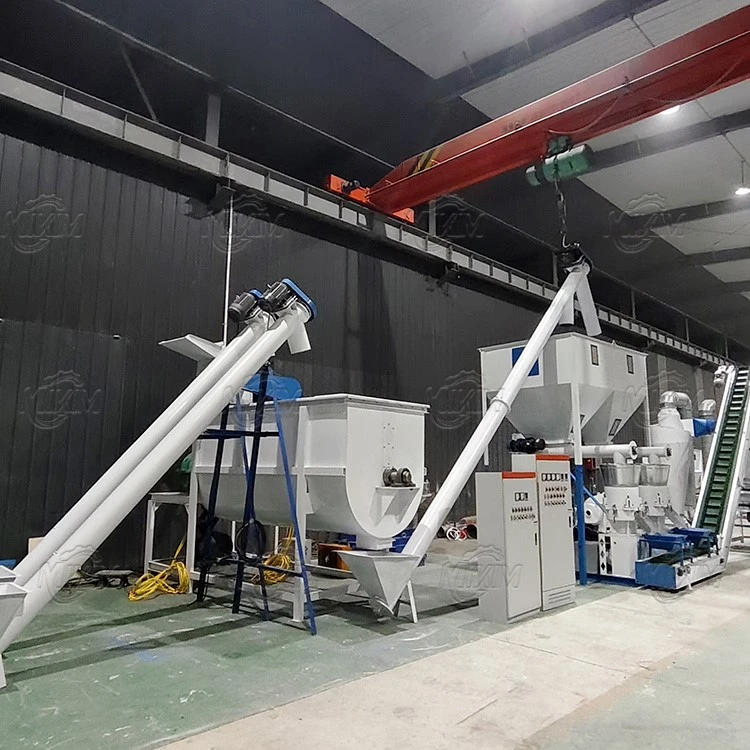
Process Sections and Their Control Points
| Section | Main equipment | Automation function | Controlled parameter |
|---|---|---|---|
| 1. Intake and cleaning | Intake pit, drum sieve, permanent magnet | Auto-start on level sensor; magnet alarm on metal detection | Intake rate, foreign material removal |
| 2. Grinding | Hammer mill with auto-load feeder | Mill motor load fed back to the feeder to hold amperage at setpoint | Grind size 2–5 mm, motor load |
| 3. Batching and weighing | Batching scale, multiple dosing bins, micro-ingredient scale | PLC calls recipe, opens screws in sequence, auto-corrects for in-flight material | Batch accuracy ±0.1% FS on major, ±0.05% on micro |
| 4. Mixing | Double-shaft paddle or ribbon mixer | Timed cycle with liquid addition interlocked to the dry mix phase | Mix time 90–180 s, CV below 5% |
| 5. Conditioning and pelleting | Conditioner, ring die or flat die pellet mill | Mill load controlled by feeder speed; steam valve modulated on mash temperature | Conditioning 80–85 °C, mill amperage |
| 6. Cooling and drying | Counter-flow cooler | Discharge rate modulated on pellet temperature at the outlet | Pellet temp within 5 °C of ambient |
| 7. Crumbling and screening | Crumbler, rotary screen | Roll gap set from the HMI; fines returned automatically to the pellet mill | Crumb size 1–2 mm, fines below 3% |
| 8. Packing and palletising | Weighing & bagging scale, robot palletiser | Auto tare, auto reject on out-of-tolerance weight, pallet pattern stored per SKU | Bag weight ±0.2%, pallet count |
| 9. Central control | PLC, HMI, MES / batch reporting | Recipe library, alarms, batch report, consumption and downtime logging | OEE, per-batch traceability |
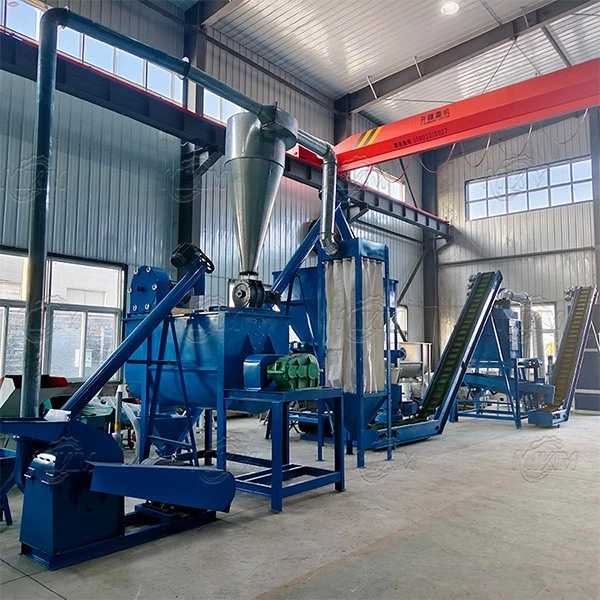
Automation Architecture: PLC, HMI and Batching Software
- Field layer. Load cells, temperature transmitters, level sensors, proximity switches and VFDs on every motor. Variable frequency drives on the mill and feeder motors are what make load control possible - without a VFD you can only switch a motor on and off.
- Control layer. A PLC (Siemens or Schneider depending on destination market) runs the sequence logic and interlocks. Interlocks are the safety-critical part: no machine upstream may start until the downstream machine is running, and the line must stop in the correct order to avoid blocking the elevator boots.
- Supervision layer. HMI screens give the operator the process mimic, recipe selection, alarm list and manual override. A batch reporting module records the actual weight of every ingredient per batch, which is what makes traceability auditable rather than asserted.
- Reporting layer (optional). MES connection for OEE, energy per tonne, downtime reasons and raw material consumption. This is where the return on automation usually shows up first.
Batching Accuracy and Traceability
Recipe accuracy is the single largest quality variable in a feed plant, and it is entirely a function of the batching system. Two scales are used, not one: a large scale for major ingredients (accuracy ±0.1% of full scale) and a separate small scale for premix and micro-ingredients (±0.05%). Using one scale for both is the most common cost-cutting mistake, because the inaccuracy on a 0.5 kg premix addition measured on a 1,000 kg scale is larger than the addition itself.
The PLC applies in-flight compensation: it closes the dosing screw slightly before the target weight, because material still in the air will land on the scale. Without that compensation, stated accuracy figures are meaningless.
Every completed batch is written to a report with timestamp, recipe ID, actual weights and operator ID. If a customer complains about a batch six months later, you can pull that batch record and see exactly what went into it.
Standard Line Configurations
| Line capacity | Pellet mill | Installed power | Workshop footprint | Operators per shift | Typical application |
|---|---|---|---|---|---|
| 1–2 t/h | SZLH250 or equivalent, 22 kW | 80–110 kW | About 20 × 8 m | 3–4 | Large farm or entry commercial mill |
| 3–5 t/h | SZLH320, 37 kW | 150–190 kW | About 28 × 10 m | 4–5 | Regional commercial feed mill |
| 6–10 t/h | SZLH400 / SZLH420, 75–110 kW | 250–380 kW | About 36 × 12 m | 5–6 | Integrated poultry or livestock operation |
| 12–20 t/h | Two SZLH420 or one SZLH508, 160 kW | 450–700 kW | About 45 × 15 m | 6–8 | Industrial feed mill, multi-SKU |
Installed power is the sum of all motor ratings, not the simultaneous draw - actual consumption is typically 60–70% of installed power, and energy per tonne of finished feed is normally 30–45 kWh depending on the pellet diameter and the conditioning duty. Workshop dimensions assume single-storey layout; a tower layout roughly halves the floor area but needs more height and a heavier structure.
Labour: Automated Against Manual
| Task | Manual operation | Automated line | Saving |
|---|---|---|---|
| Weighing and dosing | 2 people with hand scales | Automatic, no operator | 2 people |
| Material transfer between stages | 1–2 people with bags or carts | Conveyors and elevators | 1–2 people |
| Mill load monitoring | Operator judgement | Auto load control on VFD | Reduced skill dependence |
| Packing and palletising | 3–4 people | 1 person supervising auto packer | 2–3 people |
| Batch records | Paper, written by hand | Automatic per batch | Clerical time, audit risk |
| Total per shift (3–5 t/h) | 8–10 people | 4–5 people | Roughly half |
The processing and production of a feed pellet production line can reduce the use of labour costs, which is the primary reason buyers automate. The second reason, and often the one that pays back faster, is consistency: an automated line produces the same feed on the night shift as on the day shift.
Utilities and Site Requirements
| Utility | Requirement | Comment |
|---|---|---|
| Electrical supply | 3-phase, 380–440 V, 50/60 Hz; capacity = installed power × 0.7 | Confirm local voltage before ordering; motors are wound for a specific frequency |
| Steam | 0.4–0.8 MPa, 300–600 kg/h for a 5 t/h line | Biomass, oil, gas or electric boiler; this is the biggest utility decision |
| Compressed air | 0.6–0.8 MPa, oil-free and dried | Pneumatic valves and the packer; wet air causes valve failures |
| Civil works | Flat reinforced floor, 6–15 m eave height | Tower layouts need pit and platform steelwork designed by us |
| Dust extraction | Central pulse-jet filter on grinding, cooling and packing | Dust is both a health hazard and an explosion risk; do not value-engineer it away |
| Water | Boiler feed water, treated | Water quality determines boiler maintenance cost |
Installation, Commissioning and Training
| Phase | Duration | What happens | Your responsibility |
|---|---|---|---|
| Shop manufacturing | 30–60 days | Equipment built and run-tested at factory | Approve layout drawings |
| Shipment and customs | 15–45 days | Container or break-bulk, documents provided | Clear customs, arrange inland transport |
| Civil and steelwork | 10–20 days | Foundations and support steel per our drawings | Local contractor, supervised by our engineer |
| Mechanical erection | 15–30 days | Our engineers assemble and align machines | Provide labourers and lifting equipment |
| Electrical and PLC | 7–15 days | Cabling, I/O checks, sequence testing | Licensed electrician for local code compliance |
| Commissioning | 5–10 days | Empty run, load run, recipe setup, output acceptance test | Supply raw material for the test |
| Operator training | 3–5 days | Operation, routine maintenance, troubleshooting | Nominate the operators who will run the plant |
Durations are indicative for a 3–5 t/h line and scale up with capacity. Overseas installation by our engineers is included in the project scope.
Quality Management on an Automated Line
Quality management and quality control ensure that product quality meets the expected standard and the customer's requirement. On an automated line, control is built into the process rather than inspected in at the end:
- Raw material control. Every intake lot is recorded, and the batching system will not call a bin that has not been released by QC.
- In-process control. Temperature at the conditioner, amperage at the mill and temperature at the cooler outlet are logged continuously, with alarms set on deviation. Deviations are visible immediately instead of being found in a finished-product test a day later.
- Finished product control. Pellet durability, moisture and fines are sampled per shift and recorded against the batch ID.
- Traceability. Because every batch carries its ingredient record, a problem can be traced forward to the customers who received it and backward to the raw material lots that caused it.
- Continuous improvement. OEE, energy per tonne and downtime reason codes give you the data to find where the plant is actually losing money, which is rarely where the operators think it is.
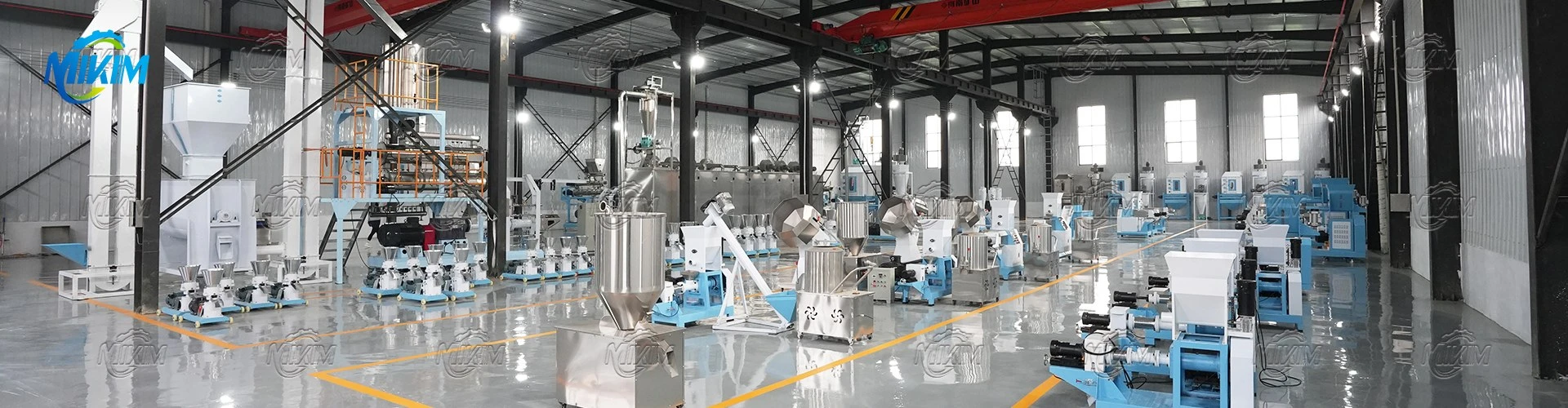
Our factory


Certifications and Standards

Lines are built to CE requirements for the European market and can be supplied to local electrical codes on request. Motors and gearboxes are specified from recognised brands so that spare parts are available in your market rather than only from us - a point worth checking with any supplier, because a plant that depends on one source for a gearbox is a plant with a single point of failure.
Customer Installations

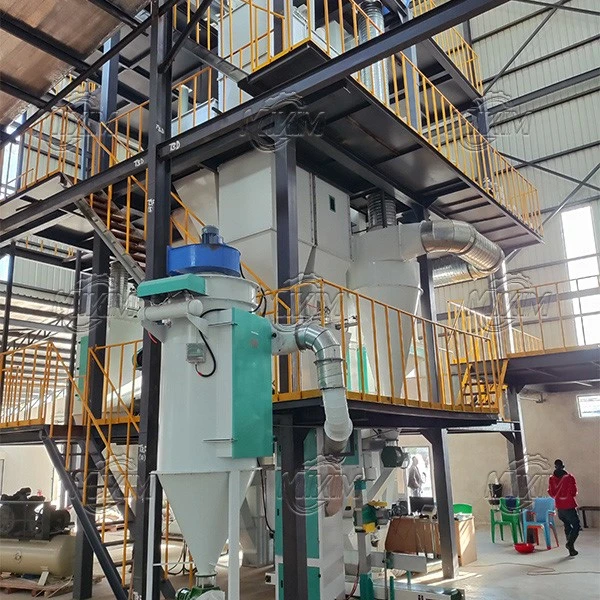
Automated Mikim lines run in compound feed plants from 3 t/h to 20 t/h across Asia, Africa, the Middle East and South America. Because the PLC records every recipe, batch weight and alarm, operators use the log for feed-safety traceability and for tracking energy use per tonne.
A typical 8–10 t/h installation is commissioned in 4–6 weeks, including HMI training for your team. Most buyers start with a semi-automatic base and add automatic packing and pellet-mill load control in a later phase, so the control architecture is built to grow.
FAQ
What is the difference between a semi-automatic and a fully automatic feed production line?
A semi-automatic line stores recipes and runs the batching scale and mixer automatically, but an operator still loads raw material into the intake and handles bags at the packing point. A fully automatic line runs intake through palletising under PLC control, including automatic dosing of micro-ingredients, automatic pellet mill load control and automatic packing. Semi-automatic suits 1–3 t/h; full automation pays back above about 3 t/h.
How accurate is the batching system?
Major ingredients are weighed to ±0.1% of full scale on the main batching scale, and premix and micro-ingredients to ±0.05% on a separate small scale. In-flight compensation is applied, meaning the PLC stops the dosing screw slightly early to account for material still falling onto the scale. Using a single scale for both major and micro ingredients is the most common accuracy mistake.
How many operators does an automated feed line need?
A 3–5 t/h automated line needs 4–5 people per shift, against 8–10 for the same output manually. The saving is concentrated in weighing and dosing (fully eliminated) and packing (3–4 people reduced to one supervisor). Below about 1 t/h the labour saving does not justify the automation cost.
How much power does a feed production line consume?
Installed power for a 3–5 t/h line is 150–190 kW, but simultaneous draw is typically 60–70% of that. Actual consumption is 30–45 kWh per tonne of finished feed, depending mainly on pellet diameter and conditioning duty. Small pellets and heavy steam conditioning both push consumption up.
What site requirements does an automated line have?
Three-phase 380–440 V supply sized at 70% of installed power, steam at 0.4–0.8 MPa (300–600 kg/h for a 5 t/h line), oil-free dried compressed air at 0.6–0.8 MPa, a flat reinforced floor with 6–15 m eave height, and central dust extraction. Tower layouts need pit and platform steelwork that we design for you.
How long does installation and commissioning take?
For a 3–5 t/h line: 10–20 days for civil and steelwork, 15–30 days for mechanical erection, 7–15 days for electrical and PLC, 5–10 days for commissioning, then 3–5 days of operator training. Manufacturing and shipping add 45–105 days. Our engineers carry out the overseas installation.
Can the line produce both poultry and livestock feed?
Yes. Recipes are stored in the PLC, so switching between a 3 mm broiler pellet and an 8 mm cattle pellet is a recipe selection plus a die change. The practical constraint is that pellet diameter and conditioning duty differ, so throughput will change between recipes. Tell us your product mix up front and we will size the mill and cooler for the worst case.
What after-sales support is provided?
We provide one-stop design, sales and overseas installation, operator training, and a spare parts package with the initial shipment. Motors and gearboxes are specified from recognised brands so wear parts and drivetrain spares are available in your market. Remote support is available for PLC troubleshooting.
Hot Tags: Automated Feed Production Line Equipment | PLC Controlled 1-20 t/h, China Automated Feed Production Line Equipment | PLC Controlled 1-20 t/h manufacturers, suppliers, factory, maintenance free feed pellet machine, rotary feed pellet machine, environmentally friendly feed pellet machine, soybean feed pellet machine, pellet feed production line, quality feed pellet machine
Send Inquiry
You Might Also Like
