

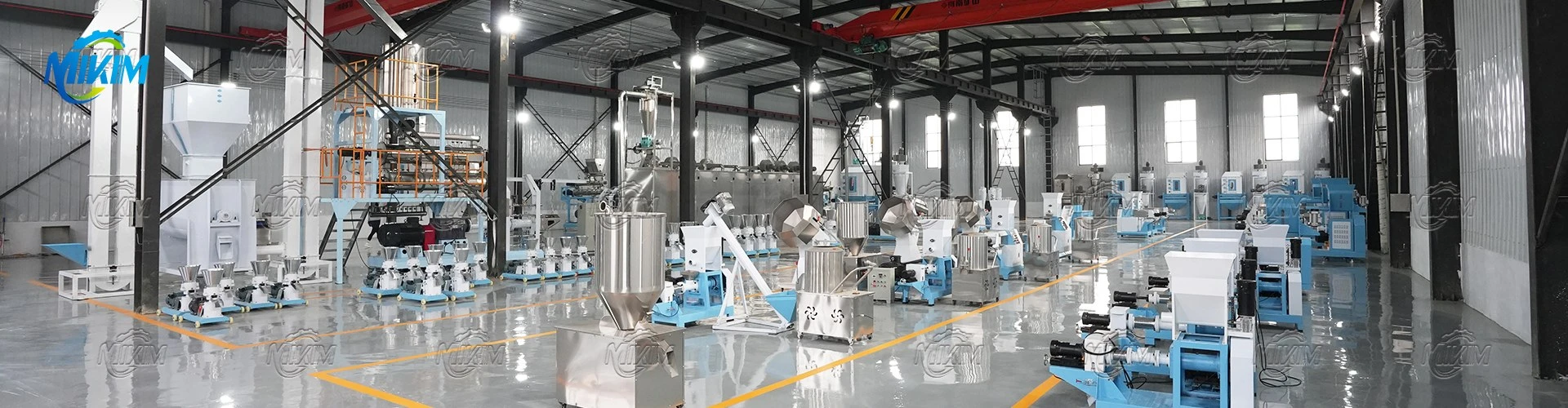


1.5-2.5 t/h Plant Feed Processing Production Line for Cactus
This 1.5–2.5 t/h cactus animal feed pellet line adopts dried cactus (40% inclusion) as raw material. It includes grinding, mixing, ring-die pelleting, cooling, screening and bagging, total connected power 99.8 kW. It makes durable feed pellets for livestock and poultry, fit for 6m single-level workshop layout.
Description
Quick answer
A 1.5-2.5 t/h plant feed processing production line for cactus takes dried cactus at 12-15 percent moisture and 0.1-5 mm, grinds it to a flour, blends it with protein meals and minerals at 40 percent cactus inclusion, presses the blend on a ring die, then cools, screens and bags it. Connected load is 99.8 kW. The 6 m ceiling covers a single level layout only.
Dried cactus arrives as a light, fibrous flour that absorbs water fast and packs against a die face. Two properties drive the whole equipment list: the 0.1-5 mm particle spread it arrives in, and the 40 percent share it takes in the final blend.


01
What Does a 1.5-2.5 t/h Cactus Feed Line Include?
Six working stages: grinding, proportioning and mixing, ring die pelleting, cooling, screening, and bagging. Cactus powder joins protein meals, grain meals, minerals and additives at the mixer, and from that point the material behaves like a standard complete feed.
The line is rated 1.5-2.5 t/h of finished pellets. That range is not a single setting on one dial. The press sets the ceiling and the grinder sets what reaches it, so a line quoted at 2.5 t/h runs at 1.5 t/h by feeding slower, not by changing a part.
Stage
What It Does
Why It Sits There
Grinding
Cactus flour to a uniform size
A ring die needs flour, not fibres
Mixing
Cactus, protein meals, grain, minerals
Cactus at 40 percent cannot be added downstream
Pelleting
Ring die with steam conditioning
Heat and moisture set pellet durability
Cooling
Counter flow air through a falling bed
A warm pellet deforms in a sack
Screening
Fines back to the press
Fines lower the bagged weight
Bagging
Weighed sacks at 200-300 per hour
Retail and bulk bags from one spout
Table 1: The six stages of the cactus feed production line.
Where the dried cactus enters
The line starts at the mill intake, with material already at 12-15 percent moisture and already reduced to 0.1-5 mm. Dewatering and drying sit upstream and belong to the cactus supply, not to this equipment list.
That boundary matters for the quotation. A cactus feed line priced here covers the dry side. The press, the dryer and the liquid stream from pressing are a separate plant, and their capacity sets how many hours a day this line can run.


02
Why Must Cactus Be Dried to 12 Percent Before Milling?
Because a hammer mill and a ring die both work on dry material. Cactus fresh from the field carries most of its weight as water, and water does three things at once: it blinds the grinder screen, it turns the mixer into a paste, and it drops pellet durability at the die.
The 12 percent figure is not a preference. A ring die compacts material by pressure and heat, and steam added at the conditioner is the only water the process wants. Material arriving wet has no room left to take conditioning steam, so the starch never gelatinises and the pellet leaves the die soft.
Mechanical pressing and the liquid stream
Pressing removes free water and leaves a press cake in the 60-65 percent moisture band. The liquid that leaves carries sugars and mucilage, and it does not go back into the feed at this inclusion rate.
Plan the liquid as a product or a waste stream before the dryer is sized. A plant that treats it as waste pays for disposal every day the line runs.
What the dryer has to remove
The dryer carries the load between the press cake and the 12-15 percent target. That is the largest thermal duty in the whole plant, and it is the reason a cactus feed project is a drying project with a pelleting line attached.
Size the dryer against tonnes of water removed per hour, not against tonnes of feed. Once the water figure is known, the feed rate follows, and the rest of this line has a fixed inlet condition.
03
What Grinder Handles Cactus Powder at 0.1-5 mm?
A hammer mill with a 3-4 t/h screen capacity, running ahead of the mixer at more output than the press can use. Cactus arrives partly milled already, and the grinder exists to close the gap between 5 mm and a die-ready flour.
Model
Power
Capacity
Rotor
SFSP56X30
11 kW
1-2 t/h
560 mm
SFSP56X36
22 kW
3-4 t/h
560 mm
SFSP56X40
37 kW
5-6 t/h
560 mm
Table 2: Water drop hammer mills covering the grinding duty.
The 3-4 t/h unit carries a 2.5 t/h press with margin, and the margin is what absorbs the fibrous fraction. Cactus fibre resists size reduction more than grain does, so the same screen gives a lower output on cactus than on maize.


Screen choice against fibre
A 2 mm screen gives a flour that presses well and costs output. A 4 mm screen gives volume and leaves fibres long enough to bridge at the die. Start at 2-3 mm and measure the pellet durability before changing it.
Dust and the filter
Cactus flour is light and travels on air. The grinder needs its own filter and a sealed discharge, or the shed ends every shift under a layer of green dust.
04
How Do You Mix 40 Percent Cactus With Concentrates?
Mix in batches sized so one batch fills the press for a fixed time, and weigh cactus as its own ingredient rather than folding it into the concentrate stream. At 40 percent inclusion the cactus is the largest single component, and it is also the lightest.
Model
Batch
Power
Type
SSHJ-0.5
250 kg
5.5 kW
Double shaft paddle
SSHJ-1.0
500 kg
11 kW
Double shaft paddle
SSHJ-2.0
1000 kg
18.5 kW
Double shaft paddle
Table 3: Double shaft paddle mixers for the cactus blend.
A 500 kg batch at 2 t/h gives one batch every 15 minutes, which leaves time for weighing, mixing and discharge inside the cycle. The mixer is the buffer between a grinder that runs in campaigns and a press that wants a steady feed.
Weighing cactus as its own line
Cactus flour bulks far more than a protein meal for the same mass. A proportioning system built for grain volumes will run out of cactus before it runs out of concentrate, so the cactus bin and its screw are sized on volume, not on weight share.
Mixing time and the mucilage
Cactus powder takes water from the air and clumps. Mixing time stays at the low end of the range for a paddle mixer, and the discharge gate stays wide, because a damp blend bridges in a narrow throat.
05
Which Ring Die animal feed pellet making machine Covers 1.5-2.5 t/h?
A Ring Die animal feed pellet mill rated 2-2.5 t/h on 37 kW, running at reduced feed when the line is asked for 1.5 t/h. The ring die holds output steady across a shift, and it keeps the die face loaded evenly when the blend carries 40 percent of a light, absorbent fibre.
Model
Power
Capacity
Feeder
Conditioner
Pellet Size
SZLH-250
22 kW
1-2 t/h
0.55 kW
1.5 kW
1.0-12.0 mm
SZLH-304
37 kW
2-2.5 t/h
1.5 kW
2.2 kW
1.0-12.0 mm
SZLH-320
37 kW
3-5 t/h
1.5 kW
3.0 kW
1.0-12.0 mm
Table 4: Ring die pellet mills for complete feed.
The 2-2.5 t/h press covers the top of the range with one machine. A line that will live at 1.5 t/h most of the year is better served by the smaller press and a second shift, because running a large die at 60 percent of its rating wastes both power and die life.


What the conditioner does to a cactus blend
Steam at the conditioner gelatinises starch and softens fibre, and both matter more with cactus in the blend. Cactus fibre is stiff and does not deform at the die on pressure alone, so the conditioner is doing structural work, not just warming the meal.
Conditioning raises moisture as it raises temperature. A blend arriving at 12 percent leaves room for that steam; a blend arriving at 15 percent does not.
Die specification against the blend
A die with a longer hole against its diameter packs a harder pellet and draws more motor load. Cactus at 40 percent needs a longer hole than a plain grain feed at the same pellet size, and the press has to be able to carry it.
06
What Pellet Size Suits Cactus Based Complete Feed?
The die sets the size, and the range runs 1.0-12.0 mm across the ring die family, with 2-8 mm covering most complete feed. Cactus based feed follows the animal rather than the plant: a poultry crumble starts at 2-3 mm, cattle and sheep take 6-8 mm.
Pellets outside that band are a die order, not a second press. Keep one die per size actually sold, plus a spare of whichever size runs most.
Crumble or whole pellet
A crumbler sits after the cooler and breaks whole pellets into crumbles for young stock. It is a separate machine with its own drive, and it is the one item on a complete feed line that a buyer can add later without moving anything else.


07
Why Does the Cooler Set the Final Moisture?
Because the cooler removes the last of the surface water the die and the conditioner added, and a pellet that leaves the die at 70 deg C keeps softening until it reaches room temperature. The counter flow cooler pulls air up through a falling bed and brings the pellet down to within a few degrees of ambient.
Model
Power
Fan
Capacity
NKSL11x11
5.5 kW
2.1 kW
1000-3000 kg/h
Table 5: Counter flow cooler covering the 1.5-2.5 t/h band.
At 2.5 t/h the cooler sits inside its band. At 1.5 t/h it runs well under capacity, which is the right direction: a cooler oversized against the press never becomes the stage that limits output.
Screening after the cooler
Fines form at the die and again in the cooler. The screener takes them out and sends them back to the mixer, and a line without one bags the fines as weight that the customer finds at the bottom of the sack.
08
Does a 6 m Workshop Height Cover Every Elevator?
No. Six metres covers a single level layout with short elevators, and it does not cover a vertical arrangement with ingredient bins above the mixer, a cooler above the press and a finished bin above the bagger.
The height question is answered by adding up four things: the elevator head and its drive, the cyclone and its discharge, the bin above the mixer, and the drop from the finished bin to the bagging spout. Each one takes height, and they stack.
Single level and two level layouts
A single level layout puts the bins beside the mixer and uses a shorter elevator, and it needs a longer building. A two level layout puts the bins above and uses gravity, and it needs a working platform plus a taller clear height.
What to send before the layout is drawn
Send the shed length, width and clear height, the door width, and the position of any existing columns. The equipment list does not change between the two layouts; the steel, the platform and the elevator heights do.
09
How Much Connected Power Does the Line Draw?
99.8 kW connected, summed from the motors on the floor. That figure excludes the cactus press and the dryer, which sit upstream and carry their own supply.
Stage
Model
Power
Grinding
SFSP56X36, 3-4 t/h
22 kW
Mixing
SSHJ-1.0, 500 kg per batch
11 kW
Pelleting
SZLH-304, 2-2.5 t/h
37 kW
Feeder
SZLH-304 feed screw
1.5 kW
Conditioning
SZLH-304 conditioner
2.2 kW
Cooling
NKSL11x11, 1-3 t/h
7.6 kW
Screening
LX-LS50
8 kW
Lifting
TDSG10-25, two units
3 kW
Conveying
KWX75YP
3 kW
Bagging
DCS-Z-W-50
4.5 kW
Total
99.8 kW
Table 6: Connected power of the 1.5-2.5 t/h cactus feed line.
Press dominates
The ring die press and its two auxiliaries carry 40.7 kW of the 99.8 kW. Size the incoming supply against the full figure, and size the start current against the press motor, because that is the largest single load on the line.
Sizing the supply against a start
The press starts against a loaded die, and that start draws several times its running current for a few seconds. A supply sized on the running total alone trips on the first start of a cold morning.
10
How Many Operators and What Maintenance?
Two operators run the line across a shift, and a third handles the yard and the cactus intake. One stays at the grinder and the mixer, one at the press, the cooler and the bagger.
Maintenance splits into daily checks and planned stops. Daily: die and roller gap, conditioner steam pressure, cooler air, bagger weight against a check sack. Planned: die and roller change as a set, screen change, bearing grease on the elevators.
Die and roller as a pair
Rollers change with the die, never one at a time. A new roller against a worn die loads one side of the ring, and the die is the more expensive part of the two.
Spares worth holding on site
One die per size in production, a spare of the size that runs most, one set of rollers, screens, bearings, and a spare bagger belt. The list is short and it is what keeps the line running through a shipment delay.
11
What Changes Between 1.5 and 2.5 t/h?
The press and the mixer carry the difference, and everything else has margin. At 2.5 t/h the press runs at its rating and the mixer needs a shorter cycle; at 1.5 t/h the same equipment runs slower and the cooler and screener fall further below their own ratings.
The grinder does not change. A 3-4 t/h hammer mill covers both ends, which is why the grinding stage is quoted once rather than as a range.
Where the saving sits on a 1.5 t/h line
A line that will never run above 1.5 t/h is quoted with the smaller press, the smaller mixer and one screening unit. That is a different equipment list, not a discount on this one.
12
What Goes Into the Quotation and Delivery Schedule?
A stage by stage quotation in the order the material moves, with a delivery schedule set against the longest lead item. Every line names the machine, the motor that drives it, and what travels in the crate with it. EXW, FOB and CIF are quoted against the same machine list, and the term changes only what is covered after the factory gate.
Cactus moisture, inclusion rate and target pellet size go into the order, because those three numbers set the grinder screen, the die specification and the conditioner setting. Send the dried cactus specification and the quotation comes back against a build rather than a range.
Installation and commissioning
Installation, commissioning and operator training are quoted as their own lines so they can be accepted or declined item by item. Commissioning runs on the buyer's own material, because a line proven on maize is not a line proven on cactus.
FAT and the proxy feed
A factory acceptance test runs the press on a feed that behaves like the buyer's blend. Cactus flour is not shipped for a test, so the proxy feed carries the same fibre and the same 40 percent inert fraction, and the die specification is confirmed against it.
The order of the stages is the whole design. Dried cactus comes in, the grinder brings it to a flour, the mixer blends it with concentrates at 40 percent, the ring die forms it under steam, and the cooler, screener and bagger turn it into a pallet of sacks.
Two margins decide whether the line runs at its rating. Grinding output has to sit above pressing output, which is 3-4 t/h against 2-2.5 t/h. Mixing has to deliver a batch inside the press cycle, which is 500 kg against 15 minutes at 2 t/h.
Start with the dried cactus specification. Measure the moisture, measure the particle spread, fix the inclusion rate, and the equipment list follows. A 1.5-2.5 t/h plant feed processing production line for cactus is a short sequence of six stages, and it works when each stage is sized against the one behind it.
1
Can the line run on cactus alone?
No. Cactus at 40 percent and above is blended with protein meals, grain meals, minerals and additives. A complete feed needs the protein and energy the concentrate brings.
2
What moisture must the dried cactus arrive at?
12-15 percent, with 12 percent as the working figure. Material above that leaves no room for conditioning steam at the press.
3
What particle size does the grinder need to produce?
A flour through a 2-3 mm screen. Cactus arriving at 0.1-5 mm still needs milling, because the 5 mm fraction bridges at the die.
4
Does a 6 m building height work?
For a single level layout, yes. A vertical layout with bins above the mixer and a cooler above the press needs more clear height, plus a working platform.
5
How much power does the line draw?
99.8 kW connected, excluding the cactus press and dryer. The ring die press and its auxiliaries account for 40.7 kW of that figure.
6
Can one press cover the full 1.5-2.5 t/h range?
Yes, with the 2-2.5 t/h unit running at reduced feed at the low end. A line that stays at 1.5 t/h is better quoted with the 1-2 t/h press.
7
What pellet sizes are available?
1.0-12.0 mm from the ring die family, with 2-8 mm covering most complete feed. A crumbler adds crumbles for young stock.
8
How many people run the line?
Two across a shift, plus one on the cactus intake and yard work.
Hot Tags: 1.5-2.5 t/h Plant Feed Processing Production Line for Cactus, China 1.5-2.5 t/h Plant Feed Processing Production Line for Cactus manufacturers, suppliers, factory, feed pellet making machine line, production line for making pet meal, maintenance free feed pellet machine, feed pellet machine for bird food, gas powered feed pellet machine, variable speed feed pellet machine
Send Inquiry
You Might Also Like


