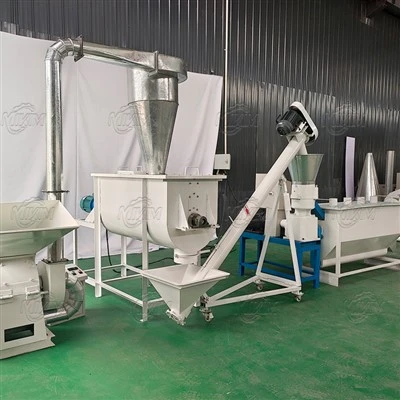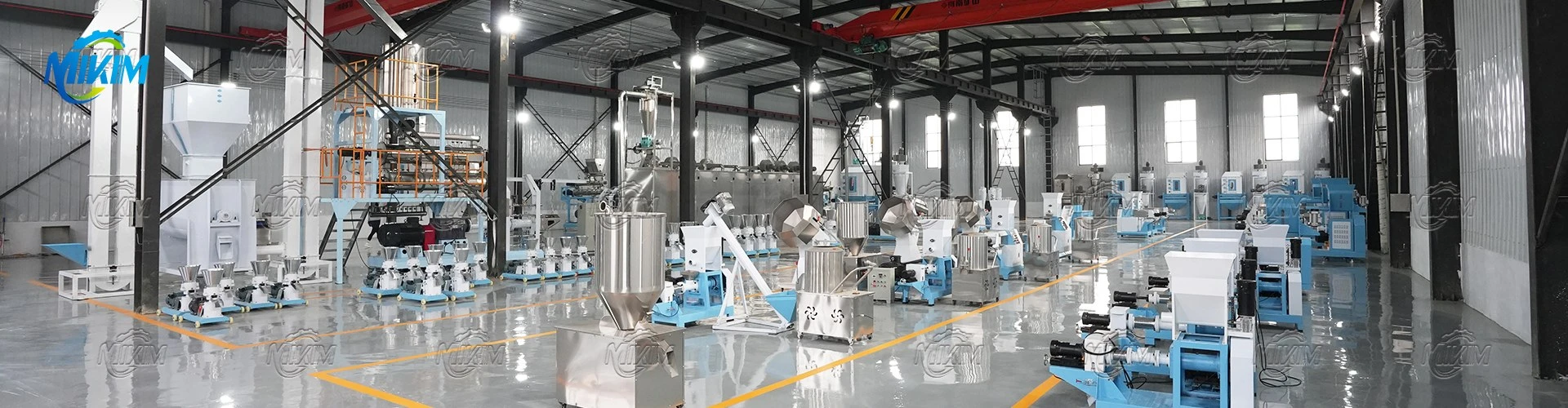


10 TPH Animal Feed Production Line
This 10 TPH animal feed production line is an automatic turnkey system. It makes pellet/mash feed for livestock, poultry and fish, covering crushing, mixing, pelleting, cooling and packing.
Description
Quick answer
A 10 TPH Animal Feed Production Line is quoted inside the 7-15 t/h fully automatic platform: fifteen process stations from the raw material elevator to the automatic bagging machine, a ring die press rated 4-12 t/h on 110 kW, a water drop hammer mill rated 10-12 t/h on 55 kW, a 2000 kg batch mixer on 30 kW, and about 222 kW of connected load across the units that carry a published motor rating (Illustrative).
▪
Fifteen stations in one continuous chain, with two buffer hoppers between batch and continuous running.
▪
Pelleting and conditioning account for 115.5 kW, more than half of the itemised load.
▪
Four 40 ft containers and four to five operators per shift for the complete line.
▪
Fully automatic batching plus computer control sits in the quoted scope; the PLC or SCADA grade is to be confirmed.
▪
Itemised quotation, EXW/FOB basis; CIF or CFR available on request.
01
Which Production Line Class Covers a 10 TPH Animal Feed Plant?
A 10 TPH Animal Feed Production Line is priced inside the 7-15 t/h fully automatic platform, and that single placement fixes the crew number, the container count, the pellet diameter range and the control package for everything that follows. The platform reads: 7-15 t/h, four to five operators per shift, four 40 ft containers, pellets from 1 mm to 12 mm, and fully automatic batching with computer control. A duty point of 10 tonnes per hour sits below the middle of that band, so the line works inside its class rather than at the top edge of it. That margin is why a ten tonne enquiry is answered with a standard station chain rather than a custom build, and why the press is chosen for die life rather than maximum tonnage.
Related
the complete feed production line range sets the classes on either side of this band beside their power and footprint, and the 3-5 t/h poultry feed line for comparison is the shorter build to study if the first two years are expected to run under eight tonnes per hour.
10 TPH Animal Feed Pellet Production Line for Feed Factories
The 7-15 t/h band against a 10 t/h duty point
The band matters more than any single machine, because the class below cannot be stretched into this duty. That class is a 3-5 t/h platform: 178.5 kW connected, a 12 x 4 x 9 m footprint, pellets from 2 mm to 8 mm, a single 40 ft container and an automatic control cabinet. Its upper edge is five tonnes per hour, half of the figure asked for here, so a 10 TPH plant built from that class would run its grinder and its press at the limit for every hour of every shift. The class above is the 15-20 t/h platform, described with the same control package and shipped in six 40 ft containers. Between five and fifteen tonnes per hour there is exactly one class, and the duty point falls inside it.
How to read a line class from crew and container data
Container count and crew size are the cheapest way to test a capacity claim, because both scale with the steel in the line and neither survives a site visit if it is wrong. Four 40 ft containers and four to five operators describe a plant of roughly this size. An offer of 10 t/h in two containers with two operators is a 1-2 t/h platform with an optimistic label.
Two figures are missing from the platform listing: total connected power and workshop footprint. Neither is invented here: power is built up from per-unit values and marked Illustrative, and the footprint is left to be confirmed against the factory technical confirmation sheet.
02
Which Machines Form the Fifteen Process Stations at 10 TPH?
The equipment list for a 10 TPH animal feed plant is a fifteen-station chain in a fixed order, and every station is sized against its immediate neighbour rather than against the plant total. Read in process order, the chain runs: raw material elevator, grinder, steel hopper, screw conveyor, batching scale, mixer, elevator, mixed material hopper, pellet press, cooler, crumbler, grader, elevator, finished feed hopper, automatic bagging machine. Fifteen stations, one material inlet, one bagging spout.
Reference
FAO, Protein Sources for the Animal Feed Industry covers the ingredient classes this batching section is built around.Related
the ring die feed pellet machine range sets the press frames beside their die and roller options, which is where the choice between a four tonne and a twelve tonne upper rating is actually made.#
Process station
Core machine
Model segment
Motor rating (kW)
Rated capacity
1
Raw material elevator
Bucket elevator
Frame to be confirmed
to be confirmed
to be confirmed
2
Grinder
Water drop hammer mill
SFSP65X60
55
10-12 t/h
3
Steel hopper
Welded steel bin
Volume to be confirmed
none
one batch buffer
4
Screw conveyor
Tubular screw conveyor
Frame to be confirmed
to be confirmed
to be confirmed
5
Batching scale
Multi-bin weigh hopper
Frame to be confirmed
to be confirmed
2000 kg per batch
6
Mixer
Twin shaft paddle mixer
SSHJ-4.0
30
2000 kg per batch
7
Elevator
Bucket elevator
Frame to be confirmed
to be confirmed
to be confirmed
8
Mixed material hopper
Welded steel bin
Volume to be confirmed
none
one batch buffer
9
Pellet press
Ring die pellet press
SZLH-420
110 + 1.5 + 4
4-12 t/h
10
Cooler
Counterflow cooler
NKSL14x14
7.5 + 2.3
2000-5000 kg/h
11
Crumbler
Roller crumbler
Matched to press
to be confirmed
to be confirmed
12
Grader
Rotary grader
Matched to press
to be confirmed
to be confirmed
13
Elevator
Bucket elevator
Frame to be confirmed
to be confirmed
to be confirmed
14
Finished feed hopper
Welded steel bin
Volume to be confirmed
none
one batch buffer
15
Automatic bagging machine
Weighing, bagging and sewing unit
DCS-Z-W-50
4.5
200-300 bags/h, 10-50 kg

The fifteen stations in process order
The chain divides into three working groups. Stations one to four receive, reduce and convey: the elevator lifts raw grain, the hammer mill takes it down to a powder, the steel hopper holds the ground material and the screw conveyor meters it onward. Stations five to eight turn powder into a uniform batch, weighing each ingredient, mixing to a timed cycle and holding the blended meal in a hopper above the press. Stations nine to fifteen convert that meal into a saleable bag: press, cool, crumble, grade, lift, hold, bag.
The two hoppers at stations eight and fourteen are buffers rather than process stations, and they are why a batch-fed line can run a continuous press. Without the first, the press stops between mixes; without the second, cooler and bagger fight over the same discharge.
Which station sets the throughput limit
Two stations sit closest to the duty point, and neither is the one buyers usually watch. The grinder is rated 10-12 t/h on 55 kW, so at 10 t/h it runs with almost no spare capacity, and the whole line inherits its fineness, its screen condition and its moisture behaviour. The press is rated 4-12 t/h, and the same duty point sits high inside that band, which is why the hopper level above the press and the conditioner setting decide real output more than the nameplate does. Everything downstream of the press - cooler, crumbler, grader, bagger - is sized to follow the press, not the grinder.
The crumbler and the grader carry no separate frame size or motor rating in our own data. Both are matched to the press, and their parameters are to be confirmed against the factory technical confirmation sheet.
03
Which Technical Specifications Apply to Each Machine in the List?
Every unit on the list can be quoted with five fields: model, motor rating, rated capacity, outline and net weight. The table below carries those five fields for the frames that apply to this band, including the smaller frames a buyer may want to compare against before accepting the recommendation.
Reference
Feedipedia, the online encyclopedia of animal feeds, gives the ingredient data behind the grind and mix settings quoted here.Model
Motor rating (kW)
Rated capacity
Outline
Net weight
SZLH-420
110 main + 1.5 feeder + 4 conditioner
4-12 t/h
2.3 x 3.2 x 3.09 m
3200 kg
SZLH-350
55 main + 0.75 feeder + 2.2 conditioner
2-6 t/h
2.15 x 1.95 x 1.9 m
2000 kg
SZLH-320
37 main + 0.75 feeder + 2.2 conditioner
2-4 t/h
1.8 x 1.55 x 1.65 m
1400 kg
SZLH-250
22 main + 0.75 feeder + 1.1 conditioner
1-2 t/h
1.7 x 0.65 x 1.75 m
715 kg
SFSP65X60
55
10-12 t/h
2000 x 960 x 1320 mm
to be confirmed
SFSP65X45
45
7-8 t/h
1720 x 870 x 1320 mm
to be confirmed
SFSP56X40
37
5-6 t/h
1630 x 860 x 1000 mm
to be confirmed
SFSP56X36
22
3-4 t/h
1430 x 860 x 1000 mm
to be confirmed
SSHJ-4.0
30
2000 kg per batch
to be confirmed
to be confirmed
SSHJ-2.0
18.5
1000 kg per batch
to be confirmed
to be confirmed
SSHJ-1.0
11
500 kg per batch
to be confirmed
to be confirmed
SSHJ-0.5
5.5
250 kg per batch
to be confirmed
to be confirmed
NKSL14x14
7.5 drive + 2.3 fan
2000-5000 kg/h
2.55 x 1.55 x 1.35 m
to be confirmed
NKSL11x11
5.5 drive + 2.1 fan
1000-3000 kg/h
1.25 x 1.25 x 1.3 m
to be confirmed
DCS-Z-W-50
4.5
200-300 bags/h; 10-50 kg per bag
1.2 x 1.2 x 2.4 m
to be confirmed
KWX150YP
4
0-2000 kg/h
3 m conveying length
to be confirmed
KWX75YP
3
0-2000 kg/h
3 m conveying length
to be confirmed
KWX50YP
1.5
0-1000 kg/h
2.5 m conveying length
to be confirmed
Reference
how to size poultry feed pellet equipment works the same five fields through the decision in the opposite direction, starting from the press and building outward to the plant.
Capacity, power and outline per unit
Three readings on that table are easy to misread. Motor rating is installed power, not absorbed power, so a 110 kW press does not draw 110 kW all shift. Feeder and conditioner motors sit on the same frame and are counted separately, which is why the press row reads as three numbers. Outline is the machine body: it excludes protruding motors, guarding and the space a fitter occupies, so a 3.2 m wide frame takes well over 4 m of floor.
The ring die frames press pellets from 3 mm to 15 mm with length set at the cutter, carry automatic lubrication to rollers, main shaft, gear and bearings, and ship with standard dies in 6, 8, 10 and 12 mm. The inlet requirement is stated plainly by the manufacturer: material must arrive as a powder, at a moisture between 12% and 20%. That single line explains why the grinder and the moisture check sit upstream of the press rather than downstream.
How to read a nameplate against a duty point
Read the two ends of a capacity band separately, because they answer different questions. The lower end says whether the frame is oversized for the plant, and the upper end says how much margin is left on a normal day. For this line the largest frame is taken for two reasons: its lower end of four tonnes per hour still covers a half-shift during die changes and grade switches, and its upper end of twelve tonnes leaves two tonnes of headroom above the ten tonne duty point.
The 2-6 t/h frame on 55 kW is not taken here. Its upper edge is six tonnes per hour, and a press held above its rating for a full shift loses die life, raises pellet temperature and degrades pellet quality long before it produces the tonnage on paper.
04
How Much Connected Power Does a 10 TPH Line Draw by Section?
Connected power for this line is not published as a single figure, so it is built here from the units that carry a motor rating in our own data, and the total is marked Illustrative rather than guaranteed. The build-up follows the process order, which is also the order in which a site electrician will want the panel split.
Section
Units counted
Subtotal (kW)
Grinding
one water drop hammer mill, 55 kW
55.0
Pelleting and conditioning
press 110 + feeder 1.5 + conditioner 4
115.5
Mixing
one twin shaft paddle mixer, 30 kW
30.0
Cooling
drive 7.5 + fan 2.3
9.8
Bagging and sewing
weigher, conveyor and sewing head, 4.5 kW
4.5
Conveying
two catalogue screw frames, 4.0 + 3.0
7.0
Itemised total
units above only
221.8, about 222 kW (Illustrative)

Per-unit power and section subtotal
The pelleting section carries more than half of the itemised load, and that is normal for a compound feed plant: size reduction and densification are the two energy-intensive steps, and everything between them is a handling exercise. Grinding takes 55 kW, mixing 30 kW, cooling 9.8 kW, bagging 4.5 kW and the two counted conveyor runs 7.0 kW. Those six subtotals add to 221.8 kW, written as about 222 kW and marked Illustrative throughout this page.
The distribution matters more than the sum, because it tells a plant owner where a soft start or a variable frequency drive repays its cost. Starting the press on a loaded die is the largest transient on the board; starting the hammer mill with a full chamber is the second.
The decision rule for a power total
A power total is only usable with its exclusion list attached, and this one excludes more than expected. Not counted: the bucket elevators at stations one, seven and thirteen, any screw run beyond the two above, dust collection fans, the air compressor, lighting and small drives, the batching scale drives, and the crumbler and grader whose ratings are still to be confirmed. Each of those is a real load on the incoming supply.
For that reason the figure of about 222 kW is a working number for a first transformer conversation, not a design value. A common allowance is a transformer and main breaker sized at roughly 1.25 times the itemised total, with the incoming cable, the panel rating and the site earth confirmed on the plant side. Both the final load schedule and the supply capacity are to be confirmed against the factory technical confirmation sheet before the electrical package is frozen.
05
Which Automation Level Is Included in the 7-15 T/H Configuration?
The automation included at this capacity is stated in two parts: fully automatic batching, plus computer control. That is the whole of the published scope: a genuine capability, narrower than the phrase plant-wide supervision suggests. Nothing in our data supports a claim of unmanned operation, remote plant supervision or a supervisory layer above the machine controllers, and none is made here.
The decision rule for reading an automation claim
Ask any supplier to split the control package into three lists, and the answer tells you what is actually being bought. List one holds the functions the controller executes on its own: weighing, sequencing, interlocks, alarms. List two holds the functions it merely displays, such as motor current or bin level. List three holds what a person still does by hand: die changes, sampler taking, bag hooking, fault reset. An offer that cannot be split this way is a slogan rather than a specification.
The PLC or SCADA grade, the point count, the communication protocol and whether a supervisory layer exists at all are to be confirmed against the factory technical confirmation sheet. No brand, point count or protocol is stated in this document, because none is fixed in our own data.
Related
the automatic animal feed production line sets out how the control package changes between semi-automatic, automatic and fully automatic builds at neighbouring capacities.Control functions inside the quoted scope
Three functions can be described today with numbers behind them. Batching is automatic against the batch size, which at this capacity is 2000 kg of mixed meal per cycle. The mixer runs a timed wet-mix and discharge cycle under the same controller. The bagging unit is computer controlled, with a static weighing accuracy of +/-0.1% and a dynamic accuracy of +/-0.2% across a 10-50 kg bag range at 200-300 bags per hour.
Interlocks and alarms between press, cooler and bagger are part of a line at this level, and their exact list belongs in the electrical annex of the quotation rather than in a brochure sentence. That annex is the document to read before signing, because an interlock that was assumed becomes an interlock that was priced.
06
What Building Footprint and Clear Height Does the Line Occupy?
The building envelope is set by the tallest unit and the widest unit, not by the floor area of the machines added together, and the gap between those two calculations is usually several hundred square metres. A 10 TPH line is governed by height and access, because the vertical chain of elevator, hopper and press has to stand above the working floor.
Machine outline envelope
On this list the tallest body is the press at 3.09 m, and the widest is the same unit at 3.2 m; it also carries the greatest concentrated load at 3200 kg. The cooler measures 2.55 x 1.55 x 1.35 m, the grinder 2000 x 960 x 1320 mm, and the bagging unit 1.2 x 1.2 x 2.4 m. Those are machine bodies only. Add protruding drive motors, guarding, the extraction hood over the bagging spout, and a walkway of roughly 1.0-1.2 m on every side a fitter has to reach.
How to set clear height from the tallest unit
Clear height is taken from the tallest item plus whatever sits above it. Above the press there is a feed hopper holding one batch, and above that the discharge of the elevator serving it. Add a service clearance of about 1.5 m over the highest inspection point and the governing figure is the elevator head, not the 3.09 m press body.
For scale, the smaller 3-5 t/h platform is listed at 12 x 4 x 9 m, meaning a 9 m clear height for a press a fraction of this size, which confirms that height is driven by the vertical conveying and the bins. The envelope of this line therefore falls between those two reference points, and its exact footprint and clear height are to be confirmed against the factory technical confirmation sheet.
The layout drawing is to be confirmed as well; a preliminary plan built from the outlines above, plus aisles and buffer positions, is normally enough to test a candidate building.
07
How Are Installation, Commissioning and Operator Training Scoped?
Site work splits into two lists: work that appears as a priced item in our quotation, and work that stays with the plant owner. Writing both lists before shipment is the difference between a commissioning week and a commissioning month, because the second list is always longer than a buyer expects.
The decision rule for the scope split
The only reliable test is whether the task is listed and priced in the quotation. Work that is not listed is not included. That rule cuts both ways: an owner who assumes lifting is included pays for a crane twice, and a supplier who assumes foundations are ready pays for idle engineers.
Site work that stays with the plant owner
Civil works and equipment foundations, including anchor bolt setting, stay on site. So do lifting and rigging, the crane crew and the unloading of containers. Water, compressed air and steam connections to the line, and the power supply to the main panel, are plant-side. Local labour for positioning and cleaning is normally drawn from the owner's team, with our engineer directing rather than lifting. Steam supply to the conditioner is a plant utility and its scope is to be confirmed rather than assumed inside the machine price.
On our side of the line, installation guidance, commissioning, trial production, and operator plus maintenance training are scoped per project. Training covers three things: the operating sequence from intake to bagging, the scheduled maintenance list with intervals, and the fault rules that state who inspects what and when a unit is stopped. Travel, lodging and the daily rate basis for engineers are to be confirmed against the factory technical confirmation sheet, and the answer is written into the quotation rather than agreed on site.
08
Which Spare Parts and Wear Items Should Be Ordered Initially?
A first spare order is sized by wear rate, not by budget, and at this capacity the wear concentrates in three places: the die, the rollers and the grinder hammers. Ordering one full wear set per wear location is the practical rule, because a single failed die stops a line that is otherwise healthy.
Related
the poultry feed complete equipment set shows the same wear points across the smaller equipment sets, which helps when the first spare order is being split between two buildings.Item
Quantity for the first 12 months
Replacement criterion
Ring die, 6, 8, 10 or 12 mm
2 sets, chosen from the diameters actually run
Hole wear, pellet quality drift, or rising press motor load at the same feed rate
Roller assembly
1 set
Shell wear, uneven pellet length, or load rise with a known die
Lubrication circuit kit, filters and seals
1 service kit
Lubrication fault alarm or pressure drop at the pump
Hammer set for the grinder
1 set
Rounded hammer corners, falling capacity, drifting fineness
Grinder screens
2 screens in two hole sizes
Perforation damage or capacity loss at unchanged power
Bagging load cell
1
Weight drift outside +/-0.2% dynamic accuracy after calibration
Sewing head parts, thread, belt, cutter
1 kit
Stitch defects, thread breakage, cut failure


Wear part set for the first 12 months
Two die sets are recommended, and they should be the two diameters the plant actually sells, not a full sweep of the range. The press ships with standard dies in 6, 8, 10 and 12 mm, so a starter mill running a grower pellet and a finisher pellet orders those two and adds a third only when a new ration is launched. Rollers wear with the die and are replaced as a set. The lubrication circuit is treated as a wear item on these frames because automatic lubrication is standard, and a blocked line damages a main bearing long before an operator notices.
How to size a first spare order
The sizing rule is one full wear set per wear location plus one consumable kit per control loop, and nothing else. Do not order a second die in a diameter the plant does not run, and do not order hammers without screens, because the two are matched. Part numbers and replacement criteria can be fixed now; the running hours behind each interval, and the quantities for a second year, are to be confirmed against the factory technical confirmation sheet, since they follow abrasive content, moisture and shift length.
09
How Long Is Manufacturing and Shipping to The Middle East Port?
A complete line at this capacity ships in four 40 ft containers, and the lead time clock starts on two events rather than one: the deposit received and the drawings approved. Until both have happened, any date offered is a guess dressed as a schedule.
Reference
request the itemised 10 TPH line quotation with the destination port, the preferred Incoterms and the pellet diameters, and the three-segment schedule is returned with the priced document rather than in a separate email.Container count per line class
Container count is the cleanest public signal of line class, and it is worth checking against the offer before discussing dates. This platform ships in four 40 ft containers. The smaller 3-5 t/h platform ships in a single 40 ft container, and the 15-20 t/h platform in six. Each container carries a loading plan that separates press frame, bins, electrical panels and packed spares.
How lead time is counted
Lead time is reported in three separate segments, never merged into one promise. The first is manufacturing, counted from deposit plus approved drawings. The second is inland transport and loading at the port of departure. The third is sea freight to The Middle East port nominated by the buyer, Latakia or Tartus, confirmed in writing before booking.
The number of days in each segment depends on the final configuration and on the container count, so each is stated on the quotation rather than on this page, and the total is to be confirmed once the port and the Incoterms are fixed. A buyer who wants a single end date is asking for a merged promise, and the three-segment form is offered instead.
10
Where Can Local Support in The Middle East or a Neighbouring Country Be Provided?
No installed reference, authorised agent or resident service team in The Middle East or in a neighbouring country can be named today. That answer is to be confirmed against the factory technical confirmation sheet, and it is stated plainly here rather than filled with an unverifiable project name, country and year.
The decision rule for a local support claim
A local support claim is only usable when it arrives with four fields: the country, the plant capacity, the year of commissioning, and a reference that can be contacted. An answer missing any one of the four is marketing, not a reference. Applied to this enquiry, the four fields are empty for The Middle East and for the neighbouring countries until the factory confirms otherwise in writing.
Support channels that can be stated today
Four channels exist independent of any local presence. Remote technical support covers fault diagnosis against the electrical annex and the operating sequence. Video-guided commissioning lets our engineer watch the same panel the site electrician sees, which answers most start-up questions without a flight. Spare parts ship direct to the site from the first spare order onward. Engineer dispatch to site is available and is priced as a separate line, with travel and lodging to be confirmed.
Where a third-party service provider in a third country is proposed, the name, the covered machines and the response obligation are confirmed in writing before the contract is signed, not after. A three-column table in the quotation holds this section together: response channel, response time, and who carries the travel cost. Each column is either filled with a value or marked to be confirmed.
11
Which Items Belong in the Formal Quotation and Payment Plan?
The formal proposal is issued as an itemised quotation, EXW/FOB basis; CIF or CFR available on request, with no price printed on this page. What the page can fix is the structure, because a structure that is agreed before numbers arrive is what keeps a comparison between two suppliers honest.
Next step
send the 10 TPH equipment list and proposal request with the site drawings and the intended pellet diameters, and the proposal is returned as one document with the annexes below attached rather than as a price in an email body.
The decision rule for an itemised proposal
Every item is either priced or explicitly excluded, and the excluded list is part of the document. For this line the priced groups run to at least eight: the main machines of the fifteen stations, conveying and bucket elevators, dust collection, electrical control cabinets, the first spare set, export packing in wooden cases, technical documents, and installation with commissioning and training.
Anything not on that list is not in the price. Steel structure, silos, the site transformer and the steam supply are the four items most often assumed and most often missing, and each is either quoted as a separate line or written into the exclusions.
Payment milestone structure
Payment follows three milestones: a deposit on order, a payment before shipment, and a balance after acceptance at site. The ratios are to be confirmed, and a balance tied to acceptance testing is negotiable rather than fixed. Each milestone is tied to a document, so the deposit follows the signed contract, the pre-shipment payment follows the pre-shipment inspection report, and the balance follows the signed acceptance sheet.
The proposal carries five annexes: the equipment list on the fifteen stations, the per-unit specification table, the section power table with its exclusion list, the preliminary layout, and the three-segment lead time table. Reading those five in that order answers the six questions behind this enquiry, and the last action is simple: return the confirmation sheet with the pellet diameters, the destination port and the preferred Incoterms marked, and the itemised quotation is issued against it.
FAQ
FAQ: Ten TPH Animal Feed Line Scope Questions
1
What fifteen stations run on a 10 TPH animal feed production line?
In process order: raw material elevator, grinder, steel hopper, screw conveyor, batching scale, mixer, elevator, mixed material hopper, pellet press, cooler, crumbler, grader, elevator, finished feed hopper and automatic bagging machine. The grinder runs at 10-12 t/h on 55 kW and the press at 4-12 t/h on 110 kW, so those two stations set the practical limit of the chain.
2
How much connected power does a 10 TPH line draw in total?
About 222 kW (Illustrative), built from the units that carry a published motor rating: 55 kW grinding, 115.5 kW pelleting and conditioning, 30 kW mixing, 9.8 kW cooling, 4.5 kW bagging and 7.0 kW conveying. That total excludes bucket elevators, dust collection, the air compressor, lighting, the crumbler and the grader. The final load schedule is to be confirmed against the factory technical confirmation sheet.
3
Is automatic batching and computer control included at 10 TPH?
Yes. Fully automatic batching and computer control are part of the 7-15 t/h configuration, with a 2000 kg batch, timed mixer cycles, and bagging accuracy of +/-0.1% static and +/-0.2% dynamic across 10-50 kg bags at 200-300 bags per hour. The PLC or SCADA grade, point count and protocol are to be confirmed; no plant-wide supervisory system is claimed here.
4
How many 40 ft containers ship a complete 10 TPH line?
Four 40 ft containers for the complete line at this capacity, against one for the 3-5 t/h platform and six for the 15-20 t/h platform. The loading plan separates press frame, bins, electrical panels and packed spares, and the forwarder quotes against that plan rather than a weight estimate.
5
What is the lead time from deposit to The Middle East port?
The clock starts when the deposit is received and the drawings are approved, and it is counted in three segments: manufacturing, inland transport and loading, and sea freight to Latakia or Tartus as nominated in writing. Days depend on container count and configuration, so they are stated on the quotation and confirmed once port and Incoterms are fixed.
6
Can a local service agent be named for The Middle East?
No. There is no installed reference, authorised agent or resident service team recorded for The Middle East or for a neighbouring country, so that item is marked to be confirmed rather than filled with an unverifiable project name. What can be stated today is remote technical support, video-guided commissioning, direct spare parts shipment, and engineer dispatch priced as a separate line.
Hot Tags: 10 TPH Animal Feed Production Line, China 10 TPH Animal Feed Production Line manufacturers, suppliers, factory, feed pellet machine supplier, feed pellet machine for crab farming, batch feed pellet machine, hydraulic feed pellet machine, roller feed pellet machine, pellet machine feed line
Send Inquiry
You Might Also Like