Boost Feed Mill Profit with Pellet Mills and Crushers
Leave a message
Why Grinding and Pelleting Go Together
A feed mill makes money when every kilogram of ingredient ends up in an eaten pellet. The two stages that control this are grinding, which opens the raw material surface for steam and digestion, and pelleting, which binds the particles into a durable form. Running a pellet mill without proper grinding wastes electricity, produces soft and dusty pellets, and lets animals sort ingredients. A crusher, usually a hammer mill, and a pellet mill therefore belong to the same line, and their combined effect is larger than either machine alone.
The Measured Benefits of a Two-Stage Line
When the crusher and pellet mill are correctly sized and operated, feed mills report the following improvements:
| Indicator | Improvement |
|---|---|
| Raw material utilization | +5-8% |
| Conditioning energy | -15-20% |
| Pellet formation rate | Over 95% vs 60-70% |
| Pellet density | 1.2-1.4 g/cm³ |
| Feed volume | -30-40% |
| Feed waste on farm | 8-12% down to 3-5% |
The formation rate is the most important number: it measures how much of the conditioned mash becomes whole pellets instead of fines, and fines are usually recycled or lost.
Grinding: The Foundation of the Line
The hammer mill reduces raw materials to a uniform particle size of about 1.0-2.5 mm, depending on the formula and animal. A uniform grind lets steam penetrate every particle during conditioning, which gelatinizes starch evenly and produces pellets with a consistent surface. Oversized particles stay hard in the pellet and become sorting points for animals, while excessive flour increases dust and electricity use. The screen aperture of the hammer mill sets the grind size, and it should be matched to the pellet diameter and the target species.
Conditioning and Pelleting for Higher Formation
Conditioning adds steam and moisture so the starch softens and binds the particles. Good conditioning raises the mash temperature and gelatinizes the surface of every particle, which directly raises the formation rate above 95 percent and lowers the energy the pellet mill needs to push the mash through the die. The pellet mill then compresses the conditioned mash into a dense pellet of 1.2-1.4 g/cm3. Higher density means the same nutrients fit into a smaller volume, cutting storage space and transport cost by 30-40 percent, and the durable pellet resists breaking during handling.
How the Benefits Scale to a Full Line
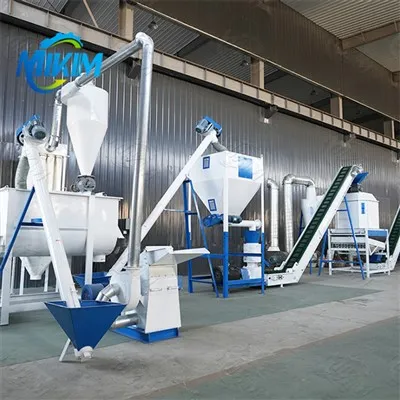
The same logic scales to a complete 15-20 t/h feed pellet production line, where the crusher, mixer, conditioner, ring die pellet mill, cooler, and packer run as one system. At this scale, the 5-8 percent utilization gain and the 3-5 percent waste reduction translate into tons of saved ingredient per day, and the volume reduction of 30-40 percent cuts warehouse and trucking cost. The line also requires only a small crew, because grinding and pelleting are supervised from one control panel.
FAQ
What grind size should a pellet mill receive?
Most formulas are ground to about 1.0-2.5 mm before pelleting; the exact target depends on the animal and the pellet diameter.
How much does pelleting improve the formation rate?
With proper grinding and conditioning, pellet formation exceeds 95 percent, compared with 60-70 percent for poorly prepared mash that produces excessive fines.
Does pelleting really reduce feed waste?
Yes. Dense, durable pellets of 1.2-1.4 g/cm3 resist crumbling during transport and feeding, so on-farm waste drops from 8-12 percent to about 3-5 percent.
Why does conditioning save energy?
Steam-softened mash presses through the die with less resistance, so conditioning cuts the pelleting energy demand by 15-20 percent.
How much volume does pelleting save?
Compressing mash into dense pellets reduces feed volume by 30-40 percent, lowering storage and transport costs at the same feeding value.