


Which fish eat floating feed
Leave a message
Freshwater Aquaculture Fish (Mainstream Species)
Tilapia: A omnivorous surface-feeding fish, tilapia actively ingests floating feed. It adapts to various nutritional formulas, with juvenile and adult fish both thriving on floating pellets (particle size 1-8 mm). Floating feed helps monitor intake, promoting uniform growth and reducing water pollution-making it the preferred feed type in tilapia farms worldwide.
Common Carp & Grass Carp: While common carp is omnivorous and grass carp is herbivorous, both forage in the mid-water layer and accept floating feed. Grass carp floating feed is often fortified with plant proteins (soybean meal, alfalfa) and fiber, while common carp feed balances animal and plant nutrients. Floating feed avoids bottom residual waste, a key advantage in pond aquaculture.
Silver Carp & Bighead Carp: Filter-feeding fish that also actively take floating pellets. Their feed is typically fine-grained (0.5-3 mm) with high protein content, supporting rapid growth. Floating feed simplifies feeding for large-scale polyculture ponds (e.g., mixed with tilapia and carp).
Koi & Goldfish (Ornamental Fish): Popular ornamental species that feed on the water surface. Floating feed for koi/goldfish comes in colorful, small pellets (0.3-5 mm) with added astaxanthin (for color enhancement) and probiotics. It allows owners to observe feeding behavior and prevent overfeeding.
2. Marine & Brackish Water Fish
Salmon & Trout: Carnivorous fish that feed in the mid-water to surface layers. Their floating feed is high in animal protein (fish meal, shrimp meal) and omega-3 fatty acids (fish oil), with a porous structure for easy digestion. Floating pellets reduce waste in net cage aquaculture, a common practice for salmon farming.
Sea Bass (Lates calcarifer): A valuable marine fish that actively chases floating feed. Juvenile sea bass use small pellets (1-3 mm), while adults take 4-10 mm pellets rich in fish protein. Floating feed improves feed conversion rate (FCR) and survival rate in intensive culture systems.
Pompano & Snapper: Warm-water marine fish with surface-feeding habits. Their floating feed is formulated with high-quality protein and fat to meet fast growth demands, suitable for coastal pond or net cage farming.
3. Specialized Aquaculture Fish
Catfish (Channel Catfish, Pangasius): Though some catfish species are bottom-feeders, improved floating feed (with enhanced palatability) is widely adopted. It allows farmers to monitor intake, reducing overfeeding and water pollution. Floating pellets for catfish are often soft and high in protein (30-40%).
Eels & Loaches: Semi-bottom feeders that can be trained to accept floating feed. Juvenile eels/laches use micro-pellets (0.5-2 mm), while adults take larger pellets. Floating feed simplifies feeding in recirculating aquaculture systems (RAS).
Key Considerations
Feeding Habit Training: Bottom-feeding fish (e.g., some catfish varieties) can adapt to floating feed via gradual training (mixing with sinking feed initially).
Particle Size Matching: Adjust pellet size to fish mouth size-larvae use 0.3-1 mm micro-pellets, juveniles 1-5 mm, and adults 5-10 mm.
Nutrient Customization: Carnivorous fish (salmon, sea bass) require high animal protein (40-50%), while herbivorous/omnivorous fish (grass carp, tilapia) need more plant-based nutrients.
Floating feed is ideal for surface/mid-water feeding fish, supporting efficient, sustainable aquaculture by improving feed utilization and water quality.
Related equipment


about Us
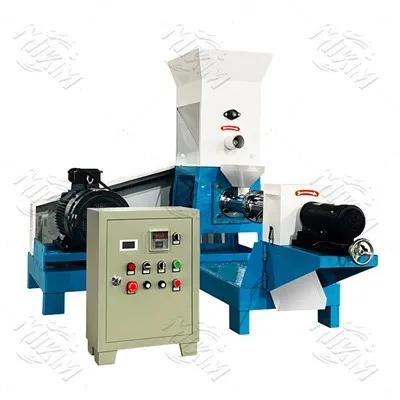
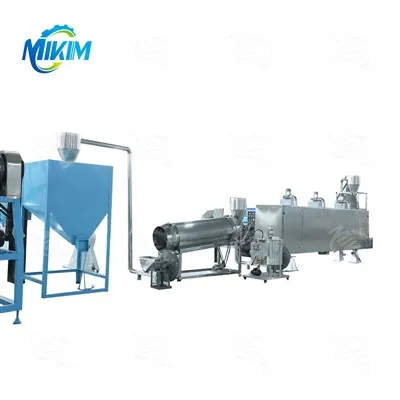
MIKIM's fish feed pellet production lines and supporting machinery offer excellent value for money. Not only are they affordable, eliminating middlemen markups and allowing small and medium-sized enterprises (SMEs) and fish farmers to purchase complete sets of equipment at reasonable costs, but they also boast exceptional efficiency. The fully automated process, from raw material crushing and precise ingredient mixing to extrusion pelleting and maturation, is completed in one continuous flow. This results in high starch gelatinization rates and uniform pellet formation, significantly improving production efficiency and feed quality, truly achieving "low cost, high output." Choosing a MIKIM fish feed pellet production line means enjoying comprehensive pre-sales and after-sales service, including 24-hour online customer support, a one-year warranty on the entire machine, professional on-site installation, commissioning, and maintenance, and a stable supply of spare parts. Customers can buy with confidence and use with peace of mind, with both excellent value and service quality!
Customer visit

Certificate of Honor

FAQ
1. What is the price of the fish feed machine?
The price ranges from approximately $3,500-$55,000
2. Do you provide maintenance services for your customers?
Yes, we offer comprehensive after-sales maintenance services to our customers.
If you would like to learn more about MIKIM machinery, please contact us. We offer one-stop service and welcome your inquiries!!!


