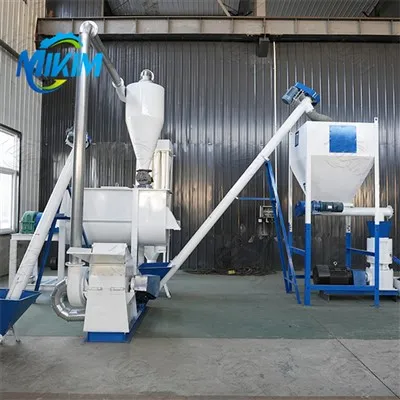
200 kg/h Floating Trout Fish Feed Production Factory in Afghanistan
200 kg/h Floating Trout Fish Feed Production Factory in Afghanistan
200 kg/h Floating Trout Fish Feed Production Factory in Afghanistan
200 kg/h Floating Trout Fish Feed Production Factory in Afghanistan
200 kg/h Floating Trout Fish Feed Production Factory in Afghanistan
1/0
200 kg/h Floating Trout Fish Feed Production Factory in Afghanistan
A 200 kg/h trout fish feed production line is a sequence, not a purchase order. Site and supply first, with 60.1 kW on the incoming line. Grinding next, held ahead of the 180-250 kg/h extruder. Dry extrusion in the middle at 19.3 kW, without a boiler. Then drying, oil and cooling, because fat on a wet pellet sinks it.
A 200 kg/h trout fish feed production factory is built in one fixed order: grind, weigh and mix, extrude dry, dry the pellet, coat it with oil, cool and screen, then bag. The extruder runs without a steam boiler and the whole line draws 60.1 kW. At a band of 0.18-0.25 t/h, 200 kg/h sits in the middle of the machine.
Key points
> - The line draws 60.1 kW, with the dryer at 24 kW and the extruder at 19.3 kW.
> - Dry extrusion removes the boiler, the boiler operator and the steam piping from the project.
> - Oil goes on after the dryer, or the pellet loses the pores that float it.
> - Six dies, forty blades and the hand tools arrive with the extruder.
01
Site, power and water at the Afghanistan plant
The site settles three things before a machine is chosen: the supply, the height and the drainage. A floor drain near the mixer and the coater carries washdown water away from where the operator stands.
60.1 kW connected load on the incoming supply
The line sums to 60.1 kW, and that figure goes to the supply authority. The dryer takes 24 kW of it and the extruder 19.3 kW, the bagger 4.5 kW and the mill and mixer 3 kW each. Supply is 380 V, 50 Hz, three-phase, and cable, breaker and meter are sized from 60.1 kW rather than from the largest motor.
Shed height for the dryer and the cooler
The three layer mesh dryer and the cooler beside it set the working height of the building. The elevator discharges above the dryer inlet, and the dryer body sits clear of the roof with room for the belt frames to come out.
02
Receiving and grinding trout feed raw materials
Maize, fish meal and soybean cake arrive in sacks, and a covered floor with room to stack a week of material keeps the grinder fed.
The grinder is a hammer mill of 3 kW with a band of 120-250 kg/h. Maize and fish meal both pass through it, and the screen under the rotor sets the fineness.
The order inside the station matters as much as the machine. Maize goes first when the formula is maize heavy, fish meal runs on its own, and the screen is brushed between the two so oily meal does not blind the holes.
03
Does the hammer mill keep up with the extruder?
120-250 kg/h grinding against 180-250 kg/h extrusion
The mill covers 120-250 kg/h and the extruder covers 180-250 kg/h, which is 0.18-0.25 t/h. Grinding has to run slightly ahead, because the mill works in batches while the extruder wants a steady feed. At 200 kg/h both machines sit in the middle of their bands.
Screen change when the grind runs coarse
A coarse grind shows up downstream rather than at the mill. The extruder pulls more current, the pellet surface comes out rough, and output drops at the same feeder setting. A finer screen fixes all three at once.
Grinding margin
The mill is deliberately the larger machine in hourly terms. Sizing it level with the extruder leaves the extruder waiting at the start of every batch.
04
Weighing maize, fish meal and soybean cake per batch
The mixer is a horizontal unit of 3 kW with a throughput of 2000 kg/h, ten times the line output. That ratio is the point: it fills in minutes and then stands while the extruder works through the batch.
Sacks are weighed on a platform scale before they go in, and the formula is written per batch rather than per hour. Premix and minor ingredients are weighed by hand at the same station and added last.
Mixing is short and the residue in the trough is small, which matters when the next batch differs. The mixed meal leaves through a screw feeder at 1.5 kW, and that feeder is the volume control into the extruder hopper. Oil for the pellet surface is not added here.
05
A Dry Type floating fish feed making machine running without a steam boiler
The extruder at the centre of this line is a dry type single screw floating fish feed making machine, and that one decision removes a boiler, a boiler operator and a steam main from the project. Inside the frame sit the screw and the expansion chamber, a screw feeder at the inlet, a changeable die, a motor with reducer and belt drive, and a rotating cutter that sets pellet length.
The band is 0.18-0.25 t/h, so 200 kg/h runs in the middle of the Dry Type fish feed making machine. The die swaps between a fish feed pattern and a pet food pattern, so one extruder serves a second product.
Six dies in the crate with the Dry Type fish feed pellet extruder machine
The machine ships with six dies, one already on the head, forty blades, a die head wrench, a screw pull rod, a hex key and a manual. That list answers the question every first time owner asks about the first start.
18.5 kW main motor with the 0.4 kW feeder
The main motor is 18.5 kW, the feeder 0.4 kW and the cutter 0.4 kW, which makes 19.3 kW at the extruder. Buoyancy comes from the pressure drop across the die and from gelatinized starch, not from a light ingredient in the formula.
Stage
Model
Power
Grinding
HM-198B, 120-250 kg/h
3 kW
Mixing
KW-250, 2000 kg/h
3 kW
Screw feed
KWX50YP
1.5 kW
Extrusion
DGP70, 0.18-0.25 t/h
18.5 + 0.4 + 0.4 = 19.3 kW
Drying
3 layer 3 m electric mesh belt
21 + 1.5 + 1.5 = 24 kW
Oil coating
LX-BZ25, 250-300 kg/h
1.1 kW
Cooling and screening
GMC-LQSF50, 250-350 kg/h
0.75 + 2.2 = 2.95 kW
Lifting
TDSG10-18
0.75 kW
Bagging
DCS-Z-W-50
4.5 kW
Connected load
60.1 kW
Table 1: Stages of the 200 kg/h trout fish feed production factory.
Item in the crate
Quantity
Dies, one pre-installed on the head
6
Blades for the rotating cutter
40
Die head wrench
1
Screw pull rod
1
Hex key
1
Manual
1
Table 2: What arrives with the extruder when the line ships.
No boiler needed
Dry extrusion puts the whole line on electricity. There is no boiler to house, no fuel line to run and no steam main to insulate.
Which die size makes a 2 mm floating trout pellet?
The pellet diameter is set by the die hole and nothing else. A 2 mm pellet needs a 2 mm die on the head, and the rest of the machine is unchanged.
Die and knife set supplied per size
Each die goes on with a knife set, and the gap between knife and die face is reset after every change. A knife held too far from the face leaves a torn pellet tail, and a knife pressed against the face wears both parts. The six dies in the crate are chosen against the sizes the plant intends to sell.
Pellet size for fry and for grow out
Trout fry take the smallest die in the set and grow out fish take a larger one. The change is a die swap plus a knife reset. The cutter sets length rather than diameter, so a short pellet for fry and a longer pellet for larger fish come off the same die.
The dryer is a three layer, three metre electric mesh belt unit at 24 kW: 21 kW of heating, 1.5 kW of fan and 1.5 kW of belt drive. Belt speed matches the dryer to 200 kg/h. Too fast and the core stays wet, which shows later as a soft pellet and mould. Too slow and the case hardens while the centre is damp, and the skin then seals the water in.
Drying does two jobs. It takes the surface water off and it fixes the closed pore structure the die created, which is why a dried pellet still floats after a week in a tank. The 200-300 kg/h small aquaculture floating fish feed line uses the same three layer drying arrangement.
08
Coating trout feed with oil before cooling
Octagonal coater at 250-300 kg/h
The coater is an octagonal drum rated 250-300 kg/h at 1.1 kW, which covers line output. Oil is sprayed on as the drum turns, and the drum shape folds the batch so the film lands on all sides.
Cooling air through the horizontal cooler
The cooler is a horizontal unit at 250-350 kg/h, drawing 0.75 kW for the drive and 2.2 kW for the fan, 2.95 kW together. Air passes through the bed and takes the heat the extruder put in, and the fat film sets as the pellet cools.
Oil after the dryer
Oil on a wet pellet soaks into the open pores and the pellet loses the air spaces that float it. Coating after drying keeps the fat on the skin and the air inside.
09
Bagging trout feed and weighing each sack
The bagger is an automatic weighing unit at 4.5 kW, filling 200-300 sacks an hour with static accuracy of +/-0.1 percent and dynamic accuracy of +/-0.2 percent. It runs on air at 0.6-0.8 MPa and 0.2 Nm3/min, so the compressor belongs to the plant specification rather than the machine order.
Sack weight is where a small factory keeps a buyer or loses one. A screener ahead of the spout takes out the fines that would settle at the bottom of every sack.
10
Floor plan and staffing for a single shift
Grinder, mixer, extruder and dryer in one row
The stations sit in a line: receiving, grinder, mixer, extruder, dryer, coater, cooler, bagger. One row keeps material moving one way and leaves a walkway on one side. A single eight hour shift at 200 kg/h puts 1.6 t of sacks on the pallet.
Dust and noise at the hammer mill
The grinder is the dust and noise source. An extract hood over the mill inlet keeps flour out of the roof trusses, and the mill sits on anti vibration pads so the frame does not ring through the building. Two or three people run the line.
11
Dies, blades and wear parts shipped with the line
Six dies and forty blades come in the crate, one die already on the head. Dies and blades are consumables counted per pellet size, so a plant selling two sizes keeps a spare of each.
The screw and the expansion chamber are a wear pair and are replaced together, because a new screw in a worn chamber loses the clearance that makes the pressure. Wear rate follows the raw material: a blend carrying more mineral and bone wears faster than maize and fish meal.
Warranty covers the main motor, the reducer, the drive and the electrical cabinet from the commissioning date. Dies, blades, screws and chambers sit outside it and are quoted on the spare parts list.
12
Trial run with a local trout feed formula
Raw material sample before shipment
The trial starts with a sample of the material the plant will actually buy, not with a standard formula. Maize from one region grinds differently from maize in another, and fish meal varies in oil and fineness. The sample sets the die, the knife and the feeder opening before the machine leaves the works.
Pellet samples returned with the trial
The run produces pellets at the target size, and a sample goes back with the shipment together with the record of output and floating state in water. On site the engineer commissions the line and trains the operators on four things: changing a die, setting the cutter, reading main motor current and judging expansion by hand.
Installation, training and warranty after delivery
Installation follows the material flow, not the crate list. The hammer mill and the mixer level against one datum first, because every later station takes its height from those two discharges. The extruder is placed next and shimmed level on its own frame before a duct is bolted on. The order cannot be reversed. The extruder reads level more directly than anything else here, and a duct pulled across to the dryer hood bends a frame that is not yet anchored, which later shows as uneven die wear and a curled pellet. Ductwork follows the level check, then electrical wiring, then a run with the chamber empty: motor rotation, fan phase sequence and cutter clearance, all before the line takes meal.
Training covers four decisions, not the start and stop buttons. A die change includes resetting the knife against the die face, not only swapping the plate. Cutter position sets pellet length alone, so short and long pellets come off one die. Main motor current shows what is happening: a coarse grind, a blinded die hole and a feeder open too far all show there before they show as a bad pellet. Judging expansion by hand and eye means squeezing a hot pellet and breaking one open. Those four decide whether the first batch is saleable or scrap. The test is plain: the operator changes a die unaided and runs a sample that holds size and floats.
Warranty runs from the commissioning sign off and covers the main motor, the reducer, the drive and the electrical cabinet. Dies, blades, the screw and the expansion chamber are wear parts, their life set by the raw material and by how hard the plant runs, quoted on the spare parts list. Response works in two stages. Remote first: photographs of the worn part, a video under load and the current reading at the panel settle most questions without travel, the cheapest route at this output. Where the reading points to something a screen cannot show, an engineer is scheduled to attend.
14
Shipping schedule and crating for the extruder line
The extruder travels in its own wooden case, with dies, blades and hand tools crated beside it and the small drives boxed by station.
Delivery is written in working days from the deposit and holds once the die list and the supply specification are confirmed. The arrival port is the one named in the contract, and the transit inland is arranged on the buyer's side because the route changes with the season.
Ask for the factory layout drawing through the contact page and the reply includes the station layout at 200 kg/h, the 60.1 kW power list and the die set matched to your sizes.
15
FAQ
1
Can a 200 kg/h trout fish feed production line make floating feed for trout fry?
Yes. The extruder runs 0.18-0.25 t/h, so 200 kg/h sits mid band, and the smallest die makes the fry pellet. Floating comes from the die pressure drop and gelatinized starch.
2
Does a 200 kg/h trout fish feed production factory need a steam boiler?
No. The extruder is a dry type machine, so there is no boiler, no steam main and no boiler operator. The line is electrical and sums to 60.1 kW.
3
How many dies and blades come with the extruder?
Six dies with one already on the head, forty blades, a die head wrench, a screw pull rod, a hex key and a manual. That is the complete first start kit.
4
What is the total connected power of the trout fish feed production line?
The stations run in one row from receiving to bagger. The length is set by the dryer and the cooler, the width by a walkway, and the roof height by the three layer dryer.
6
What happens during the trial run before shipment?
Your material sample is run at the target pellet size, and pellets come back with the shipment along with the output record. Die, knife and feeder settings are fixed from that run.
7
Which spare parts should I keep for the first year?
One die and one knife set for each size you sell, plus a screw and expansion chamber kept as a pair. Blades wear fastest on the extruder.