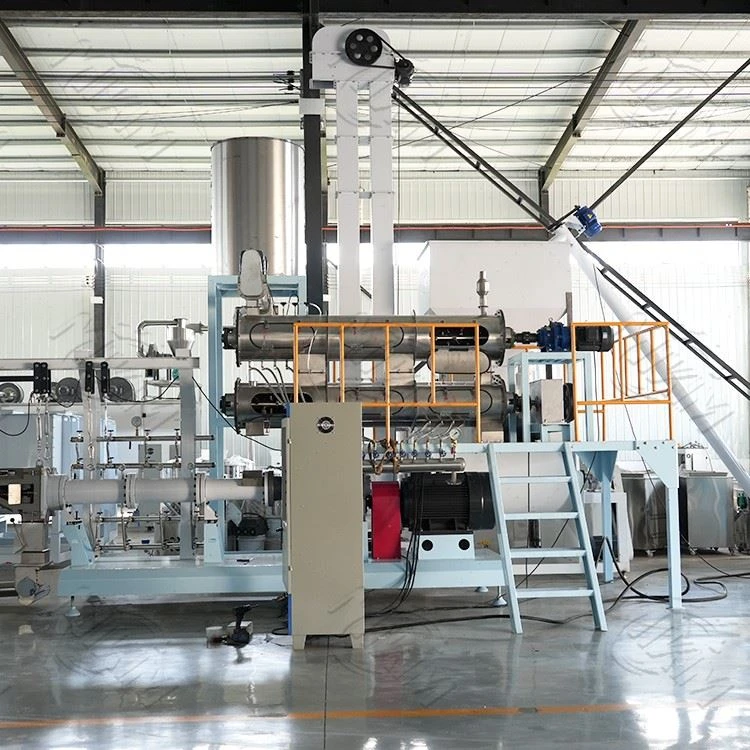
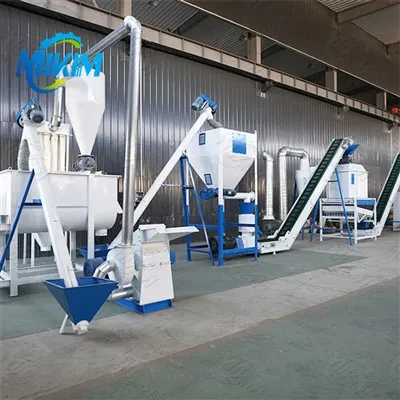
A 1-2 t/h floating fish feed production line for Cameroon is one line quoted at 500, 1000 and 2000 kg/h, with the same stage order at every point. It runs maize, cassava, soybean cake, cottonseed cake, fish meal and palm kernel cake into 1.5-8 mm pellets for tilapia and catfish, on a 380 V, 50 Hz, three-phase supply sized from the heat source.
Key points
> - The same line is quoted at 500, 1000 and 2000 kg/h. The stage order holds, the machine size moves.
> - Electric heaters sum to 137.4, 259.2 and 318.0 kW. A steam or hot air exchanger brings the same points to 92.4, 164.2 and 223.0 kW.
> - The 94-217 kW figure published for this class is line level, so it never matches a machine sum.
> - Cassava, cottonseed cake and palm kernel cake each change one setting at the extruder.
01
Three capacity points on the floating fish feed line
This is one line quoted at three output points, not three separate lines. The order is identical everywhere: grind, mix, feed, extrude, dry, coat, cool, screen, bag. What moves is the machine size inside each stage.
The 500 kg/h point is the optional small build: an 11 kW mill, a 250 kg mixer batch and the smallest wet twin-screw size at 41.1 kW. The 1000 kg/h point is the main quoted build at 84.7 kW. The 2000 kg/h point goes to 128 kW, a 1000 kg batch and two screeners.
Stage
Model
500 kg/h
1000 kg/h
2000 kg/h
Grinding
SFSP56X30 / SFSP56X36
11 kW
22 kW
22 kW
Mixing
SSHJ-0.5 / SSHJ-1.0 / SSHJ-2.0
5.5 kW
11 kW
18.5 kW
Screw feed
KWX50YP
1.5 kW
1.5 kW
1.5 kW
Extrusion, wet twin-screw
70 / 85 / 120
41.1 kW
84.7 kW
128 kW
Drying, electric mesh belt
5 layer 5 m / 5 layer 8 m / 5 layer 8 m
56.8 kW
118.5 kW
118.5 kW
Coating
Double drum
6 kW
6 kW
6 kW
Cooling
SKLN11x11 / SKLN14x14
1.5 kW
1.5 kW
1.5 kW
Screening
LX-LS50
8 kW
8 kW
16 kW
Lifting
TDSG10-25
1.5 kW
1.5 kW
1.5 kW
Bagging
DCS-Z-W-50
4.5 kW
4.5 kW
4.5 kW
Total with electric drying
137.4 kW
259.2 kW
318.0 kW
Total with steam or hot air exchanger
92.4 kW
164.2 kW
223.0 kW
Table 1: Capacity of the 1-2 t/h floating fish feed production line, stage by stage at three output points.
Pick the point by the sacks you fill in a shift, then check the stages that ignore it. The dryer is shared by both upper points, and only the screener doubles.
02
Hammer mill and mixer sizing at each capacity point
Water drop hammer mill at 11 kW and 22 kW
The 500 kg/h point takes the 11 kW mill, a 1-2 t/h class machine on its own. The other two take the 22 kW mill, a 3-4 t/h class machine. Grinding sits above line output because the mill works in batches and the bulk density of the blend moves with the raw material, so a mill matched exactly to output starves the extruder.
Mixer batch from 250 to 1000 kg
The batch mixer carries 250 kg at 5.5 kW, 500 kg at 11 kW and 1000 kg at 18.5 kW. Batch size is set so one mix keeps the extruder hopper fed between two mixes, which keeps the line off stop and start running.
Screw feeder held at 1.5 kW on all builds
The screw feed into the conditioner is 1.5 kW at all three points, with a range of 0 to 1000 kg/h. It is the volume control on the extruder, and one size covers the range, so it never becomes a reason to re-quote.
03
Which local crops can the Wet-type Twin-Screw floating fish feed extruder machine handle?
All six materials run on the line. What changes is the setting at the conditioner and the die.
Maize and cassava flour in the blend
Maize grinds to flour and supplies the binding starch. Cassava brings a second starch that gelatinizes early in the conditioner, so mash viscosity climbs before the die and resistance at the die holes rises. The correction is water and steam at the conditioner plus a slower feed rate, not a different die.
Soybean cake, cottonseed cake and palm kernel cake
Soybean cake binds well and carries little oil. Cottonseed cake is high in fiber and light in bulk, so the screw conveys volume rather than weight and hourly output drops. Palm kernel cake carries oil, slips under the screw and blocks die holes as its share climbs, so keep that share moderate and clean the die face every shift.
Fish meal raises oil content while lowering the starch available to bind, so pellets come out softer. A trial on your own formula starts with samples, because cassava moisture and palm kernel oil content decide the setting.
Local raw materials
Cassava, cottonseed cake and palm kernel cake are the three that move the setting. None needs a different machine, and each needs a sample before the die list is fixed.
04
Wet-type Twin screw floating fish food extruder machine at 380 V three-phase power
The wet Type Twin screw floating fish feed pellet processing machine self-cleans along the screws and conveys sticky, high-oil mash without slipping.
The conditioner takes steam from a site boiler through a main, a trap set and a condensate return, and it takes water at the same point. Steam and water set how far the starch gelatinizes before the die, and that gelatinization is what gives the pellet its structure. Each extruder figure in Table 1 is main motor plus conditioner plus cutter: 37 kW with 3.0 kW and 1.1 kW at the smallest point, 110 kW with 15 kW and 3.0 kW at the largest. The line runs on 380 V, 50 Hz, three-phase, with a cabinet that carries an overload on each motor and an interlock between feeder and extruder.
With electric heaters the short body draws 45 kW of elements and the long body 95 kW. Fans and mesh drive add the remainder, putting the short body at 56.8 kW and the long body at 118.5 kW. This version needs no boiler, no steam main and no boiler operator, and it doubles the electrical demand.
Steam or hot air furnace leaving 18 kW of fan
Put a steam exchanger or a hot air furnace in place of the elements and the electrical side keeps the fans and the mesh drive. On the long body that is 18 kW of fan plus 5.5 kW, on the short body 8.8 kW plus 3 kW. Heat arrives as fuel rather than current, so the figure drops by the whole element load.
Dryer body
Heating elements
Fans
Mesh drive
Total with electric heat
Total with steam heat
5 layer 5 m
45 kW
8.8 kW
3 kW
56.8 kW
11.8 kW
5 layer 8 m
95 kW
18 kW
5.5 kW
118.5 kW
23.5 kW
Table 2: Heat source against dryer body, with the element load removed on the steam route.
The heat source is settled before the supply is sized, because an electric build and a steam build sit in different supply classes.
The two power accounts
The machine list sums every motor, the supply follows the heat source, and the gap between the two columns is the decision.
06
Power draw across the three capacity points
At the 2000 kg/h point with electric heaters the summed figure is 318.0 kW, of which extrusion contributes 128 kW and the dryer 118.5 kW.
Change only the heat source and the same line lands at 223.0 kW. Nothing mechanical moved, no motor changed and the layout is untouched. The full ladder reads 137.4, 259.2 and 318.0 kW on electric heat against 92.4, 164.2 and 223.0 kW on steam or hot air.
The published 94-217 kW figure for this class counts a line rather than a machine list, and it assumes a heat source that is not electric. Sizing a cable from 217 kW on an electric build leaves a 2 t/h plant short by around 100 kW.
07
Oil coating on floating pellets after drying
The coater sits between the dryer and the cooler. The double drum handles 800-2000 kg/h at 6 kW and is the unit at all three points; the single drum runs 300-400 kg/h at 5 kW. Oil arrives by pump circuit or by direct spraying from a pressurised line.
Fat goes on after the water is out. A wet pellet takes oil into open pores, the film smears, and a pellet that floated at the die starts to sink. After drying the pore structure is fixed and the oil stays on the skin.
08
Screening and bagging of finished floating pellets
Two screening units at 8 kW on the 2 t/h build
One screener handles 800-1000 kg/h at 8 kW, so the 500 and 1000 kg/h points run one unit and the 2000 kg/h point runs two. Oversize and fines come out of the pellet, and fines return to the extruder hopper rather than into a sack.
Bagging at 200-300 sacks per hour
The bagger fills 200-300 sacks an hour at 4.5 kW, with static accuracy of +/-0.1 percent and dynamic accuracy of +/-0.2 percent, on air at 0.6-0.8 MPa and 0.2 Nm3/min. A steady pellet size upstream is what makes that accuracy hold.
09
Pellets from 1.5 mm to 8 mm for tilapia and catfish
The die range on this line is 1.5-8 mm, and the machine itself is built for 1-12 mm, so the band sits inside the capability.
A size change means a die change, then a reset of the knife gap and cutter position. Each size has its own die, ordered as a set covering the band the plant sells. The cutter sets length rather than diameter: a fast cutter gives short pellets for fry, a slower cutter the longer pellet catfish take. Tilapia starts at 1.5-2 mm and grows out at 3-4 mm, and catfish moves to 6-8 mm. Die and cutter follow each other across the fish feed extruder machine range, so a proven size maps onto a larger build.
10
What floor area, water and steam does the line need?
The line fits a hall of 30 x 6 x 7 m, runs with 2-3 operators and ships in 2 x 40 ft containers. The 7 m height is set by the dryer and the cooler rather than the extruder.
Water is needed at the conditioner, where it joins the steam, and at the oil circuit on the coater. Steam is generated on site, and the main from the boiler to the conditioner, with trap set and condensate return, belongs to the building work rather than the machine supply.
11
Three quote tiers from EXW to CIF Douala
All three tiers carry the same machine list from Table 1. What differs is where the seller's responsibility ends.
What EXW leaves at the factory gate
EXW ends at the factory gate, and the machine arrives with its motors, electrical cabinet and the standard spare parts kit, packed for export. Everything after that point sits with the buyer.
FOB and CIF Douala with motors and cabinet
FOB adds inland haulage to the port, export clearance and loading on board. CIF Douala adds ocean freight and marine insurance through to Douala. Motors, cabinet and standard spares sit inside the machine price at every tier, and none of the three carries installation or training.
Installation, training and spares outside the machine price
Installation, commissioning, operator training and any wear part beyond the standard kit are quoted as separate lines.
Item
EXW
FOB
CIF Douala
Machine with motors and electrical cabinet
included
included
included
Standard spare parts kit
included
included
included
Export packing
included
included
included
Inland haulage to the port
buyer
included
included
Export clearance
buyer
included
included
Ocean freight
buyer
buyer
included
Marine insurance
buyer
buyer
included
Installation and training
separate
separate
separate
Wear parts beyond the standard kit
separate
separate
separate
Duty and clearing at Douala
buyer
buyer
buyer
Inland transport from Douala to site
buyer
buyer
buyer
Table 3: What each quote tier includes and what stays with the buyer.
Four things sit outside a CIF Douala figure, all visible before the order: duty and clearing at Douala, inland transport from the port to the site, installation and training, and wear parts beyond the standard kit. The first two are local costs; the last two are separate lines.
12
Wear parts, dies and expected service life
Wear parts quoted as a separate list
Screws, barrels, dies and knives are listed on their own sheet, counted per pellet size and per wearing pair. The sheet carries quantities and part names, quoted apart from the machine because an abrasive blend draws on it faster than maize and soybean cake.
Die and screw life judged by output and power
Three signals decide a change, and none is a calendar date. Hourly output falls at the same feeder setting. The pellet surface turns rough and dull instead of smooth and glossy. The main motor current climbs at the same feed rate. Abrasiveness, die compression and cleaning between shifts move all three, so the judgement is made on the machine.
13
Engineer installation in Cameroon and the payment terms
A line of this size is commissioned by an engineer on site, and the visit is structured rather than bundled. The visit is quoted in three lines: international travel, visa, and service days from arrival to the commissioning sign off. Travel and visa are settled at cost against receipts, service days are billed per day, and board and lodging on site sit with the buyer.
Payment runs in stages: a deposit with the order, a second instalment when the line is ready for inspection, and the balance against the shipping documents. The delivery date is written in working days from the deposit and holds once the die list and the electrical specification are signed. Warranty covers the main motor, gearbox, drive train and cabinet from commissioning; screws, barrels, dies and knives are wear parts and stay outside it. Reference lines in Africa and a factory video are available, and no site is named.
Send the raw material list and the target capacity through the contact page and the reply comes as one sheet: the capacity point, the power list on both heat sources, and the three tiers.
14
FAQ
1
Can the fish food making production line run on cassava and palm kernel cake?
Yes. The mill and mixer take all six materials, and the line fills sacks with 1.5-8 mm pellets for tilapia and catfish. Cassava and palm kernel cake each need a setting change.
2
What power supply does the 2 t/h fish feed making production line build need?
380 V, 50 Hz, three-phase. Electric drying sums to 318.0 kW, and a steam exchanger brings the same line to 223.0 kW. The supply follows the heat source.
3
How much floor area does the whole fish food pellet making production line take?
A hall of 30 x 6 x 7 m with 2-3 operators. It ships in 2 x 40 ft containers, and the height is set by the dryer and cooler.
4
What does CIF Douala cover and what stays outside?
CIF covers ocean freight and marine insurance to Douala, and the machine arrives with motors, cabinet and standard spares. Installation, training and wear parts beyond that kit are quoted separately.
5
How long do extruder screws and dies last?
Replacement is judged on three signals, not hours: hourly output falls at the same feeder setting, the pellet surface turns rough, and the main motor current climbs at the same feed rate.
6
Can the floating fish feed making production line be tested with our own formula?
Yes. The formula runs on the wet twin-screw machine, and the trial records pellet diameter, output and floating state in water. Raw material samples come first, because cassava moisture sets the conditioner.
7
How is installation handled after the line arrives in Cameroon?
An engineer attends on site for installation and commissioning, quoted as travel, visa and service days, with operator training inside that period.